
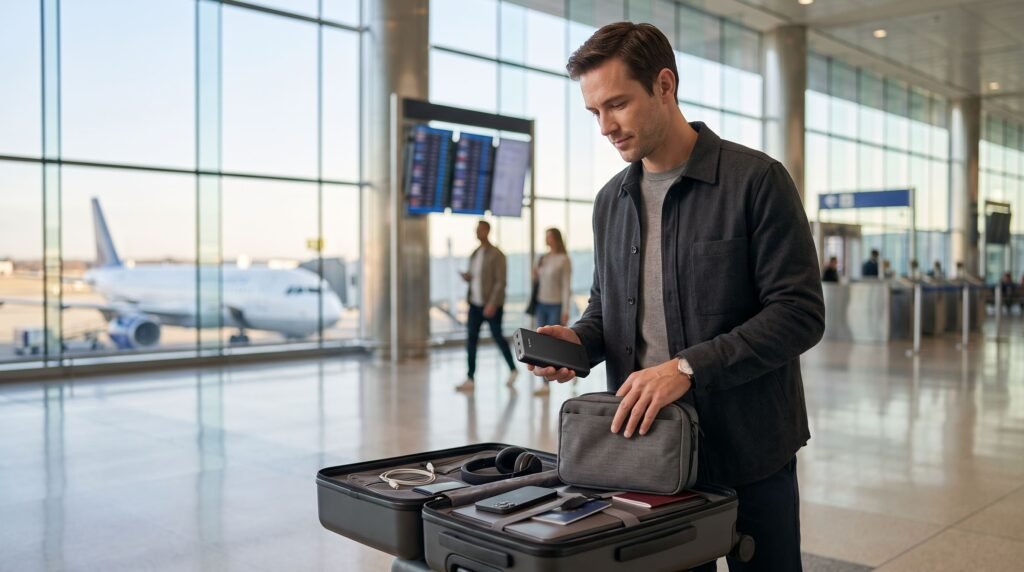
If you’re wondering whether you can bring a power bank on flights in USA, the short answer is yes—but it must be packed correctly.
Power banks are treated as spare lithium-ion batteries, which means the rules are different from ordinary electronic accessories. Under current FAA guidance, power banks must travel with you in the aircraft cabin and cannot be placed in checked baggage. Most consumer power banks fall below the 100 watt-hour (Wh) threshold, but larger batteries can require airline approval or may be prohibited entirely. (Federal Aviation Administration)
There are also practical rules that travelers sometimes overlook. If your carry-on is taken at the gate and placed in the aircraft’s cargo hold, you need to remove the power bank and keep it with you in the cabin. Battery terminals should also be protected against short circuits, and damaged or recalled lithium batteries should not be brought onto the aircraft. (Federal Aviation Administration)
This guide explains power bank rules for flights in the USA, including TSA and FAA requirements, carry-on vs. checked baggage, watt-hour limits, mAh calculations, airline restrictions, packing tips, gate-check situations, and what to do if a power bank becomes hot or damaged during your journey.
Can You Bring a Power Bank on a Flight in the USA?
Yes. Power banks are generally permitted on U.S. passenger flights when they meet the applicable lithium-battery requirements.
The most important rule is where you pack it.
Power banks must be in your carry-on
A power bank is considered a spare lithium-ion battery because it is not permanently installed in the device it powers.
The FAA states that spare lithium-ion batteries, including power banks and portable chargers, must be carried in carry-on baggage and cannot be placed in checked baggage. (Federal Aviation Administration)
That means:
Carry-on: Yes
Checked baggage: No
This remains true even if the power bank is turned off.
Why can’t power banks go in checked luggage?
Lithium-ion batteries can experience a dangerous reaction called thermal runaway, particularly if they are damaged, overheated, short-circuited or defective.
When a spare battery is in the passenger cabin, flight crew can respond to smoke, overheating or fire. That’s one reason aviation rules require spare lithium batteries to remain accessible to passengers rather than being hidden inside checked luggage. (Federal Aviation Administration)
Power Bank TSA and FAA Rules: The Quick Answer
For most travelers, the rules can be simplified into a few key points.
| Power Bank Situation | U.S. Flight Rule |
| Under 100 Wh | Generally allowed in carry-on |
| 101–160 Wh | Requires airline approval; up to 2 spare batteries |
| Over 160 Wh | Not permitted on passenger aircraft |
| Checked baggage | Not allowed for spare power banks |
| Gate-checked carry-on | Remove power bank and keep it in cabin |
| Damaged/recalled power bank | Do not bring it aboard |
| Short-circuit protection | Required/properly protect terminals |
| Airline-specific limits | May be stricter |
These are based on current FAA guidance and U.S. hazardous-material regulations; individual airlines can impose additional restrictions. (Federal Aviation Administration)
How Many mAh Can You Bring on a Plane?
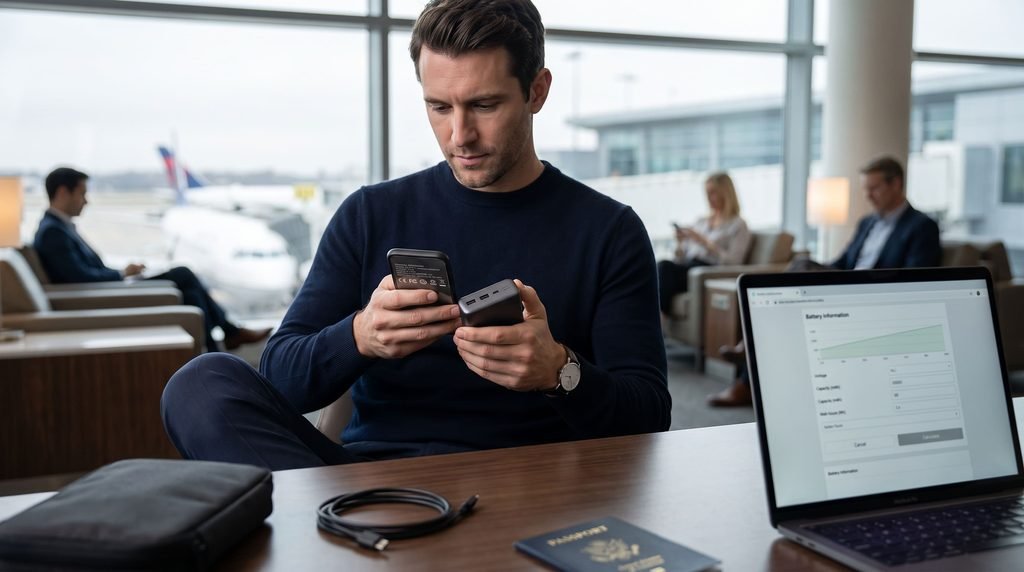
This is where power-bank rules become confusing.
Power banks are often marketed using mAh, such as:
- 5,000 mAh
- 10,000 mAh
- 20,000 mAh
- 26,800 mAh
- 30,000 mAh
But aviation regulations use watt-hours (Wh).
The FAA explains that you can calculate watt-hours using:
Wh = Volts × Amp-hours
For mAh:
Wh = Voltage × mAh ÷ 1,000
(Federal Aviation Administration)
Example: 10,000 mAh power bank
If a power bank is rated at 3.7 volts internally:
3.7 × 10,000 ÷ 1,000 = 37 Wh
That is comfortably below 100 Wh.
Example: 20,000 mAh
3.7 × 20,000 ÷ 1,000 = 74 Wh
Again, below the 100 Wh threshold.
Example: 30,000 mAh
3.7 × 30,000 ÷ 1,000 = 111 Wh
That crosses the 100 Wh threshold and therefore falls into the larger-battery category.
However, do not determine compliance from mAh alone. The actual voltage and the manufacturer’s stated Wh rating matter.
The FAA recommends using the battery’s marked Wh rating when available. (Federal Aviation Administration)
What Is the 100 Wh Power Bank Rule?
The 100 Wh threshold is the most important number for ordinary travelers.
The FAA currently states that rechargeable lithium-ion batteries rated at 0–100 Wh are allowed for passenger use, subject to the applicable conditions. Spare batteries such as power banks must remain in carry-on baggage. (Federal Aviation Administration)
For most everyday consumer power banks, this is unlikely to be a problem.
Typical portable chargers marketed for phones and tablets are often well below 100 Wh.
Still, check the label rather than assuming.
What If Your Power Bank Is 101–160 Wh?
Larger lithium-ion power banks between 101 and 160 Wh are subject to additional restrictions.
The FAA states that these larger spare lithium-ion batteries require airline approval, and passengers may carry no more than two such spare batteries per person. They must remain in carry-on baggage. (Federal Aviation Administration)
This is where checking your airline’s specific policy becomes especially important.
Do not assume that because the FAA framework permits a battery, your airline will necessarily accept it under identical conditions.
The FAA explicitly warns that airlines may have stricter quantity and watt-hour limits. (Federal Aviation Administration)
Can You Bring a Power Bank Over 160 Wh?
No, not as an ordinary spare power bank on a passenger aircraft.
The FAA states that lithium-ion batteries exceeding 160 Wh are prohibited on passenger aircraft. (Federal Aviation Administration)
This distinction matters because some large portable power stations are marketed as travel batteries even though their capacity is far beyond what is permitted for ordinary passenger travel.
A large portable power station is not automatically treated like a small phone charger.
Before traveling with a high-capacity battery, check its Wh rating and the airline’s specific requirements.
Can You Put a Power Bank in Checked Luggage?
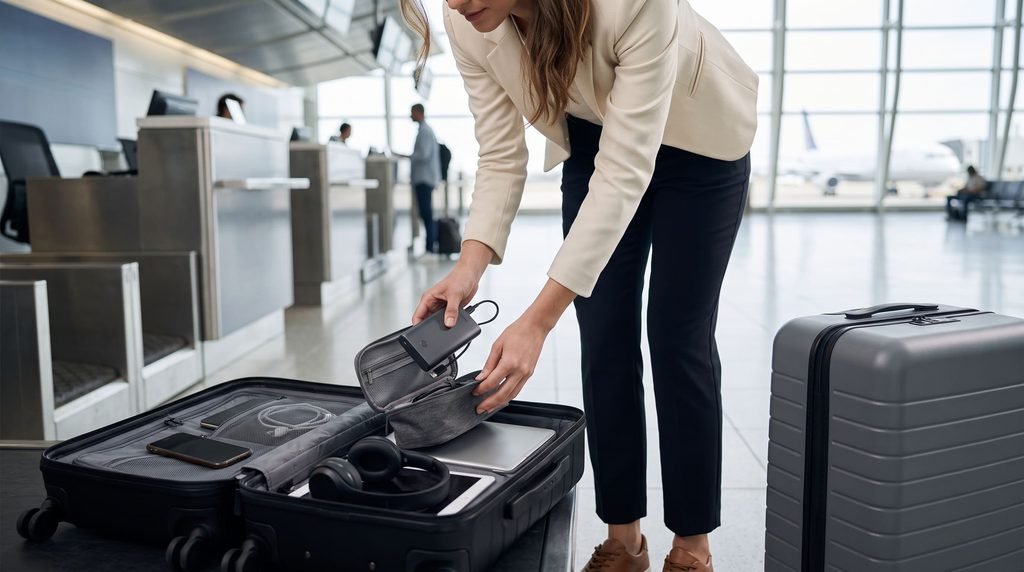
No.
This is one of the most important rules to remember.
Power banks and other spare lithium batteries must not be placed in checked baggage. (Federal Aviation Administration)
Even if the power bank is:
- turned off
- inside a suitcase
- in its original box
- protected by clothing
it still belongs in your carry-on.
What if your carry-on gets gate-checked?
This is an easy situation to overlook.
If an airline takes your carry-on at the gate and puts it into the aircraft’s cargo hold, the FAA says you must remove your spare lithium batteries and power banks and keep them with you in the cabin. (Federal Aviation Administration)
So before handing over your carry-on:
Open the bag → remove the power bank → keep it with you.
Can You Bring Multiple Power Banks on a Flight?
For ordinary lithium-ion spare batteries under 100 Wh, the FAA says there is no general federal quantity limit for personal-use batteries, provided they meet the applicable requirements and are not being carried for resale or distribution. However, airlines may impose their own restrictions. (Federal Aviation Administration)
For larger spare lithium-ion batteries in the 101–160 Wh range, the FAA limits passengers to two with airline approval. (Federal Aviation Administration)
Therefore, don’t assume:
“Under 100 Wh means I can bring unlimited power banks.”
The federal framework and the airline’s own policy are two separate considerations.
How Should You Pack a Power Bank for a Flight?
Correct placement is only part of the rule.
You should also protect the battery from:
- Damage
- Crushing
- Short circuits
- Contact with metal objects
- Accidental activation
The FAA recommends protecting battery terminals through methods such as the original packaging, insulating exposed terminals with tape, using a battery case, or placing the battery in a protective pouch. (Federal Aviation Administration)
A practical packing method
Place your power bank in:
A dedicated electronics pouch or protective sleeve
and keep it away from:
- Loose coins
- Keys
- Metal objects
- Sharp items
- Heavy luggage components
This is especially useful when you’re carrying multiple electronics.
Can You Use a Power Bank During a Flight?
Whether you can use a power bank during the flight is a separate question from whether you can carry it aboard.
FAA rules establish how spare lithium batteries must be transported, but individual airlines can have additional operating restrictions concerning the use or charging of portable batteries during flight.
Therefore:
Check your airline’s current onboard electronics policy before relying on a power bank during the flight.
Also follow all cabin-crew instructions.
If a crew member asks passengers to stop using or stow a battery-powered device, comply immediately.
What Should You Do If a Power Bank Gets Hot on a Plane?
Do not ignore unusual battery behavior.
The FAA advises passengers to immediately notify the flight crew if a lithium-ion battery or device is:
- Overheating
- Expanding
- Smoking
- Burning
(Federal Aviation Administration)
Do not attempt to hide the problem or continue using the battery.
Warning signs include:
- Unusual heat
- Swelling
- Smoke
- Burning smell
- Hissing
- Visible damage
If you notice one of these signs, alert the cabin crew immediately.
Can You Fly With a Damaged Power Bank?
You should not.
The FAA states that damaged, defective or recalled lithium batteries that could create sparks or dangerous heat must not be carried aboard an aircraft unless the battery has been removed or otherwise made safe. (Federal Aviation Administration)
That means a power bank with:
- A swollen casing
- Cracked housing
- Burn marks
- Severe physical damage
- A known recall
should not simply be placed into your carry-on.
When in doubt, replace the battery before your trip.
Does TSA Have Different Power Bank Rules?
Travelers often search for “TSA power bank rules”, but the practical passenger requirements are tied to the broader U.S. aviation safety and hazardous-material framework.
The FAA provides the specific battery transportation guidance, while airport security screening is handled by TSA.
The important takeaway for passengers is:
Do not put a spare power bank in checked luggage. Keep it with you in your carry-on and make sure it meets the applicable battery-size and airline requirements. (Federal Aviation Administration)
For unusual or high-capacity batteries, verify the requirements before arriving at the airport.
Power Bank Rules for Domestic Flights in the USA
For a typical U.S. domestic flight, the process is straightforward.
Before leaving home
Check:
- Power-bank Wh rating
- Physical condition
- Airline-specific restrictions
- Carry-on placement
At security
Keep the power bank accessible if needed for screening.
Follow the TSA officer’s instructions.
At the gate
If your carry-on is going to be checked, remove the power bank first. (Federal Aviation Administration)
During the flight
Keep the battery accessible and follow crew instructions.
If it overheats, swells or smokes, notify the crew immediately. (Federal Aviation Administration)
What Is the Best Power Bank Size for Air Travel?
For ordinary phone and tablet travel, a power bank comfortably below the 100 Wh threshold is generally the simplest choice from a regulatory perspective.
Rather than choosing a massive battery simply because it has a larger mAh number, consider what you actually need.
5,000 mAh
Good for:
- Emergency phone charging
- Light travel
- Day trips
10,000 mAh
A practical middle ground for:
- Smartphones
- Airport days
- Short trips
20,000 mAh
Useful for:
- Long travel days
- Multiple phone charges
- Phone + tablet use
- Frequent travelers
Very large power banks
These require more careful attention to Wh ratings and airline restrictions.
The key isn’t the marketing number on the front of the package.
Check the actual Wh rating.
mAh vs Wh: Why Travelers Should Understand the Difference
One of the biggest sources of confusion is that consumers shop using mAh while aviation regulations use Wh.
For example, two batteries with the same mAh rating could theoretically have different watt-hour ratings if their voltage differs.
The FAA’s formula is:
Wh = V × Ah
or:
Wh = V × mAh ÷ 1,000
(Federal Aviation Administration)
If your power bank doesn’t clearly show its Wh rating, check the manufacturer’s specifications.
Don’t guess.
Can You Bring a Laptop Power Bank on a Plane?
Potentially, yes.
But the same lithium-battery principles apply.
A laptop power bank may have a significantly higher capacity than a typical phone charger, so check its Wh rating rather than relying on its advertised mAh capacity.
If it is over 100 Wh, additional restrictions may apply, including airline approval for batteries in the 101–160 Wh range. Batteries above 160 Wh are not permitted on passenger aircraft under the FAA’s general passenger rules. (Federal Aviation Administration)
What About Portable Power Stations?
Portable power stations deserve special attention.
Some products marketed as portable generators or backup power stations have batteries far larger than ordinary travel power banks.
The FAA states that large lithium battery-powered generators exceeding 160 Wh are not permitted on passenger aircraft. (Federal Aviation Administration)
Therefore, never assume that a product is allowed simply because it is sold as a “portable power station.”
Check:
Battery chemistry + Wh rating + airline rules
before taking it to the airport.
Do Airlines Have Stricter Power Bank Rules?
Yes.
This is one of the most important caveats.
FAA rules establish the federal baseline, but the FAA specifically states that airlines may impose stricter restrictions on the number and size of power banks passengers can carry. (Federal Aviation Administration)
Your airline may therefore have additional requirements concerning:
- Number of power banks
- Maximum capacity
- Storage location
- In-flight use
- Charging
- Whether the battery must remain accessible
Always check the airline you’re actually flying before departure.
Power Bank on Flights in USA: A Simple Pre-Flight Checklist
Before leaving for the airport, run through this checklist:
Battery
☐ Check the Wh rating
☐ Make sure the power bank is not damaged
☐ Do not bring a swollen or recalled battery
Packing
☐ Put the power bank in your carry-on
☐ Never put it in checked luggage
☐ Protect terminals from short circuits
☐ Keep it away from loose metal objects
Airline
☐ Check the airline’s current battery policy
☐ Confirm any special restrictions for large batteries
☐ Check rules for using power banks during the flight
At the airport
☐ Keep the power bank accessible
☐ Remove it if your carry-on is gate-checked
☐ Follow security-screening instructions
During the flight
☐ Follow cabin-crew instructions
☐ Monitor the battery for unusual heat or damage
☐ Notify the crew immediately if it smokes, burns, expands or overheats
Common Power Bank Mistakes Travelers Make
Putting a Power Bank in Checked Luggage
This is the biggest mistake.
Spare lithium batteries and power banks are not permitted in checked baggage. (Federal Aviation Administration)
Looking Only at mAh
Aviation limits are based on Wh, so check the watt-hour rating.
Bringing a Damaged Battery
A damaged lithium battery can present a serious safety hazard.
Forgetting About Gate-Checked Bags
A carry-on can become a checked bag at the gate.
Remove the power bank before handing over the luggage. (Federal Aviation Administration)
Assuming Every Airline Has Identical Rules
Airlines can be more restrictive than the general FAA framework. (Federal Aviation Administration)
Buying an Extremely Large Battery for Travel
More capacity isn’t always more useful.
For ordinary smartphone travel, a moderate-capacity power bank is often easier to manage and more practical.
Best Practices for Traveling With a Power Bank
If you want the simplest approach, follow these principles:
1. Choose a reputable power bank.
Avoid questionable batteries with unclear specifications.
2. Check the Wh rating before your trip.
Don’t rely only on the mAh number.
3. Keep it in your carry-on.
Never put a spare power bank in checked luggage. (Federal Aviation Administration)
4. Protect it from damage.
Use a protective pouch and prevent metal objects from contacting the terminals.
5. Keep it accessible.
Especially important if your carry-on might be gate-checked.
6. Check your airline’s policy.
The airline may have stricter requirements.
7. Never fly with a damaged or recalled battery.
If it is swollen, cracked, overheating or recalled, don’t bring it aboard. (Federal Aviation Administration)
Power Bank on Flights in USA: The Bottom Line
For most travelers, bringing a power bank on a U.S. flight is straightforward.
Keep it in your carry-on, not your checked bag.
For ordinary spare lithium-ion batteries, the FAA’s current framework generally allows batteries up to 100 Wh for personal use. Batteries from 101–160 Wh require airline approval and are limited to two spare batteries, while batteries over 160 Wh are not permitted on passenger aircraft. Airlines can impose stricter requirements. (Federal Aviation Administration)
The smartest approach is therefore not to memorize dozens of battery rules.
Instead:
Check the Wh rating → protect the battery → pack it in your carry-on → check your airline’s policy → remove it if your carry-on is gate-checked.
And if a battery becomes unusually hot, swollen, smoky or damaged, tell the cabin crew immediately. (Federal Aviation Administration)
Frequently Asked Questions
1. Can I bring a power bank on a flight in the USA?
Yes. Power banks are generally allowed when they meet applicable lithium-battery requirements, but they must be carried in your cabin baggage rather than checked luggage. (Federal Aviation Administration)
2. Can I put a power bank in checked baggage?
No. Power banks are spare lithium-ion batteries and must remain in carry-on baggage. If your carry-on is checked at the gate, remove the power bank and keep it with you in the cabin. (Federal Aviation Administration)
3. What size power bank can I bring on a plane?
The FAA generally permits spare lithium-ion batteries up to 100 Wh. Batteries from 101–160 Wh require airline approval and are limited to two spare batteries per person. Batteries exceeding 160 Wh are prohibited on passenger aircraft under the general FAA passenger rules. (Federal Aviation Administration)
4. Is a 20,000 mAh power bank allowed on a plane?
A 20,000 mAh power bank is commonly below 100 Wh when calculated using a typical lithium-ion cell voltage, but travelers should check the manufacturer’s stated Wh rating because aviation limits are based on watt-hours, not mAh alone.
5. What should I do if my power bank overheats on a plane?
Stop using it and immediately notify the cabin crew. The FAA specifically advises passengers to alert flight crew if a lithium-ion battery is overheating, expanding, smoking or burning. (Federal Aviation Administration)
Conclusion
A power bank on flights in USA is generally perfectly manageable when you understand one central rule: keep spare lithium batteries and power banks in the cabin, never in checked baggage.
For most travelers, a power bank under 100 Wh is the simplest option. Larger batteries require additional attention, and airline-specific restrictions can be stricter than the federal baseline.
Before your trip, check the Wh rating, inspect the battery for damage, protect its terminals, pack it in your carry-on and verify your airline’s current policy.
That small amount of preparation can prevent a frustrating airport problem—and more importantly, helps you travel with lithium batteries safely.