

Choosing what to wear while traveling is not only about style. The fabric inside your suitcase can determine how often you need to wash your clothes, how quickly they dry, how comfortable you feel in changing weather, and how much clothing you actually need to pack.
That is why the debate over merino vs synthetic vs cotton for travel matters, particularly for one-bag travelers, backpackers, long-term travelers, and anyone trying to build a smaller travel wardrobe.
Merino wool is known for temperature regulation and odor resistance. Synthetic fabrics such as polyester and nylon are valued for quick drying, durability, and performance. Cotton remains popular because it is comfortable, affordable, and familiar—but it has limitations when you are sweating heavily or need clothes to dry quickly.
There is no universal winner. The best travel fabric depends on your destination, climate, activity level, trip length, laundry access, and personal comfort.
Merino vs Synthetic vs Cotton for Travel at a Glance
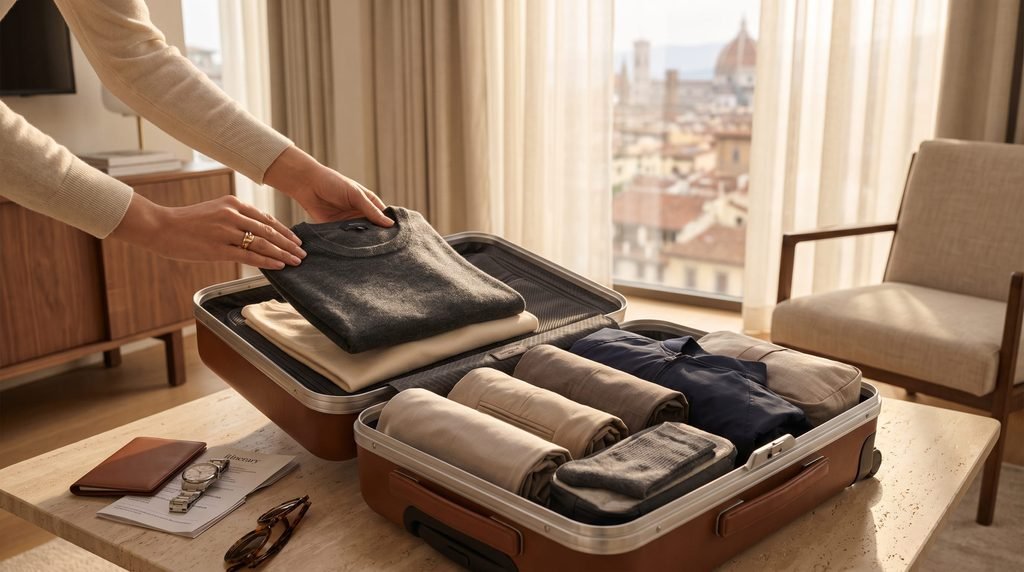
| Feature | Merino Wool | Synthetic Fabrics | Cotton |
| Odor resistance | Excellent | Varies; often lower without odor-control treatments | Moderate |
| Drying speed | Moderate | Excellent | Slow |
| Moisture management | Excellent | Excellent in performance garments | Low to moderate |
| Temperature versatility | Excellent | Excellent depending on construction | Moderate |
| Hot-weather comfort | Very good in lightweight fabrics | Very good for active use | Good when dry |
| Humid-weather performance | Good | Excellent for fast drying | Often poor |
| Durability | Good, but depends on construction | Excellent | Good |
| Wrinkle resistance | Good | Excellent to very good | Often lower |
| Packability | Excellent | Excellent | Moderate |
| Upfront cost | Usually higher | Low to high | Usually low |
| Best for | Long trips, mixed climates, re-wearing | Active travel, humidity, frequent washing | Casual travel and short trips |
The important detail is that fiber type alone does not determine performance. Fabric weight, construction, blend percentage, garment design, and finishing can change how a particular shirt behaves.
Why Fabric Choice Matters When You Travel
At home, a slow-drying cotton shirt may not matter. You can put it in the washing machine and dryer or simply wait until tomorrow.
Travel is different.
You might have:
- One small suitcase or backpack
- Limited access to laundry
- A hotel sink instead of a washing machine
- Long walking days
- Hot or humid weather
- Multiple climates during one trip
- A need to re-wear clothing
- Little space for backup outfits
A fabric that dries overnight can therefore be considerably more useful than one that remains damp into the next day.
Odor also becomes more important. If you are carrying only a few shirts, the ability to wear a garment again after airing it out can reduce how many pieces you need.
That is where merino and technical synthetic fabrics often have an advantage over ordinary cotton.
Merino Wool for Travel
Merino wool has become one of the most popular fabrics for minimalist travel because it combines several useful properties in a single fiber.
Fine Merino wool can manage moisture vapor, regulate temperature, resist odors, and provide comfortable next-to-skin wear. Woolmark describes these as inherent properties of the wool fiber rather than benefits that depend entirely on added chemical treatments.
Why Merino Works So Well for Travel
The biggest advantage is versatility.
A lightweight Merino shirt can work across a surprisingly broad range of conditions. Wool fibers can absorb moisture vapor and help regulate the microclimate next to the skin, which is one reason Merino is used in both warm-weather and cold-weather base layers.
For travelers, that can translate into fewer clothing changes.
Merino is particularly attractive when you:
- Travel for several weeks
- Pack with a carry-on
- Move between different climates
- Want to re-wear shirts
- Expect limited laundry access
- Prefer natural fibers
- Want one shirt to work for sightseeing and casual evenings
Merino’s Biggest Advantage: Odor Resistance
Odor resistance is one of Merino’s strongest travel benefits.
Wool fibers can absorb moisture vapor and bind odor-producing molecules within the fiber structure. Those molecules are released during washing, helping Merino garments remain fresher between washes.
This does not mean a Merino shirt can be worn indefinitely without washing. Sweat, dirt, food, body oils, and environmental exposure still accumulate.
But for a traveler packing a limited wardrobe, the ability to wear a garment multiple times can be valuable.
The Downsides of Merino
Merino is not perfect.
The biggest disadvantages are:
- Higher purchase price
- Some garments can be less resistant to abrasion than robust synthetics
- Fine fibers can require more careful washing
- Very lightweight garments may be less suitable for rough use
- Some travelers may still dislike the feel of wool
- Drying can be slower than lightweight technical synthetics
The quality of the garment matters enormously. A delicate ultralight Merino T-shirt should not be treated like a heavy-duty hiking shirt.
Is Merino Good for Hot Weather?
Yes—provided you choose the right garment.
A common misconception is that wool automatically means warmth. Lightweight Merino fabrics can be designed for warm-weather use, and Woolmark specifically identifies lightweight Merino as suitable for warm conditions because of its breathability and moisture-management characteristics.
For extremely humid conditions combined with intense activity, however, a quick-drying synthetic may be more practical.
Synthetic Fabrics for Travel
“Synthetic” is a broad category. Polyester, nylon, polyamide, elastane blends, and specialized performance fabrics can behave differently.
Still, technical synthetics share several characteristics that make them extremely useful for travel.
Where Synthetics Excel
Their strongest advantage is usually fast drying.
A lightweight synthetic shirt can often be washed and hung to dry with considerably less waiting than a heavier cotton garment.
That matters when you are:
- Washing clothes in a hotel
- Traveling through humid destinations
- Exercising during a trip
- Hiking
- Changing hotels frequently
- Carrying very few garments
Synthetics can also be highly durable, particularly when designed for outdoor or active use.
Synthetics Are Excellent for Active Travel
If your trip includes:
- Hiking
- Cycling
- Long-distance walking
- Running
- Adventure activities
- Hot-weather sightseeing
a technical synthetic shirt can be extremely practical.
The fabric can be engineered for moisture movement, stretch, abrasion resistance, and rapid drying.
The Main Synthetic Problem: Odor
The major weakness of many synthetic travel shirts is odor.
Not every synthetic garment performs the same way, and some technical clothing incorporates specific odor-control technologies. But a basic polyester shirt can develop noticeable odor after repeated sweaty wear.
That means a traveler should not assume:
“Synthetic = performance fabric = ideal for re-wearing.”
Instead, check the garment’s actual construction and performance claims.
If frequent re-wearing is a priority, Merino may have the advantage.
Polyester vs Nylon for Travel
Both can be excellent, but they are commonly used for somewhat different purposes.
Polyester is widespread in performance shirts because it is lightweight, quick drying, and versatile.
Nylon is often valued for strength and abrasion resistance, making it particularly useful in travel pants, outer layers, backpacks, and other gear that receives more mechanical stress.
The specific garment matters more than simply choosing one fiber name.
Cotton for Travel
Cotton has developed a reputation as the fabric travelers should avoid.
That is too simplistic.
Cotton is comfortable, inexpensive, widely available, and perfectly practical for certain kinds of trips.
The problem is that its weaknesses become much more obvious when you are sweating heavily or trying to wash clothes overnight.
Where Cotton Works Well
Cotton can be a sensible choice for:
- Short city breaks
- Casual sightseeing
- Dry climates
- Resort vacations
- Trips with easy laundry access
- Low-activity travel
- Travelers who prioritize familiar comfort
A cotton T-shirt for a relaxed weekend in a dry destination is a completely different proposition from a cotton shirt on a humid backpacking trip.
Cotton’s Biggest Weakness: Drying
Cotton can hold substantial amounts of moisture and may take longer to dry than lightweight technical synthetics.
That can become frustrating when you wash a shirt in the evening and need it again the next morning.
In humid conditions, the problem becomes even more noticeable.
Cotton Can Still Be the Right Choice
If your trip is short, your accommodation has laundry facilities, and you are not doing intense physical activity, the disadvantages may barely matter.
There is also an important comfort consideration: fabric preference is personal.
Some travelers simply prefer the feel of cotton against their skin.
That preference should not be dismissed just because another fiber performs better on a technical checklist.
Merino vs Synthetic vs Cotton for Hot and Humid Travel
Hot and humid travel is one of the most useful situations for comparing these fabrics.
Best for Fast Drying: Synthetic
If you sweat heavily and need to wash clothes frequently, a lightweight technical synthetic is often the easiest option.
It dries quickly and works well for active days.
Best for Odor Management: Merino
If you want to wear the same shirt repeatedly between washes, Merino has a major advantage because of its natural odor-management properties.
Least Practical for Heavy Activity: Cotton
Cotton can feel comfortable when dry, but a saturated cotton shirt can remain wet for much longer.
For humid destinations with lots of walking, that can become uncomfortable.
The Best Hybrid Strategy
For a long trip in tropical or humid conditions, you do not necessarily need to choose one fabric for everything.
A smart wardrobe might combine:
- Merino shirt for sightseeing and repeated wear
- Synthetic shirt for workouts and high-sweat days
- Lightweight cotton shirt for relaxed evenings
That approach can be more practical than trying to make one fabric do every job.
Merino vs Synthetic vs Cotton for Cold Weather
Cold-weather travel changes the priorities.
The goal is usually not to find one magical warm fabric. Instead, travelers benefit from layering.
A lightweight Merino base layer can be particularly useful because it provides moisture management and temperature-regulating properties while adding relatively little bulk.
Synthetic technical layers can also perform extremely well, especially when rapid drying and durability are priorities.
Cotton is generally less attractive as a base layer for strenuous cold-weather activity because wet cotton can remain damp and uncomfortable.
For winter travel, think in layers:
- Moisture-managing base layer
- Insulating mid-layer
- Weather-resistant outer layer
The fabric choice for each layer does not need to be identical.
What About Merino Blends?
Merino blends deserve more attention than they usually receive.
A blend can combine properties from different fibers rather than forcing you to choose between pure Merino and pure synthetic.
For example, a Merino/synthetic blend can potentially provide:
- Better durability than an ultralight pure-Merino garment
- Some of Merino’s odor-management advantages
- Better stretch or recovery
- Improved resistance to abrasion
- Faster drying depending on construction
The exact result depends on the fiber ratio and garment design.
Do not assume that a shirt labeled “Merino blend” will automatically perform like 100% Merino. Check the fiber composition before buying.
Does Fabric Weight Matter?
Yes.
Two shirts made from the same fiber can feel completely different.
A lightweight Merino shirt and a heavy Merino sweater should not be treated as equivalent.
Fabric weight, often expressed in grams per square meter (GSM), can influence:
- Warmth
- Drying time
- Breathability
- Durability
- Packability
- Seasonal suitability
For warm-weather travel, lightweight construction is generally more useful than simply choosing a particular fiber.
For cooler destinations, a heavier fabric may provide greater insulation.
The important point is:
Do not choose a fabric based only on the fiber name. Choose the complete garment.
Which Fabric Is Best for One-Bag Travel?
For one-bag travel, Merino and technical synthetics generally make the strongest foundation.
A Minimalist Merino Wardrobe
Best when you prioritize:
- Re-wearing
- Odor resistance
- Mixed climates
- Versatility
- Minimal packing
A Technical Synthetic Wardrobe
Best when you prioritize:
- Fast washing
- Rapid drying
- Hiking
- Exercise
- Humidity
- Durability
A Cotton-Heavy Wardrobe
Best when you prioritize:
- Low purchase cost
- Familiar comfort
- Casual travel
- Short trips
- Easy access to laundry
For many travelers, a mixed-fabric wardrobe is more useful than choosing one material exclusively.
How to Choose Your Travel Fabric by Trip Type
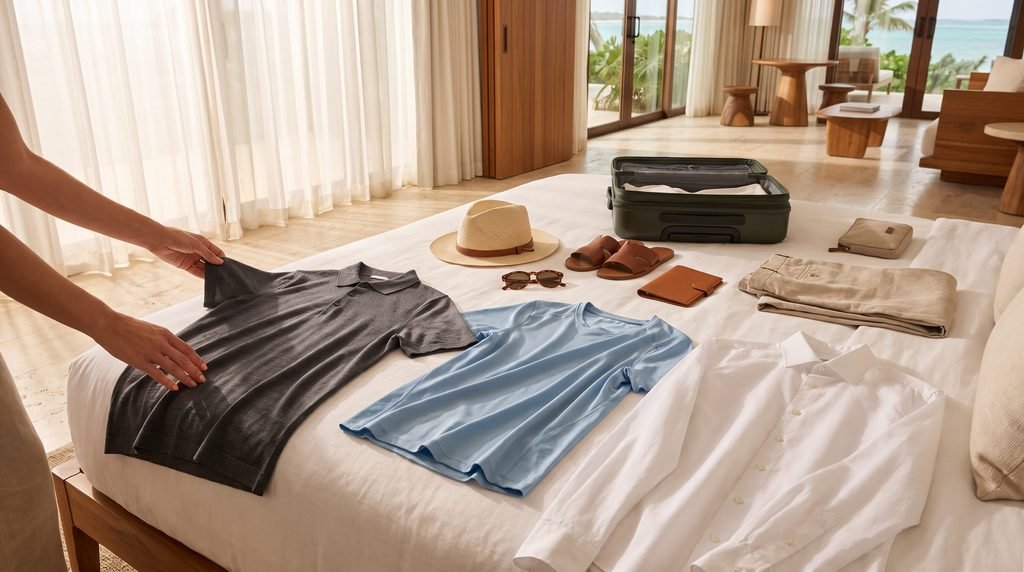
For a Two- to Four-Day City Break
Choose based on comfort and style first.
Cotton is perfectly reasonable if laundry is not an issue.
A lightweight Merino shirt can be useful if you want to pack fewer pieces.
For a Two-Week Europe Trip
Merino or Merino blends are particularly attractive because the itinerary may involve changing cities and variable weather.
Add a technical synthetic piece if you expect lots of walking or exercise.
For Backpacking
Prioritize:
- Low weight
- Quick drying
- Durability
- Odor management
- Easy washing
A combination of Merino blends and technical synthetics is often more versatile than an all-cotton wardrobe.
For Tropical Travel
Prioritize rapid drying and moisture management.
Technical synthetics can be excellent for highly active days, while lightweight Merino can work well when odor resistance and versatility matter.
For Business Travel
Merino can be especially useful because certain garments can transition between transportation, sightseeing, and casual professional settings.
Look for wrinkle resistance and a polished construction rather than focusing on fiber alone.
For Resort Travel
Cotton can make perfect sense.
You may have easy laundry access, spend relatively little time doing strenuous activity, and prioritize softness and relaxed styling.
What Should You Look for When Buying Travel Clothes?
Instead of shopping by labels such as “travel shirt” or “performance fabric,” examine the specifications.
1. Fiber Composition
Look at the actual percentage of each fiber.
A Merino blend containing a small amount of wool will behave differently from a garment made mostly from Merino.
2. Fabric Weight
Lightweight garments generally pack smaller and dry faster, while heavier fabrics may offer greater warmth or durability.
3. Construction
Look for:
- Strong seams
- Quality stitching
- Reinforced stress points
- Appropriate stretch
- Comfortable seams
- Durable fabric where abrasion is likely
4. Care Instructions
A theoretically excellent travel shirt is less useful if its care requirements are incompatible with your trip.
Always check whether the garment requires special washing or drying.
5. Fit
A fabric cannot compensate for a poor fit.
For hot climates, overly tight clothing can reduce comfort. For layering, the base layer should sit comfortably without excessive bulk.
6. Odor-Control Claims
If a garment promises odor resistance, check whether the benefit comes from the fiber itself, a blend, or a specific treatment.
How to Wash Travel Clothes Without a Laundry Machine
Fabric selection becomes much more useful when combined with a simple laundry strategy.
For sink washing:
- Fill the sink or basin with clean water.
- Add a small amount of suitable detergent.
- Gently agitate the garment.
- Let it soak according to the care instructions.
- Rinse thoroughly.
- Press out excess water rather than aggressively twisting delicate garments.
- Roll the garment inside a clean towel and press gently to remove additional moisture.
- Hang it where there is good airflow.
- Follow the garment’s care instructions for drying.
Synthetic garments are usually the easiest choice when overnight drying is critical.
Merino garments can also work well for travel laundry, but care instructions should be followed carefully.
Cotton requires more planning if your accommodation is humid or poorly ventilated.
Can You Re-Wear Travel Clothes?
Yes—but re-wearing should depend on the garment and how it was used.
After a low-intensity sightseeing day, a shirt may only need to be aired out.
After intense exercise, heavy sweating, or exposure to dirt, washing is more appropriate.
Merino’s odor resistance can make repeated wear more practical, while technical synthetics may be better when frequent washing and rapid drying are the priority.
A useful minimalist strategy is:
Wear → air out → inspect → wash when needed.
Do not treat “odor resistant” as “does not need washing.”
What About Sensitive Skin?
Fiber choice can matter, but skin reactions are not necessarily caused by the fiber itself.
DermNet notes that textile dermatitis can involve natural or synthetic fibers, while reactions are often related to dyes, finishes, resins, or other textile-processing chemicals. Sweating and friction can also worsen symptoms.
If you know that certain fabrics or textile treatments irritate your skin, prioritize garments you already tolerate well.
For an important trip, wearing and washing a new garment before departure is also sensible rather than discovering a comfort problem halfway through your journey.
The Best Travel Fabric Depends on Your Priorities
There is no single winner in the merino vs synthetic vs cotton for travel debate.
Instead, use this simple framework:
Choose Merino If You Want:
- Excellent odor resistance
- Comfortable repeated wear
- Temperature versatility
- Minimal packing
- A natural performance fiber
- Strong performance across changing conditions
Choose Synthetic If You Want:
- Very fast drying
- Excellent performance for active travel
- Strong durability
- Easy frequent washing
- Good performance in humid conditions
Choose Cotton If You Want:
- Familiar softness
- Affordable clothing
- Casual comfort
- Simple everyday outfits
- A short, low-intensity trip
Choose a Blend If You Want:
- A balance of properties
- Improved durability
- Versatility
- Better performance than basic cotton
- A compromise between Merino and synthetic characteristics
A Practical Travel Wardrobe Formula
You do not need to fill your suitcase with one fabric.
For a versatile minimalist wardrobe, consider assigning different jobs to different materials.
Merino: everyday sightseeing and repeated wear.
Synthetic: exercise, hiking, humid days, and situations where rapid drying matters.
Cotton: relaxed outfits, casual evenings, and destinations where laundry is easy.
This creates a wardrobe in which each garment has a purpose.
That is ultimately more useful than asking which fiber wins a theoretical comparison.
Common Mistakes Travelers Make
Packing Only Cotton
This can become frustrating on humid or active trips because wet garments may take longer to dry.
Assuming Every Synthetic Is the Same
A basic polyester T-shirt and a technical performance shirt can have very different moisture, odor, and durability characteristics.
Buying Expensive Merino Without Checking Construction
Fiber quality matters, but garment construction matters too.
A very delicate shirt may not be ideal for rough backpacking conditions.
Choosing by Fiber Alone
Fabric weight, fit, weave or knit, blend ratio, and finishing can all influence performance.
Ignoring Laundry Access
A traveler staying in hotels with easy laundry access has different needs from someone washing everything in a hostel sink.
Packing Too Many “Specialized” Clothes
Minimalism works best when each garment has multiple uses.
A shirt that works for sightseeing, restaurants, and casual evenings is usually more valuable than three single-purpose shirts.
The Bottom Line: Which Fabric Should You Pack?
For most travelers, the smartest answer is not Merino vs synthetic vs cotton.
It is Merino + synthetic + cotton, used strategically.
Merino is an excellent choice when odor resistance, repeated wear, temperature versatility, and minimal packing matter most. Its natural fiber structure provides moisture management and temperature-regulating properties that make it particularly useful for travel.
Technical synthetics are hard to beat when fast drying, durability, high activity, and frequent washing are the priorities.
Cotton remains useful for relaxed trips where drying time and repeated wear are not major concerns.
If you are building a compact travel wardrobe, start with the conditions of your trip—not the marketing label on the shirt.
The best travel fabric is the one that solves your biggest travel problem.
FAQs
1. Is Merino wool better than synthetic fabric for travel?
Neither is universally better. Merino is particularly strong for odor resistance, repeated wear, and temperature versatility, while technical synthetics are often better for rapid drying, intense activity, and frequent washing.
2. Is cotton a bad fabric for travel?
No. Cotton can work very well for short trips, dry climates, casual travel, and travelers with easy laundry access. Its main disadvantages become more noticeable when you are sweating heavily or need clothes to dry quickly.
3. What is the best fabric for hot and humid travel?
For highly active travel in hot and humid conditions, lightweight technical synthetics are often practical because they can dry quickly. Lightweight Merino is another strong option when odor management and versatility are more important.
4. Is Merino wool worth the extra cost for travel?
It can be, especially for travelers who value repeated wear, odor resistance, minimal packing, and versatility across changing conditions. The value is less compelling if your trips are short and you have easy access to laundry.
5. Can you mix Merino, synthetic, and cotton clothing when traveling?
Yes—and for many travelers, that is the most practical strategy. Use Merino for versatile everyday wear, synthetics for high-sweat or fast-drying situations, and cotton for relaxed outfits where drying speed is less important.
Conclusion
The smartest travel wardrobe is not built around one “perfect” fabric.
Merino, synthetics, and cotton each have a place. The key is matching the fabric to the conditions you will actually encounter.
For minimalist packing and repeated wear, Merino is difficult to overlook. For intense activity, humid destinations, and quick laundry, technical synthetics are highly practical. For relaxed travel and everyday comfort, cotton remains a perfectly reasonable choice.
Before buying your next travel shirt, think beyond the label. Consider climate, activity, laundry access, trip length, durability, comfort, and how often you expect to wear the garment.
That decision will usually lead to a better-packed suitcase than simply choosing the fabric with the strongest reputation.
1 comment