
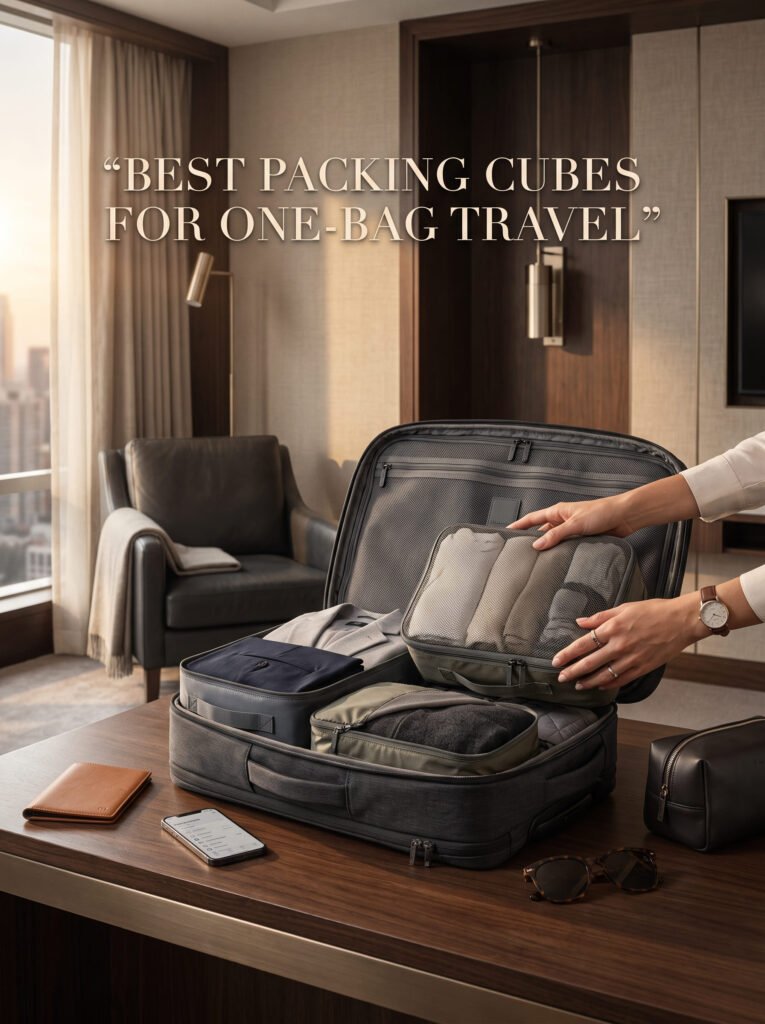
SEO Title: Best Packing Cubes for One-Bag Travel: 2026 Guide
Packing cubes can make one-bag travel dramatically easier—but only when the cubes actually fit your backpack, packing style, and clothing load. The wrong set can add unnecessary weight, create awkward gaps, and give you the illusion of saving space when you are really just rearranging it.
The best packing cubes for one-bag travel are therefore not necessarily the largest, cheapest, or most heavily compressed. The right choice depends on your bag’s dimensions, whether you carry bulky layers, how often you access your clothes, and how much organization you genuinely need.
For most travelers, a simple system of two or three well-sized cubes is enough. A standard cube can handle everyday clothing, while a compression model can be reserved for bulky sweaters, fleece, or other soft layers. Travelers who prioritize durability and sophisticated organization may prefer premium designs with internal dividers and compression features.
This guide explains which packing cubes make sense for different one-bag setups, how many you actually need, when compression helps, how to choose the right size, and when packing cubes may be better left at home.
Best Packing Cubes for One-Bag Travel at a Glance
There is no universal winner because a 25L minimalist backpack has very different requirements from a 40L clamshell travel pack.
Here is the most useful way to think about the leading options:
| Packing Cube | Best For | Main Advantage | Main Trade-Off |
| Eagle Creek Pack-It Reveal | Everyday one-bag organization | Visibility and straightforward organization | Not a dedicated compression cube |
| Peak Design Packing Cube | Premium all-around organization | Compression, divider, fast access | Higher price |
| Eagle Creek Pack-It Reveal Expansion | Flexible packing volume | Can expand or compress | More structure than a minimalist cube |
| Compression cubes from budget brands | First-time travelers | Low-cost way to test the system | Materials and zippers vary |
| Lightweight minimalist cubes | Sub-30L bags | Low empty weight | Usually fewer features |
Current product specifications vary by size and version, so treat dimensions and prices as product-page information rather than permanent specifications. For example, Eagle Creek’s current Pack-It Reveal Medium is listed at 14 × 10 × 3 inches, with a 7L calculated capacity and 4 oz weight.
What Are the Best Packing Cubes for One-Bag Travel?
Best Overall for Simple Organization: Eagle Creek Pack-It Reveal
The current Eagle Creek Pack-It Reveal Packing Cube is a strong choice if your priority is straightforward organization rather than maximum compression.
Its angled zippered opening lets you stack or roll clothing, while the mesh construction makes the contents visible. The current Medium version uses recycled 300D polyester mesh, has a top handle, and is listed at 4 oz.
Best for: travelers who want an uncomplicated clothing-management system.
Why it works: visibility matters when you are living from a backpack. You can identify a shirt or pair of trousers without emptying an entire compartment.
Potential drawback: it is primarily an organization solution. If your trip requires heavy sweaters or other bulky layers, a dedicated compression cube may make more sense.
Eagle Creek Pack-It Reveal Packing Cube
Best Premium Option: Peak Design Packing Cube
The Peak Design Packing Cube is particularly interesting for travelers who want several functions in one piece of gear.
Its design combines a fast-access opening, an internal divider for separating clean and worn clothing, and an expansion/compression zipper. Peak Design currently offers the cubes in several sizes, including Small, Smedium, Medium and Large depending on the current product configuration.
The internal divider is especially useful for longer trips because one cube can function as two clothing zones instead of requiring another separate organizer.
Best for: frequent travelers, organized one-baggers, and people who value premium construction.
Why it works: one cube can perform several jobs—organization, separation, expansion and compression.
Potential drawback: premium features come with a higher purchase price than basic packing cubes.
Best Flexible Option: Eagle Creek Pack-It Reveal Expansion Cube
If your packing load changes from trip to trip, an expandable cube can be more useful than a permanently compressed design.
The current Eagle Creek Reveal Expansion Cube uses an expansion zipper so the organizer can increase its dimensions when you need additional capacity and return to a smaller profile when you do not.
Best for: travelers whose clothing volume varies between warm- and cold-weather trips.
Why it works: you are not locked into one volume.
Potential drawback: the extra structure and zipper system can be unnecessary if your packing list is already extremely minimal.
Eagle Creek Pack-It Reveal Expansion Cube
Do Packing Cubes Actually Save Space?
This is where expectations matter.
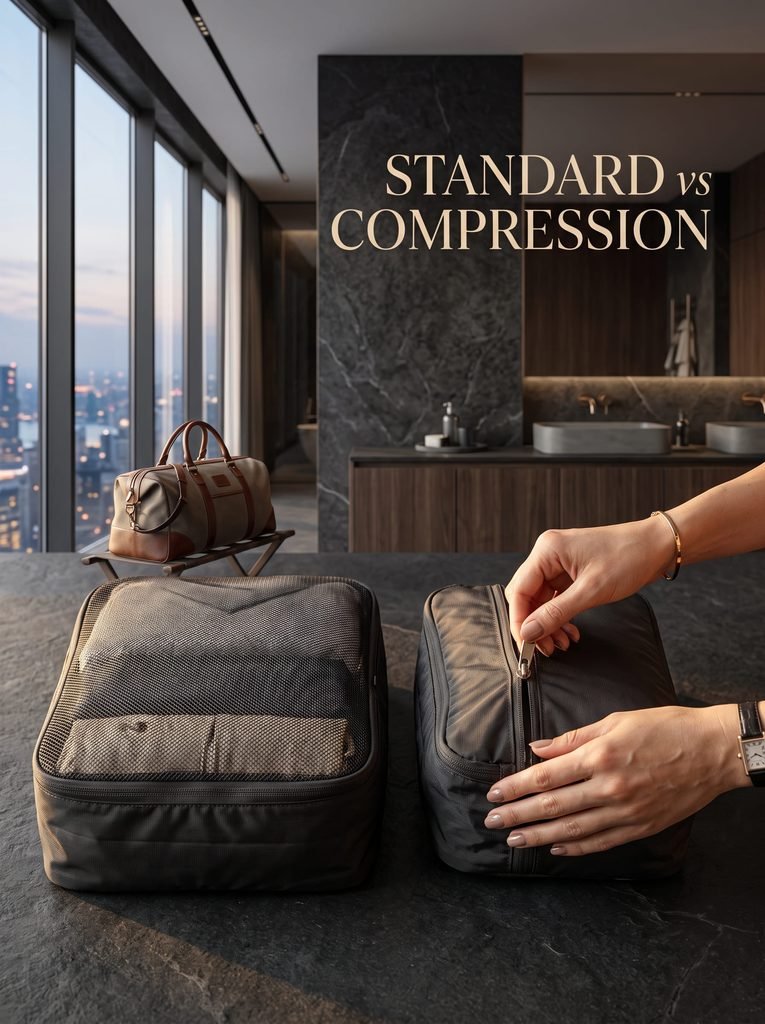
Standard packing cubes primarily organize space. Compression packing cubes can reduce the volume occupied by suitable soft clothing.
A normal cube does not magically make five shirts smaller. It gives those shirts a defined shape that is easier to place inside your backpack.
Compression works differently. A second zipper can pull the walls of the cube inward, reducing the air and empty volume around soft garments.
That can be particularly useful for:
- fleece
- sweaters
- merino layers
- synthetic insulation
- lightweight jackets
- soft base layers
It is much less useful for dense objects that do not compress easily.
The Important Difference Between Volume and Weight
Compression changes volume, not weight.
If a sweater weighs 500 grams before compression, it still weighs 500 grams afterward.
This distinction matters because one-bag travelers sometimes use compression cubes to squeeze more clothing into a bag and then discover that the backpack has become uncomfortable or exceeds an airline’s weight allowance.
Compression should therefore be viewed as a space-management tool, not a weight-saving tool.
Are Compression Packing Cubes Worth It?
For many travelers, yes—but you probably do not need every cube to be a compression cube.
A better system is often:
- 1 standard cube for everyday clothing
- 1 compression cube for bulky layers
- 1 small cube or pouch for underwear, socks or accessories
This gives you compression where it has the greatest benefit without adding unnecessary hardware to the entire packing system.
When Compression Makes Sense
Choose compression when:
- you travel in cold weather
- you carry sweaters or fleece
- your backpack is close to its capacity
- you want to reserve space for shoes or electronics
- you move frequently between destinations
- your clothing contains many soft, bulky layers
When Standard Cubes Are Better
Skip compression when:
- you pack mostly lightweight summer clothing
- your backpack has plenty of unused space
- minimizing gear weight is your top priority
- your clothes are already compact
- you use a very small personal-item-sized bag
For a minimalist summer setup, adding multiple compression zippers can be solving a problem you simply do not have.
How Many Packing Cubes Do You Need for One-Bag Travel?
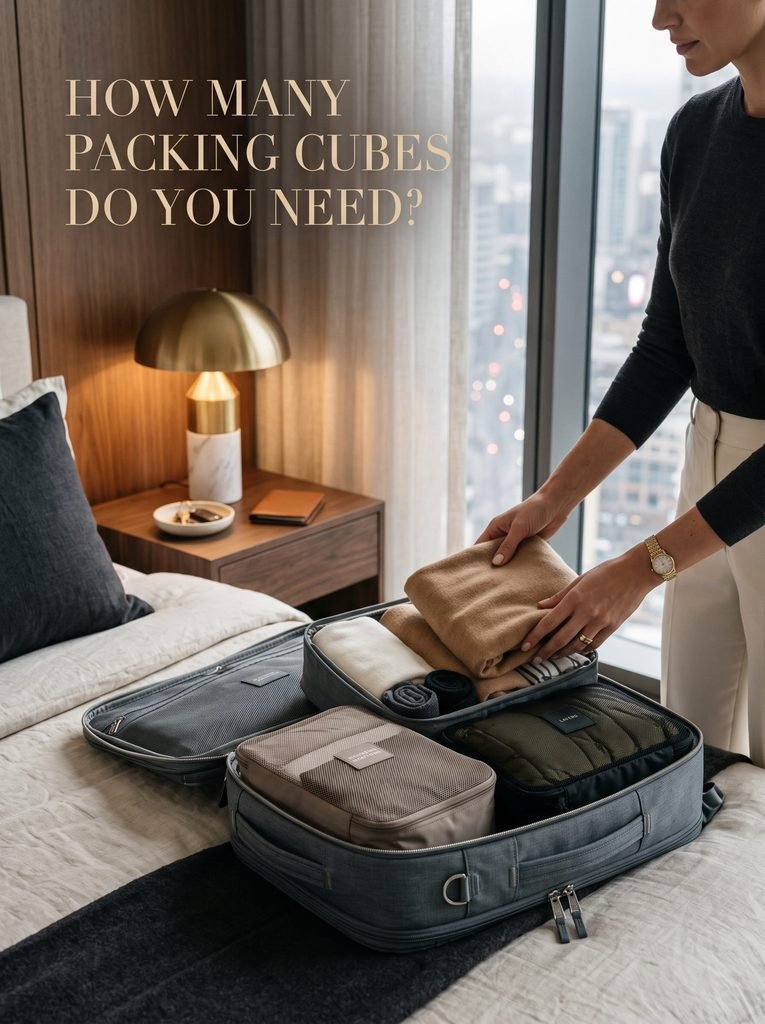
For most travelers, two or three cubes are enough.
The ideal number depends more on your backpack’s internal shape and your clothing system than on the number of days you are traveling.
20–25L Backpack
Start with:
- 1 small or medium clothing cube
- 1 small cube for underwear and socks
A third cube often becomes unnecessary clutter.
26–35L Backpack
A useful starting configuration is:
- 1 medium standard cube
- 1 medium compression cube
- 1 small accessory cube
This gives you a dedicated place for everyday clothes, bulky layers, and small items.
36–45L Backpack
A larger one-bag backpack can accommodate:
- 1–2 medium standard cubes
- 1 compression cube
- 1 small accessory organizer if genuinely needed
Do not assume that a larger backpack requires more cubes. Extra organizers can actually make a large bag harder to use if they fill the interior with rigid shapes.
46L and Larger
At this point, cube selection should be based on the actual compartment layout rather than a fixed number.
If you are carrying enough clothing to require five or six cubes, reconsider the clothing list before simply adding more organization.
The Best Packing Cube Setup for Most One-Bag Travelers
A simple three-zone system works exceptionally well:
Cube 1: Daily Clothing
Use this for:
- T-shirts
- shirts
- underwear
- socks
- lightweight sleepwear
Keep frequently used clothing here.
Cube 2: Bottoms and Larger Garments
Use it for:
- trousers
- shorts
- skirts
- button-front shirts
- heavier everyday pieces
Fold structured garments rather than aggressively compressing them.
Cube 3: Bulky Layers
Use a compression cube for:
- fleece
- sweater
- down jacket
- thermal layer
- other soft insulating clothing
This cube can also become your laundry zone as the trip progresses.
The advantage of this system is not that it fits an arbitrary number of garments. Its advantage is that every cube has a clearly defined job.
How to Choose the Right Packing Cube Size
Do not start by asking:
“Which cube size should I buy?”
Start with:
“What are the dimensions of the space inside my backpack?”
Step 1: Measure the Main Compartment
Check the approximate:
- width
- height
- depth
Then look at the narrowest part of the compartment.
Step 2: Consider the Backpack Shape
A rectangular clamshell backpack is naturally cube-friendly.
A narrow top-loading backpack is less compatible with rigid rectangular organizers.
This matters because a cube can technically fit inside a bag while still wasting space around its edges.
Step 3: Consider Packed Thickness
A cube measuring 3 inches deep when full may occupy significantly more useful volume than the same cube when lightly packed.
Do not fill every cube simply because you have the space.
Step 4: Leave Space Outside the Cubes
You still need room for:
- shoes
- toiletries
- electronics
- documents
- chargers
- water bottle
- travel accessories
A backpack filled wall-to-wall with cubes is not necessarily an efficient backpack.
Front-Loading vs. Top-Loading Packing Cubes
For backpacks, front-loading access is generally easier to use.
A front-opening cube lets you open the organizer broadly and see its contents.
A narrow top-opening cube can force you to reach into the container and disturb items to find something near the bottom.
This distinction becomes particularly important when your backpack itself opens from the front.
Why Clamshell Bags Work So Well With Cubes
A clamshell travel backpack opens more like a suitcase.
That creates a flat interior where packing cubes can sit beside or on top of each other.
The result is a simple system:
Open bag → see cubes → remove one → take clothing → replace cube.
With a narrow top-loader, the same cube can become an obstacle inside a deeper vertical cavity.
What Features Actually Matter?
Brand names are useful, but construction and design matter more.
1. Dimensions
This should be your first consideration.
A beautifully designed cube that does not fit your backpack is still the wrong cube.
2. Weight
Every cube has an empty weight.
If you carry three heavy organizers, the system itself may consume a meaningful portion of your luggage allowance.
For minimalist travel, lighter construction can be more valuable than extra features.
3. Zippers
Zippers are one of the most important components because they receive repeated stress.
Look for:
- smooth operation
- durable zipper tracks
- useful zipper pulls
- stitching that does not strain when the cube is full
Do not overfill a cube simply because the zipper can technically close.
4. Fabric
Common travel-cube materials include:
- polyester
- nylon
- ripstop nylon
- recycled synthetic fabrics
- lightweight technical textiles
The ideal material depends on your priorities. Durability-focused travelers may accept additional weight, while ultralight travelers may prefer thinner fabrics.
5. Visibility
Mesh panels are useful when you want to identify contents without opening every cube.
This is especially valuable when several cubes contain similar clothing.
6. Handles
A top or side handle makes a cube easier to remove from a backpack and carry independently.
7. Compression
Compression is useful for bulky soft clothing but should not automatically be considered a premium feature you need everywhere.
8. Internal Dividers
A divider can be extremely useful for separating:
- clean and worn clothes
- tops and bottoms
- everyday and sleep clothing
Peak Design’s current packing cubes specifically incorporate an internal divider system alongside expansion/compression functionality.
Packing Cubes vs. Rolling Clothes
You do not have to choose one.
The best approach is usually to combine both methods.
Roll:
- T-shirts
- underwear
- socks
- soft synthetic garments
- casual tops
Fold:
- trousers
- button-down shirts
- structured clothing
- garments that wrinkle easily
Compress:
- fleece
- sweaters
- soft jackets
- other bulky insulating layers
The cube provides organization; rolling or folding determines how efficiently the clothing occupies that cube.
Packing Cubes vs. Vacuum Bags
Vacuum bags can reduce volume dramatically, but they are not always ideal for one-bag travel.
| Method | Organization | Compression | Convenience | Best Use |
| Standard cube | Excellent | Low | Excellent | Everyday clothing |
| Compression cube | Excellent | Moderate | Excellent | Bulky soft layers |
| Vacuum bag | Moderate | High | Moderate | Very bulky clothing or specialized trips |
For normal travel, compression cubes offer a better balance between organization and convenience.
Vacuum bags can become awkward when you repeatedly need access to clothing during a trip.
When Packing Cubes Are Not Worth It
Packing cubes are helpful, but they are not mandatory travel equipment.
Very Small Backpacks
If you are traveling with a tiny personal-item bag, every gram and cubic inch matters.
A simple clothing bundle may sometimes be more efficient than several organizers.
Narrow Top-Loading Bags
A rectangular cube inside a narrow, tapered bag can create empty corners.
Those gaps are lost capacity.
Extremely Minimalist Packing
If your entire clothing collection consists of a few garments, you may not need multiple organizational layers.
Travelers Who Prefer Open Access
Some people simply prefer packing loose clothing and pulling out individual pieces.
A packing cube adds an organizational step. If that step does not make your travel easier, there is little reason to force it into your system.
Standard Packing Cubes vs. Compression Cubes
| Feature | Standard Cube | Compression Cube |
| Organization | Excellent | Excellent |
| Volume reduction | Low | Moderate for soft items |
| Empty weight | Usually lower | Usually higher |
| Best for summer | Yes | Optional |
| Best for winter | Good | Excellent |
| Bulky sweaters | Moderate | Excellent |
| Minimalist packing | Excellent | Sometimes unnecessary |
| Ease of use | Very easy | Slightly more involved |
For most travelers, the smartest answer is not all standard or all compression.
It is a mixture.
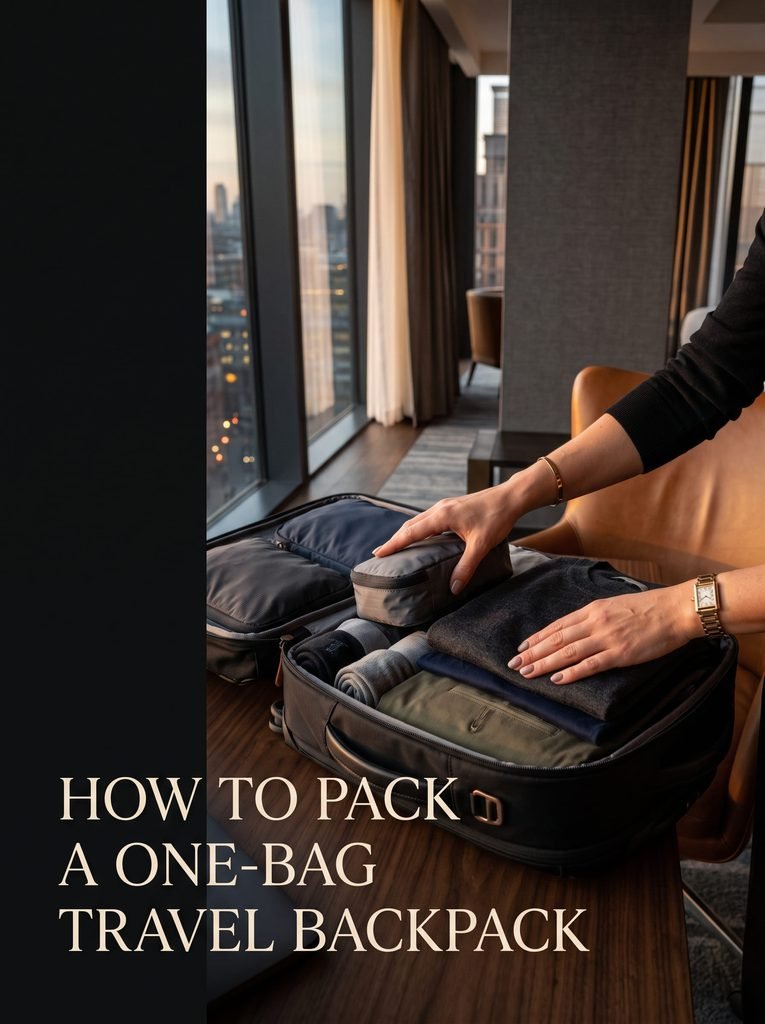
How to Pack a One-Bag Backpack With Packing Cubes
A practical one-bag layout might look like this:
Bottom Zone
Place less frequently needed items toward the bottom of the backpack.
This might include:
- spare clothing
- sleepwear
- backup layers
Center Zone
Place your primary clothing cubes here.
The center of the backpack is where most of your clothing volume should live.
Compression Cube
Put bulky layers into one compression cube rather than spreading them throughout the backpack.
Top Zone
Keep frequently accessed items outside the main clothing cubes:
- passport
- travel documents
- headphones
- charger
- medications
- small electronics
The objective is simple:
You should not have to unpack your entire backpack to find one item.
How to Use Packing Cubes for a 7-Day Trip
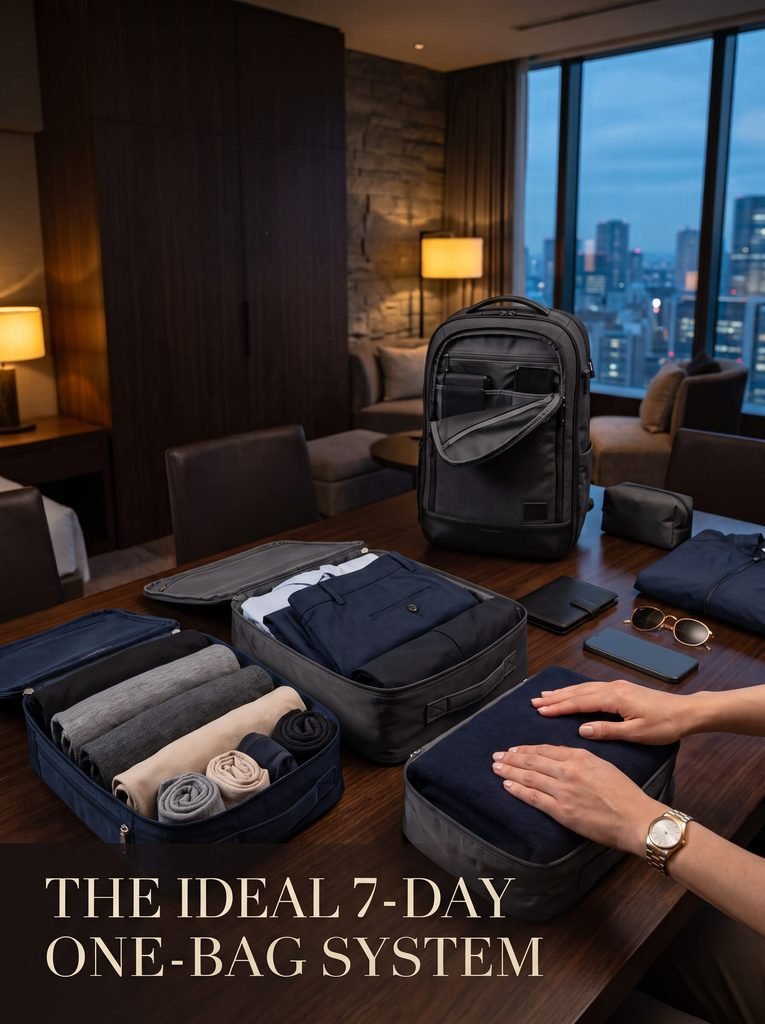
A seven-day trip does not necessarily require seven days of clothing.
If you have access to laundry, your packing cube system can remain surprisingly compact.
A practical setup could include:
Standard Cube
- 4–5 tops
- underwear
- socks
Second Cube
- 2 bottoms
- sleepwear
- one versatile additional layer
Compression Cube
- fleece or sweater
- lightweight jacket
Then rotate clothing and wash selected pieces during the trip.
The real space-saving strategy is therefore not compression alone.
It is packing less clothing and managing laundry intelligently.
Clean Clothes and Dirty Laundry
One of the easiest ways to improve a packing-cube system is to plan for clothing after it has been worn.
You can use:
Option 1: Separate Laundry Cube
Keep worn clothing in a dedicated organizer.
Option 2: Divided Cube
A divided cube can keep fresh and worn clothing in separate sections.
Option 3: Repurpose a Compression Cube
Start the trip with bulky layers inside it.
As the trip progresses, move worn clothing into the same cube.
This works particularly well when the compression function is useful early in the journey but less important later.
Should You Buy a Packing Cube Set or Individual Cubes?
Buy a Set If:
- this is your first packing-cube system
- you are unsure which sizes you need
- you want to experiment
- you need several cubes immediately
Buy Individual Cubes If:
- you already know your backpack
- you only need one or two organizers
- you want to minimize empty weight
- you are replacing one damaged cube
- you want specific dimensions
The mistake is buying a large set simply because it appears to offer better value.
A four- or six-piece set is not a bargain if half the pieces never leave your closet.
Common Packing Cube Mistakes to Avoid
1. Buying Before Measuring Your Bag
This is probably the biggest mistake.
Measure first.
2. Filling Every Cube Completely
A cube should organize your clothing—not encourage you to pack more clothing.
3. Using Compression for Everything
Compression adds complexity and may add weight.
Use it where it produces a meaningful benefit.
4. Ignoring Empty Weight
Three premium organizers can weigh considerably more than three minimalist ones.
5. Creating Too Many Categories
If you have one cube for T-shirts, another for underwear, another for socks, another for shorts, another for trousers and another for sleepwear, organization can become more complicated than the original problem.
6. Forgetting the Laundry Cycle
If you wash clothes during the trip, you may need much less clothing than you initially expect.
7. Ignoring Bag Geometry
Theoretical capacity does not equal usable capacity.
A 35L backpack with awkward corners can sometimes work better with fewer, smaller cubes than a more rectangular 30L pack.
Best Packing Cube System by Traveler Type
For Minimalist Travelers
Choose one or two lightweight standard cubes.
Focus on low empty weight and simple access.
For Cold-Weather Travelers
Use at least one compression cube for sweaters, fleece or other soft layers.
For Frequent Travelers
Invest in durable construction, reliable zippers and a system you can reproduce consistently from trip to trip.
For Business Travelers
Prioritize wrinkle control, clean organization and quick access.
A garment folder or structured organizer can complement standard cubes for shirts and trousers.
For Budget Travelers
A basic set can be perfectly adequate.
You do not need premium materials simply to organize T-shirts and underwear.
For Long-Term Travelers
Look for flexible systems that can separate clean and dirty clothing and adapt as your packing load changes.
A divided compression cube can be especially useful here.
The Best Packing Cube Strategy for One-Bag Travel
If you want the simplest answer, start here:
For a 20–25L bag: one main clothing cube plus one small organizer.
For a 26–35L bag: one standard medium cube, one compression cube and optionally one small organizer.
For a 36–45L bag: two standard clothing cubes plus one compression cube, adjusting the configuration to your backpack’s actual shape.
Then stop.
You do not need to fill every available compartment with an organizer.
The goal is not maximum organization.
The goal is easy access, efficient use of space and a bag that remains comfortable to carry.
Are Packing Cubes Worth It for One-Bag Travel?
For most travelers using a reasonably rectangular travel backpack, yes.
They make clothing easier to organize, simplify unpacking, and let you separate categories without turning your entire backpack into a loose pile of garments.
But packing cubes are not automatically space-saving.
Their value comes from creating a repeatable packing system.
The best setup is the one that matches your backpack’s geometry, your clothing choices and your trip conditions.
For a warm-weather minimalist trip, two lightweight cubes may be enough. For a cold-weather journey in a 40L backpack, a combination of standard and compression cubes makes more sense.
And if your backpack is tiny, tapered and heavily optimized for minimum weight, skipping cubes altogether may actually be the smarter decision.
FAQs
1. What are the best packing cubes for one-bag travel?
The best choice depends on your backpack and packing style. Eagle Creek’s Pack-It Reveal is a strong organization-focused option, while Peak Design’s Packing Cube is better suited to travelers who want compression, internal separation and premium construction. The right cube should fit your bag’s dimensions rather than simply being highly rated.
2. Do compression packing cubes really save space?
Yes, compression cubes can reduce the volume occupied by soft, compressible clothing such as fleece, sweaters and some insulated layers. They do not reduce weight, and they provide much less benefit for dense garments. For most travelers, one compression cube is enough.
3. How many packing cubes do I need for one-bag travel?
Most travelers need two or three. A 20–25L bag may work with one main cube and one small organizer, while a 26–35L bag can typically accommodate two main clothing zones plus an optional small cube. Larger bags can use three or four, but the actual backpack shape should determine the configuration.
4. Should I roll or fold clothes inside packing cubes?
Use whichever method suits the garment. Rolling works well for soft casual clothing, underwear and socks, while folding is better for structured garments such as trousers and button-down shirts. Combining both methods usually provides the best balance between organization and wrinkle control.
5. Are packing cubes worth using in a small backpack?
Sometimes. In a compact, rectangular backpack, a lightweight cube can make clothing much easier to manage. In a narrow or tapered backpack, however, rectangular cubes may create unusable gaps. For very small bags, measure the compartment first and consider whether the cube’s empty weight and structure justify the organizational benefit.
Conclusion
The best packing cubes for one-bag travel are not necessarily the biggest, most expensive or most heavily compressed options. They are the ones that fit your backpack and give each part of your clothing system a useful purpose.
For most travelers, start with two or three cubes, keep standard clothing separate from bulky layers, and use compression only where it genuinely reduces volume. Measure your backpack before buying, pay attention to empty weight and avoid purchasing large sets simply because they look like better value.
A good packing-cube system should make your bag easier to live out of—not encourage you to pack more.
1 comment