
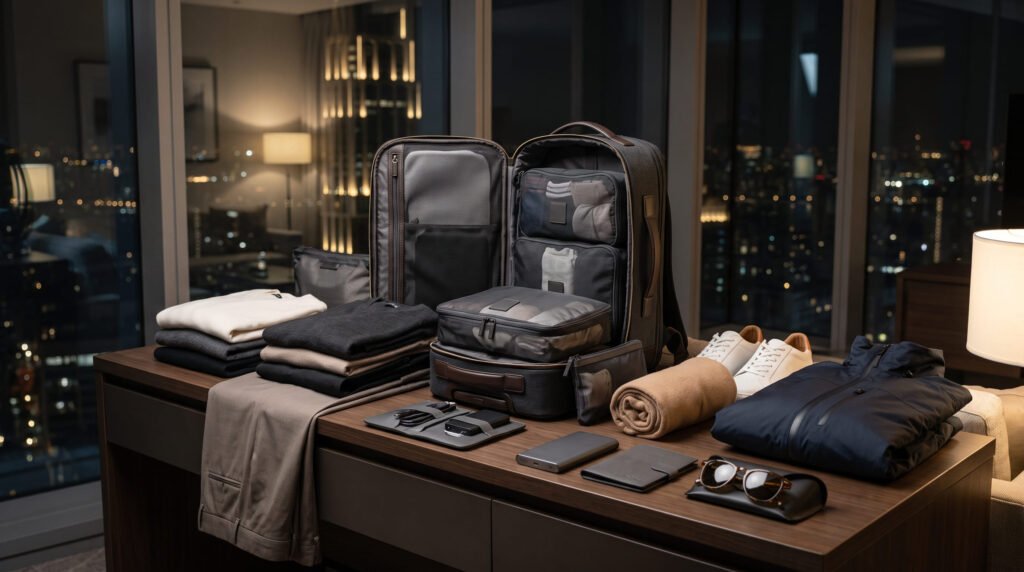
Packing for two weeks in one bag sounds restrictive until you stop thinking in terms of 14 separate outfits. A smarter 2 week packing list one bag strategy is built around versatile clothing, repeatable outfits, lightweight essentials, laundry, and the specific rules of your airline.
The goal is not to pack as little as physically possible. It is to pack only what earns its place.
This guide walks through how to build a practical 14-day one-bag setup, from choosing the right backpack and creating a capsule wardrobe to handling toiletries, shoes, electronics, laundry, changing weather, and last-minute overpacking. It also explains when a standard minimalist list needs to be adjusted for cold weather, active trips, business travel, or destinations with specific dress requirements.
Can You Really Pack for Two Weeks in One Bag?
Yes, for many trips—but the number of travel days is not the most important factor.
A two-week trip does not normally require two weeks of clothing because many garments can be worn repeatedly and washed during the journey. A compact wardrobe of interchangeable pieces can create substantially more outfit combinations than the number of items suggests.
One-bag travel becomes much easier when you build around four principles:
- Repeat outfits instead of packing 14 complete looks.
- Choose pieces that work in multiple situations.
- Plan at least one laundry cycle for longer trips.
- Adapt the list to the destination rather than following a rigid formula.
A beach holiday, winter city break, hiking trip, and business itinerary may all last 14 days, but they should not have identical packing lists.
Start With Your Airline’s Carry-On Rules
Before buying a backpack or deciding how much to pack, check the baggage allowance for every airline operating your itinerary.
The important measurements are not simply the bag’s advertised capacity. Airlines may specify maximum external dimensions, weight, and whether the bag qualifies as an overhead carry-on or personal item. Rules can also differ between fare types and carriers.
Carry-On vs. Personal Item
A personal item is generally intended to fit beneath the seat, while a larger carry-on is intended for the overhead compartment. Do not assume that a backpack marketed as a “carry-on” will automatically meet the requirements of your particular airline.
If your journey includes connections operated by different airlines, check each carrier rather than relying on the most generous allowance in your itinerary.
Why Bag Dimensions Matter More Than Liters Alone
A 35-liter, 40-liter, or 45-liter backpack can have very different external dimensions depending on its design.
Look for:
- Airline-compliant dimensions
- Comfortable shoulder straps
- A supportive hip belt if appropriate
- Full-zip or clamshell opening
- Separate laptop compartment if needed
- Compression capability
- Accessible pockets
- Durable but reasonably lightweight construction
The best one-bag travel backpack is not necessarily the largest one. A smaller bag can encourage better editing and may be easier to carry through airports and city streets.
Build Your 14-Day One-Bag System
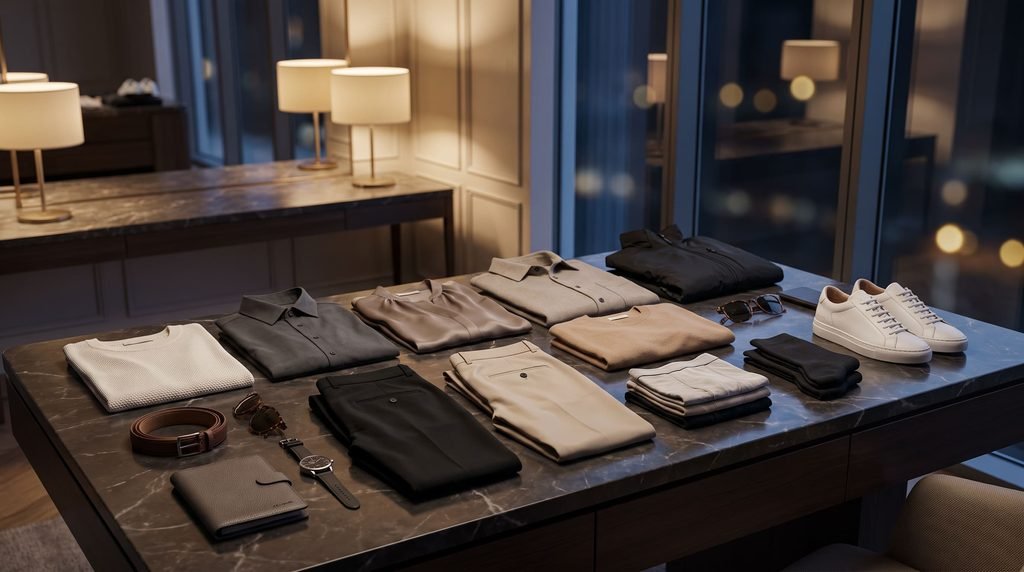
Before placing anything inside the backpack, divide everything you need into functional categories:
Wear → Pack → Wash → Recharge → Access
Your travel outfit is what you wear on the flight. Your packed wardrobe provides alternatives. Laundry keeps the clothing rotation going. Your electronics need a compact charging system. Frequently used documents and essentials should remain accessible.
This simple system prevents the common mistake of treating every possession as equally important.
A Useful Packing Principle
For every item, ask:
Can I use it more than once, in more than one outfit, or for more than one purpose?
A lightweight layer that works for sightseeing, dinner, and a cool flight earns its space more easily than a specialized piece that will be worn once.
The 14-Day Capsule Wardrobe
A one-bag wardrobe works best when most pieces coordinate with one another.
Instead of creating individual outfits, choose a small collection of tops, bottoms, layers, underwear, and accessories that can be mixed across the trip.
Tops
A practical starting point for a warm or moderate climate might be:
- 4–6 everyday tops
- 1 slightly smarter top
- 1 lightweight long-sleeve layer
Choose colors that work together rather than building several unrelated combinations.
For hot destinations, breathable and quick-drying materials can be especially useful. For cooler climates, fewer tops may be necessary if you rely more heavily on insulating layers.
Bottoms
For many city and leisure trips, 2–3 versatile bottoms can form the foundation of the wardrobe.
Consider a combination such as:
- 1 everyday trouser or travel pant
- 1 lighter or alternate trouser
- 1 shorts or activity-specific option when appropriate
A pair of trousers that works with several tops is generally more valuable in a one-bag setup than multiple single-purpose bottoms.
Underwear and Socks
Underwear and socks are among the categories where personal preference matters most.
A minimalist traveler may pack roughly a week’s worth and wash during the trip. Someone who dislikes frequent laundry may prefer more.
The right quantity depends on:
- Laundry access
- Climate
- Activity level
- Personal comfort
- Fabric drying speed
There is no universal number that works for everyone.
Layers and Outerwear
Layers are more efficient than packing several bulky garments.
Depending on the destination, consider:
- Lightweight sweater or fleece
- Overshirt
- Packable rain shell
- Light jacket
- Warm insulating layer for cold destinations
For cooler trips, wear the bulkiest layer during transportation whenever practical rather than using valuable backpack space.
Sleepwear and Activity Clothing
Sleepwear can be minimal. In some climates, an existing lightweight T-shirt and shorts may perform double duty.
Activity clothing deserves more consideration if the trip includes:
- Hiking
- Running
- Cycling
- Swimming
- Skiing
- Gym sessions
Do not add specialized clothing automatically. First determine whether you actually need it.
How Many Clothes Do You Actually Need?
There is no single correct number for a two-week trip.
A useful minimalist framework is the 5-4-3-2-1 method:
- 5 tops
- 4 bottoms
- 3 pairs of shoes
- 2 layers or outerwear pieces
- 1 dressier or special-purpose item
But this is a starting framework, not a rule.
A traveler going somewhere hot might need fewer layers. Someone visiting a cold destination may need fewer tops but substantially warmer clothing. A business traveler may need a dress shirt or formal outfit, while an active traveler may need technical clothing.
The better question is:
How many clothing items do I need between laundry cycles?
If you can comfortably wash clothes during the trip, your packing list can be much smaller.
Choose a Travel-Friendly Color Palette
A coordinated palette makes a small wardrobe feel considerably larger.
Neutral foundations such as black, navy, charcoal, beige, cream, olive, or denim can be combined easily. Add one or two accent colors if you want more personality.
A simple approach is:
2–3 base colors + 1 accent color
This avoids packing an outfit because one top only matches one pair of trousers.
Accessories can provide variety without adding much bulk.
Best Fabrics for One-Bag Travel
Fabric selection matters because a one-bag wardrobe often needs to be worn, washed, and dried repeatedly.
Merino Wool
Merino is popular for travel because it can be comfortable across a range of temperatures and is often resistant to developing odors quickly.
Potential drawbacks include higher cost and the need for appropriate care.
Synthetic Fabrics
Technical polyester and nylon fabrics can be lightweight and quick-drying, making them useful for frequent washing.
They can be particularly practical for humid climates, active travel, and sink laundry.
Cotton
Cotton can be comfortable and familiar, but it generally takes longer to dry than many lightweight synthetic or merino options.
That does not make cotton unsuitable. It simply means you should consider drying time when building a minimalist wardrobe.
Blended Fabrics
Blends can balance comfort, durability, drying performance, stretch, and appearance.
Rather than choosing fabric based solely on marketing claims, consider the garment’s actual role in your trip.
Shoes: Keep Your Footwear Under Control
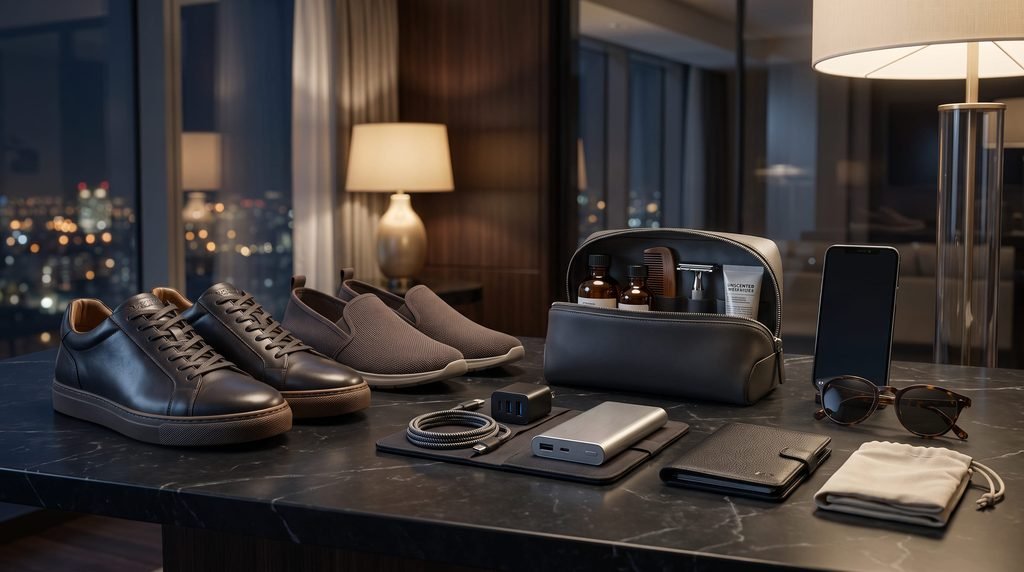
Shoes can consume disproportionate amounts of space, so footwear deserves careful editing.
For many trips, two versatile pairs may be enough:
- A comfortable pair suitable for extensive walking
- A lighter secondary pair for evenings, casual use, or specific activities
A third pair may make sense for specialized trips, but it should have a clear purpose.
A Good Travel Shoe Should:
- Be comfortable for your expected walking
- Work with several outfits
- Suit the destination
- Be practical to pack
- Avoid unnecessary bulk
Whenever possible, wear your largest or heaviest shoes during transit.
Pack a Minimal Toiletry Kit
Toiletries are another category where small individual items can quietly consume a surprising amount of space.
Build your kit around what you actually use every day.
Core Toiletry Categories
- Toothbrush and toothpaste
- Deodorant
- Face and body care essentials
- Hair-care basics
- Shaving or grooming items
- Sunscreen where appropriate
- Any required personal products
Choose travel-size containers when practical and consider solid alternatives for products that are available in that format.
For flights departing from U.S. airports, TSA’s current carry-on guidance uses the 3-1-1 liquids framework: liquids, gels and aerosols generally need to be in containers of 3.4 oz/100 mL or less and fit within the designated quart-size bag. Other countries and airports may apply different screening rules, so verify the requirements for your departure point.
Don’t Forget Medications and Personal Essentials
A minimalist bag should never mean leaving behind something genuinely important.
Depending on your circumstances, your personal essentials may include:
- Prescription medication
- Required medical or personal supplies
- Glasses or contact-lens supplies
- Basic first-aid items
- Menstrual products
- Copies of important documentation
- Emergency contact information
Keep essential medication and important documents accessible rather than buried at the bottom of your backpack.
Laundry Is What Makes Two Weeks in One Bag Possible
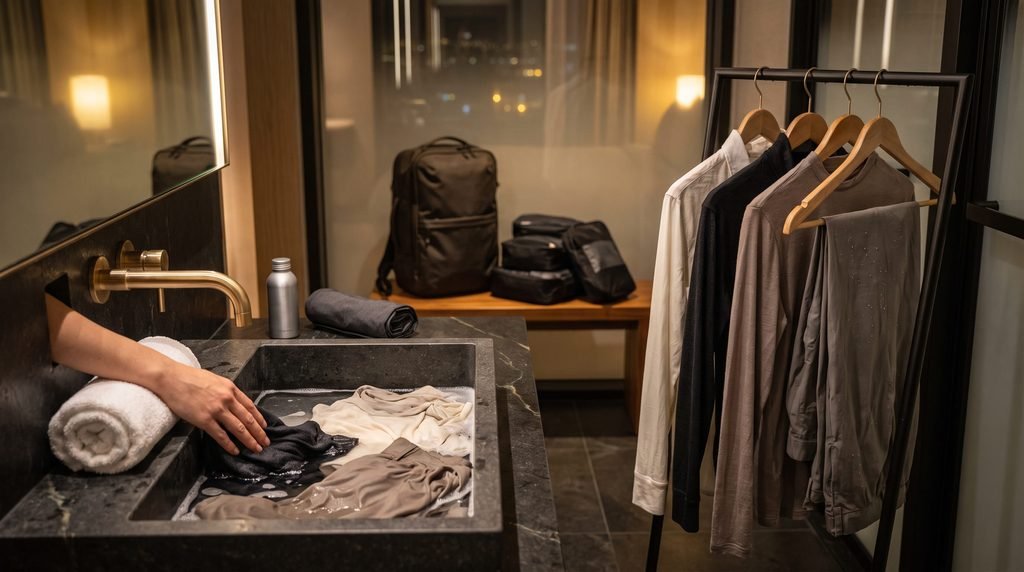
Laundry is the bridge between a small wardrobe and a longer trip.
You do not need a full laundry room. For many journeys, basic sink washing can refresh lightweight clothing between wears.
A Simple Sink-Laundry System
- Separate dirty clothing from clean clothing.
- Wash small loads rather than waiting until everything is dirty.
- Use an appropriate amount of detergent or a compact travel laundry solution.
- Rinse thoroughly.
- Remove as much water as possible.
- Hang garments where there is airflow.
- Allow extra drying time for thicker materials.
A useful trick is to roll damp clothing inside a clean towel and press firmly before hanging it. This can remove additional moisture.
Drying conditions vary considerably, especially in humid rooms, so avoid planning a tight itinerary around clothing that must be completely dry by a specific hour.
Build a Minimal Travel Tech Kit
Technology should be selected according to the devices you actually use.
A compact kit might contain:
- Smartphone
- Appropriate charging cable
- Compact wall charger
- Power bank where useful
- Laptop or tablet only if genuinely necessary
- Earbuds or headphones
- Small cable organizer
A multi-port charger can sometimes eliminate several individual charging bricks.
Before departure, check which cables your devices actually require. A cable that exists only because you “might” need it is an easy item to remove.
Power Banks and Spare Batteries
For air travel, spare lithium batteries and power banks belong in carry-on baggage rather than checked baggage. The FAA also advises removing such items from a carry-on if the bag is gate-checked. Airlines can impose additional restrictions, so verify the current requirements before flying.
What to Do If Your Carry-On Gets Gate-Checked
A gate check can turn an organized one-bag system into a problem if your essentials are packed incorrectly.
Keep a small group of critical items accessible:
- Passport and travel documents
- Wallet
- Medication
- Phone
- Power bank
- Spare batteries
- Essential electronics
- Valuables
If the airline requires you to surrender your backpack at the gate, remove anything that must remain in the cabin.
This is one reason a small personal item or easily accessible pouch can be useful even when you intend to travel with one main bag.
What Not to Pack for a Two-Week Trip
Overpacking usually happens through small “just in case” decisions.
Before closing the bag, reconsider:
- Multiple pairs of nearly identical shoes
- Too many heavy jeans
- Full-size toiletries
- Duplicate electronics
- Clothing that matches only one outfit
- Several formal outfits for a casual trip
- Large towels when accommodation provides them
- Specialized equipment that can be rented
- Excessive accessories
- Backup items you have no realistic reason to need
The question is not whether an item could be useful. Almost anything could be useful in some hypothetical situation.
Ask whether it is likely enough to justify the space and weight.
Adjust Your Packing List for the Destination
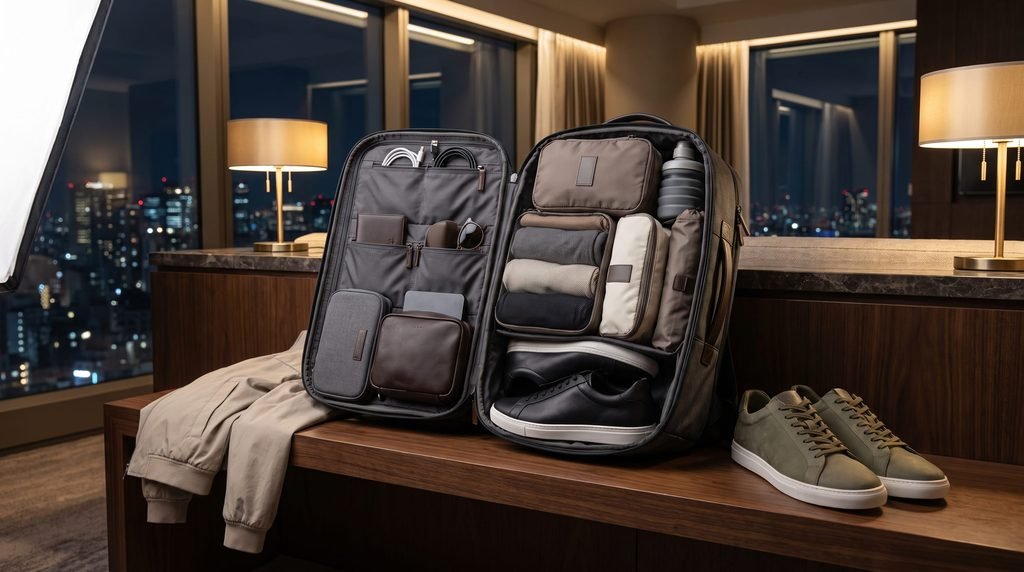
A standard minimalist list should always be modified for the trip.
Warm-Weather Travel
Prioritize:
- Breathable tops
- Lightweight bottoms
- Sun protection
- Swimwear if required
- Quick-drying underwear
- Lightweight footwear
Reduce bulky layers and heavy fabrics.
Cold-Weather Travel
Cold-weather one-bag travel is more challenging because insulation takes up space.
Prioritize:
- Layering
- Warm base layers
- Compact insulation
- Weather-resistant outerwear
- Warm accessories
- Appropriate footwear
Wear your bulkiest pieces during transit when practical.
Mixed-Weather Travel
Layering becomes particularly valuable.
Instead of carrying separate outfits for every temperature, combine:
base layer + mid-layer + outer shell
This gives you more flexibility while keeping the wardrobe compact.
Active or Adventure Trips
Activity-specific equipment can quickly overwhelm a minimalist bag.
Separate essential technical equipment from items that can reasonably be rented, purchased locally, or substituted with versatile clothing.
City or Business Travel
If your itinerary includes meetings, restaurants, or formal events, reserve space for one or two polished pieces rather than attempting to create a complete business wardrobe.
A smart pair of trousers, refined top, lightweight blazer or versatile jacket can often bridge casual and formal settings more efficiently than several specialized outfits.
The Complete 2 Week One-Bag Packing List
Use this as a flexible checklist rather than a rigid formula.
Clothing
- 4–6 versatile tops
- 2–3 bottoms
- 1 long-sleeve layer
- 1 sweater, fleece, or mid-layer if needed
- 1 weatherproof outer layer if required
- Underwear
- Socks
- Sleepwear
- Swimwear if needed
- Activity-specific clothing if genuinely required
- One dressier option if appropriate
Footwear
- Main walking shoes
- Lightweight secondary shoes
- Specialized footwear only if necessary
Toiletries
- Toothbrush
- Toothpaste
- Deodorant
- Skincare essentials
- Hair-care essentials
- Grooming items
- Sunscreen if needed
- Personal-care products
- Travel laundry detergent
Health & Personal Essentials
- Prescription medication
- Necessary personal supplies
- Glasses/contact-lens supplies
- Basic first-aid essentials
- Any destination-specific personal items
Electronics
- Smartphone
- Charging cable
- Compact charger
- Power bank if needed
- Earbuds/headphones
- Laptop/tablet only if necessary
- Required adapters
- Cable organizer
Documents & Money
- Passport
- Visa or entry documents where applicable
- Boarding information
- Accommodation details
- Travel insurance information
- Payment cards
- Some local currency where useful
- Copies/backups of important documents
Travel Accessories
- Main backpack
- Packing cubes
- Laundry bag
- Small day bag if permitted and useful
- Reusable water bottle where appropriate
- Sunglasses
- Travel lock if needed
What to Remove If Your Bag Is Too Full
If everything does not fit, do not immediately buy a bigger bag.
Edit in this order:
1. Remove duplicates.
Do you really need three versions of the same item?
2. Reduce shoes.
Footwear is often one of the biggest space savings.
3. Reduce bulky clothing.
Look for heavy or rarely used pieces.
4. Simplify toiletries.
Decant, consolidate, or remove nonessential products.
5. Audit electronics.
Remove devices and cables that are not genuinely necessary.
6. Reconsider “just in case” items.
Separate realistic needs from hypothetical ones.
7. Recheck the destination.
You may be packing for conditions that your itinerary does not actually involve.
Only after editing should you consider whether you genuinely need additional capacity.
Common Two-Week One-Bag Packing Mistakes
Packing 14 Complete Outfits
This is the fastest route to an oversized bag. Build combinations instead.
Ignoring Laundry
A small wardrobe without a laundry strategy becomes a large wardrobe surprisingly quickly.
Choosing Clothes That Do Not Coordinate
Individual garments may look excellent but become inefficient if they only work with one other item.
Packing Too Many Shoes
Three or four pairs can consume the space needed for an entire clothing category.
Forgetting Airline Weight Limits
A bag can fit dimensionally and still exceed an airline’s weight allowance.
Packing for Every Possible Weather Scenario
Check the expected conditions and build a layering system instead of bringing several complete weather wardrobes.
Putting Critical Items in the Main Compartment
Passports, medication, valuables, and important electronics should remain accessible.
Treating a Packing Formula as Universal
The best minimalist system is flexible. Climate, activities, culture, laundry access, and personal needs should all influence the final list.
A Simple Pre-Flight One-Bag Audit
Before leaving home, perform one final check.
Airline: Does the packed bag meet current size and weight requirements?
Wardrobe: Can most pieces be combined into multiple outfits?
Laundry: Do I know when and how I will wash clothes?
Shoes: Does every pair have a clear purpose?
Toiletries: Have I removed duplicates and unnecessary full-size products?
Technology: Do I have only the devices and cables I actually need?
Documents: Are passport, payment methods, reservations, and essential information accessible?
Gate check: Could I quickly remove my power bank, medication, valuables, and critical electronics?
Weather: Does the clothing match the destination and season?
Space: Is there enough room to close the bag comfortably without overstuffing it?
If the answer is yes across the board, your packing system is doing its job.
FAQs
1. Can you really pack for two weeks in one bag?
Yes, for many types of trips. The key is to pack a versatile capsule wardrobe, repeat clothing, plan laundry, limit footwear, and adjust the list to the climate and activities. Two weeks of travel does not require 14 complete outfits.
2. How many clothes should I pack for a 2-week trip?
A useful starting point is around 4–6 tops, 2–3 bottoms, enough underwear and socks to reach your planned laundry cycle, plus appropriate layers and activity-specific pieces. Your ideal quantity depends on climate, personal preferences, and access to laundry.
3. What size backpack is best for a 2-week one-bag trip?
There is no universal ideal capacity. A compact carry-on-sized backpack can work for many minimalist travelers, but the airline’s external dimensions and weight allowance matter more than the bag’s liter rating alone.
4. How often should you do laundry on a two-week trip?
Many travelers can make a small wardrobe work with one or two laundry sessions during a 14-day trip. The ideal timing depends on the number of garments, climate, activity level, and access to laundry facilities.
5. What should I pack differently for a cold-weather two-week trip?
Use a layering system rather than packing numerous bulky outfits. Prioritize warm base layers, compact insulation, a suitable outer shell, and weather-appropriate accessories and footwear. Wear bulky clothing during transit when practical.
Conclusion
A successful 2 week packing list one bag is less about squeezing an arbitrary number of possessions into a backpack and more about designing a flexible travel system.
Start with your airline’s current baggage limits, build a coordinated capsule wardrobe, choose versatile footwear, keep toiletries compact, plan your laundry, and remove anything that has no clear purpose. Then adjust the system for the destination’s climate, activities, dress expectations, and your own travel style.
The objective is simple: enough to travel comfortably for 14 days, without carrying 14 days’ worth of unnecessary stuff.
1 comment