
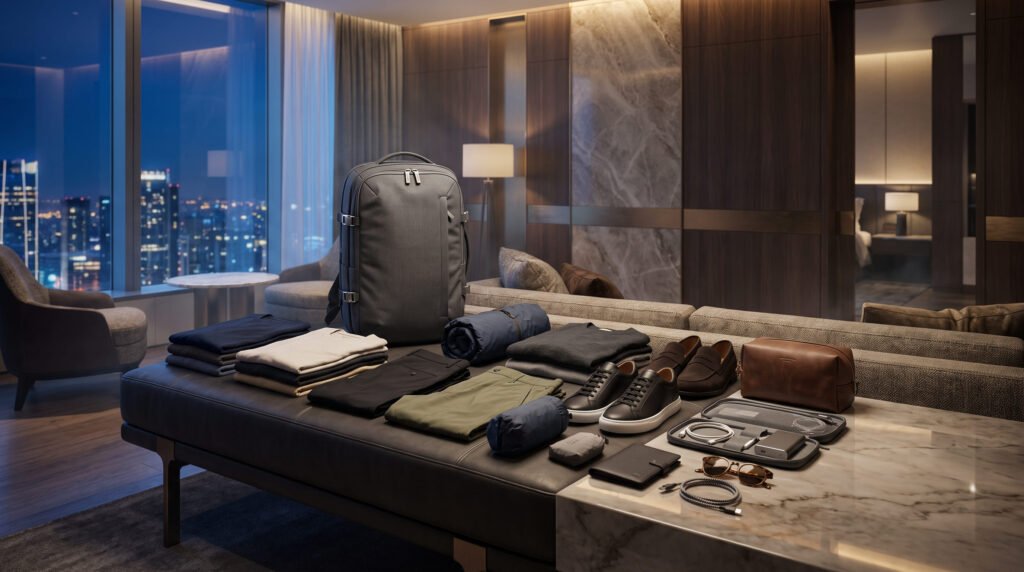
Packing for seven days with one bag is less about taking as little as possible and more about taking the right combination of versatile items. The goal is a compact travel wardrobe that gives you enough clothing, shoes, toiletries, electronics, and essentials without turning your bag into a heavy, overstuffed burden.
This 7-day one-bag packing list gives you a practical starting point for a one-week trip, including a laundry-friendly option, a no-laundry option, clothing quantities, shoes, toiletries, electronics, weather adjustments, and a simple packing system. It also explains how to choose a bag based on your trip rather than assuming one capacity works for everyone.
The Quick 7-Day One-Bag Packing List
For a typical one-week trip with at least one laundry opportunity, start with this compact setup:
| Category | Recommended starting point |
|---|---|
| T-shirts/tops | 3–4 |
| Bottoms | 2–3 |
| Underwear | 5–7 |
| Socks | 4–7 pairs |
| Sleepwear | 1 set |
| Mid-layer | 1 |
| Weather layer | 1 |
| Shoes | 1 pair packed + 1 worn |
| Toiletries | Small travel kit |
| Electronics | Phone + charger + essential devices |
| Documents | Passport/ID, cards, reservations |
| Laundry kit | Small detergent + laundry bag |
| Accessories | Sunglasses, hat, compact umbrella as needed |
This is a baseline, not a rigid formula. A winter trip, business trip, hiking holiday, or destination without laundry access may require different quantities.
The biggest space-saving decision is whether you are willing to wash a few clothes during the trip. If you are, seven days can usually be approached as a compact capsule rather than seven complete outfits.
How Much Can You Really Pack for 7 Days?
A seven-day trip does not require seven complete outfits.
Instead, build around pieces that work together:
- Several tops that coordinate with the same bottoms
- Two or three versatile bottoms
- One comfortable walking shoe
- One optional second shoe
- One insulating layer
- One weatherproof layer
- Enough underwear and socks for your laundry strategy
- Toiletries in travel-sized quantities
- Only the electronics you genuinely use
The trick is to think in outfit combinations rather than individual days.
For example, three tops and two bottoms can create several combinations without requiring six separate clothing pieces.
The laundry decision changes everything
If you are willing to do one small laundry load, you can pack considerably less.
If you want to avoid laundry completely, increase underwear, socks, and potentially tops—but resist the temptation to double every category.
What Size One-Bag Backpack Do You Need?
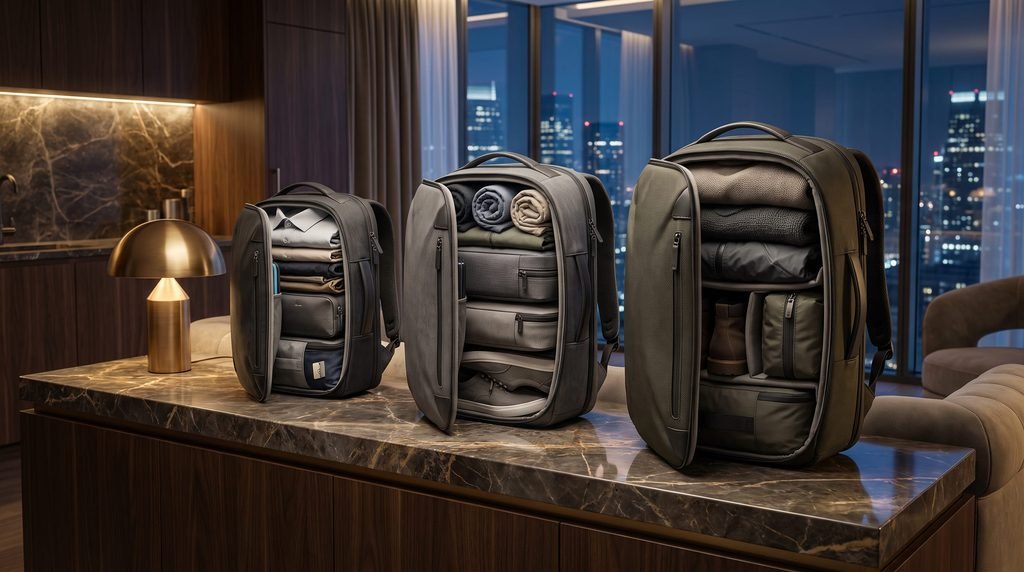
There is no universal “perfect” one-bag size. The right capacity depends on clothing bulk, climate, footwear, electronics, and whether you will do laundry.
Around 28L: Compact One-Bag Travel
A bag around this size can work well for an experienced minimalist traveler, especially with:
- Lightweight clothing
- One-bag laundry
- Minimal toiletries
- One versatile packed shoe or no second shoe
- Warm-weather clothing
- Limited electronics
It becomes more challenging for bulky winter clothing or trips requiring multiple pairs of shoes.
Around 30–32L: Balanced Option
This range can provide a useful middle ground for a seven-day trip.
It offers more flexibility for:
- A small clothing capsule
- Toiletries
- Electronics
- A light jacket
- One extra pair of shoes
The actual usable space depends heavily on the bag’s design.
Around 35L: More Forgiving
A larger carry-on-sized travel backpack can make seven-day packing easier, particularly when you need:
- Cold-weather layers
- Larger shoes
- Business clothing
- Camera equipment
- More toiletries
- More clothing variety
The trade-off is simple: more capacity makes overpacking easier.
Capacity Isn’t the Same as Comfort
A bag that technically holds everything may still be unpleasant to carry.
Think about:
Volume + weight + dimensions + carrying system
rather than liters alone.
For flights, always check the operating airline’s current baggage dimensions, weight limits, and fare-specific restrictions before leaving home. Airlines can impose rules that are stricter than general aviation regulations.
7-Day Clothing Capsule
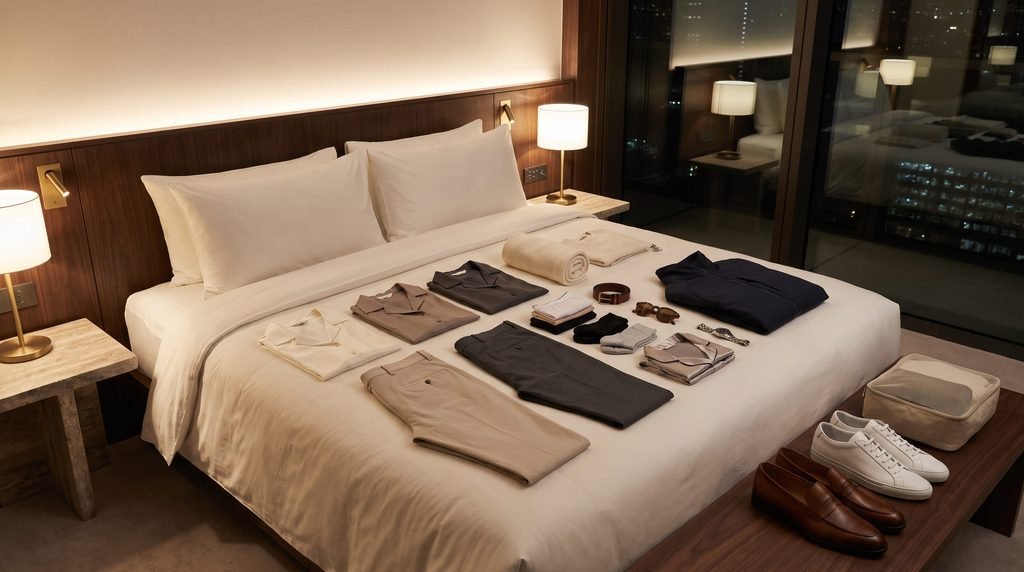
The clothing portion should form the core of your one-bag system.
Tops: 3–4
A useful starting point is:
- 2–3 everyday tops
- 1 slightly nicer top
Choose colors and styles that work with most of your bottoms.
For warm destinations, lightweight quick-drying fabrics can make hand-washing easier. For cooler destinations, prioritize layering rather than bringing multiple bulky sweaters.
Bottoms: 2–3
Two versatile bottoms are enough for many trips.
Consider:
- 1 comfortable everyday pair
- 1 second pair in a different color or style
- 1 optional lightweight or activity-specific pair
If one pair can work for both daytime sightseeing and casual evening plans, it earns valuable space.
Underwear: 5–7 Pairs
With laundry:
5 pairs can be enough for many travelers.
Without laundry:
7 pairs provides a simpler no-wash approach.
Underwear takes relatively little space, so this is one category where convenience can outweigh extreme minimalism.
Socks: 4–7 Pairs
Match the number to your shoes and activities.
Walking-heavy trips may justify more socks, while sandals or warm-weather destinations can reduce the requirement.
Sleepwear: 1 Set
One lightweight sleep set is generally enough.
For very warm destinations, it can be as simple as a T-shirt and comfortable shorts.
Mid-Layer: 1
Bring one layer that works over your everyday tops.
Examples include:
- Lightweight sweater
- Cardigan
- Fleece
- Overshirt
- Merino layer
The best choice depends on the climate.
Weather Layer: 1
A lightweight rain shell or packable weatherproof jacket can provide considerably more utility than a bulky coat on many trips.
For genuinely cold destinations, however, a proper insulated outer layer may be necessary.
7-Day Packing List With Laundry
If you can wash clothes once during the trip, use a smaller capsule:
Clothing
- 3–4 tops
- 2 bottoms
- 5 underwear
- 4–5 socks
- 1 sleep set
- 1 mid-layer
- 1 weather layer
- 1 activity-specific item if required
Simple laundry kit
- Small laundry bag
- Travel detergent or detergent sheets
- Sink stopper only if genuinely useful for your destination
- Compact clothesline if you know you’ll use it
You do not need a complicated laundry setup.
For many travelers, washing a few lightweight garments in a sink and allowing them to dry overnight is enough.
7-Day Packing List Without Laundry
If laundry is not part of your plan, increase the pieces that are worn closest to the body.
Clothing
- 4–5 tops
- 2–3 bottoms
- 7 underwear
- 6–7 socks
- 1 sleep set
- 1 mid-layer
- 1 weather layer
This is still substantially more efficient than packing seven complete outfits.
The key is to keep your outer layers and bottoms reusable while rotating the smaller clothing items.
How to Choose Clothes That Work Together
The most effective one-bag wardrobe behaves like a capsule.
Start with a simple color palette
Choose two or three core colors and one accent.
For example:
- Black
- Navy
- White
- Olive accent
The exact colors do not matter. Coordination does.
Prioritize multi-use pieces
A good travel garment should ideally work for more than one situation.
A pair of lightweight trousers might work for:
- Airport travel
- City sightseeing
- Dinner
- Casual business settings
That is much more valuable than a garment that works for one specific occasion.
Choose fabrics strategically
Look for fabrics that are:
- Comfortable
- Relatively lightweight
- Easy to wash
- Reasonably quick-drying
- Appropriate for the destination’s climate
Merino wool can be useful for odor resistance and temperature regulation, while synthetic technical fabrics can offer fast drying and durability. Cotton can still be perfectly comfortable, but it may be slower to dry after washing.
The best fabric is the one that suits your destination, climate, activities, and laundry situation.
Shoes: How Many Do You Actually Need?
Shoes are one of the easiest ways to destroy a one-bag packing system.
For many seven-day trips, start with:
Wear: one comfortable walking pair
Pack: one additional pair only if genuinely necessary
Your worn pair should ideally handle most of the trip.
The second pair might be:
- Sandals for a warm destination
- Dress shoes for business travel
- Trail shoes for hiking
- A lighter alternative for evenings
A useful test
Before packing a second pair, ask:
Will I realistically use these shoes for a different activity that my main pair cannot handle?
If the answer is no, leave them behind.
Also wear your bulkiest practical shoes during transit rather than using valuable bag space for them.
Toiletries and Liquids
A seven-day trip rarely requires full-size toiletries.
Build a compact kit around:
- Toothbrush
- Toothpaste
- Deodorant
- Face wash
- Moisturizer
- Sunscreen
- Hair products if needed
- Shaving supplies
- Basic personal-care items
- Any required medications
Where possible, choose:
- Solid toiletries
- Small refillable containers
- Products available at your destination
For flights departing from the United States, TSA’s current guidance generally limits liquids, gels, aerosols, creams, and pastes in carry-on baggage to containers of 3.4 oz / 100 mL or less, subject to the applicable screening rules. TSA also maintains its current “What Can I Bring?” database for individual items.
Do not assume that every country’s security rules are identical. For international travel, check the relevant airport, security authority, and airline.
Keep the liquids pouch accessible
Put your liquids where you can reach them without unpacking half the bag.
That makes airport screening considerably easier.
Electronics and Travel Tech
The minimalist electronics kit should usually include:
- Smartphone
- Phone charging cable
- Wall charger
- Earbuds/headphones
- Power bank if genuinely needed
- Laptop/tablet only if required
- Necessary adapters
- Small charging organizer
Avoid packing electronics simply because you own them.
For a seven-day leisure trip, ask of every device:
What problem does this solve?
If the answer is unclear, it probably does not belong in the bag.
Power Banks and Spare Batteries
This is an area where current aviation rules matter.
The FAA states that spare lithium batteries, including power banks, must be carried in carry-on baggage rather than checked baggage. For lithium-ion batteries, those rated up to 100 Wh are generally permitted for passengers, while 101–160 Wh batteries require airline approval and are subject to additional limits. Airlines may impose stricter restrictions.
If your carry-on is taken at the gate and placed in the aircraft’s hold, remove your spare batteries and power banks and keep them with you in the cabin.
Documents, Money & Important Items
Keep the things that would be difficult or expensive to replace close at hand.
Essential documents
- Passport or ID
- Boarding information
- Hotel/accommodation details
- Travel insurance information if applicable
- Required visas or entry documents
- Driving license if renting a vehicle
Financial essentials
- Primary payment card
- Backup payment method
- Small amount of appropriate local currency where useful
Keep digital copies of important documents in a secure location, but do not rely exclusively on your phone.
Adjust the Packing List for Your Trip
The best seven-day packing list changes dramatically according to destination.
Hot Weather
Reduce bulky layers and prioritize:
- Breathable tops
- Lightweight bottoms
- Sandals
- Sun protection
- Lightweight rain layer if appropriate
Do not automatically pack seven different hot-weather outfits. A small rotating wardrobe can work well.
Cold Weather
Cold-weather packing is fundamentally different.
Prioritize:
- Thermal base layer if needed
- Insulating mid-layer
- Proper outer layer
- Warm socks
- Weather-appropriate footwear
- Gloves
- Hat
For cold trips, wear your bulkiest layers in transit whenever practical.
Rainy Weather
Prioritize a lightweight waterproof layer over multiple umbrellas or bulky weather gear.
A compact umbrella can still be useful where appropriate, but check airline-specific size requirements.
Business Travel
Replace one casual outfit with:
- One polished shirt/blouse
- Versatile trousers or skirt
- One smart layer
- Appropriate shoes
Choose garments that can work for both professional meetings and travel days.
Hiking or Active Travel
The list changes according to the activity.
You may need:
- Technical clothing
- Activity-specific footwear
- Performance layers
- Weather protection
- Hydration equipment
- Safety equipment
Do not force a minimalist packing philosophy to eliminate equipment that is genuinely necessary for safety.
Beach or Resort Trip
Prioritize:
- Swimwear
- Lightweight cover-up
- Sandals
- Sun protection
- One casual evening outfit
Resist packing multiple “just in case” resort outfits.
How to Pack Everything Into One Bag
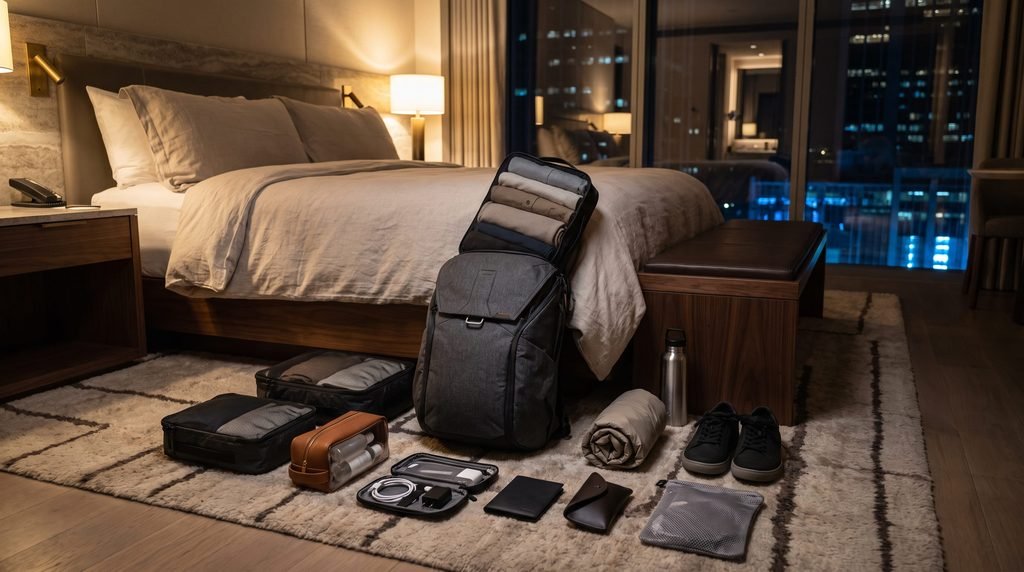
Step 1 — Build Your Outfits First
Lay everything out before putting anything into the bag.
Create actual combinations rather than piles of individual clothing.
If a top only works with one specific bottom, reconsider it.
Step 2 — Remove Duplicates
Look for:
- Two similar jackets
- Too many tops
- Multiple pairs of similar shoes
- Duplicate electronics
- Full-size toiletries
- “Just in case” clothing
This is where most unnecessary weight disappears.
Step 3 — Separate by Category
Group:
- Clothing
- Underwear
- Toiletries
- Electronics
- Documents
- Accessories
Packing cubes can make organization easier, but they are not mandatory.
Step 4 — Put Heavy Items Close to Your Back
For a backpack, heavier items generally feel better when positioned close to your body rather than hanging far away from it.
Keep frequently needed items accessible.
Step 5 — Leave a Little Flexibility
Do not fill every centimeter of the bag on departure.
A completely stuffed bag becomes difficult to close, difficult to reorganize, and leaves no room for anything acquired during the trip.
What You Should Leave Behind
A strong one-bag packing list is defined partly by what you do not bring.
Consider leaving behind:
- Extra shoes with overlapping purposes
- Seven complete outfits
- Full-size toiletries
- Multiple jackets for similar weather
- Excessive “just in case” clothing
- Books you can replace with an e-reader
- Duplicate charging cables
- Large hair or beauty tools unless essential
- Clothing that only works for one occasion
- Bulky items available at your accommodation
The question is not:
“Could I possibly need this?”
Ask instead:
“What happens if I don’t bring it?”
If the answer is minor inconvenience, it may not deserve the space.
One-Bag Packing Mistakes to Avoid
Packing for Seven Days Instead of Packing for Seven Days of Use
You need enough clothing to stay comfortable—not seven separate costumes.
Bringing Too Many Shoes
Shoes consume disproportionate amounts of space.
Choose them around your actual itinerary.
Ignoring Laundry
A single wash can dramatically reduce clothing volume.
Packing for Every Possible Weather Scenario
Check the forecast closer to departure and pack for the conditions you are actually likely to encounter.
Filling the Bag Completely
Leave some breathing room.
Forgetting Airline Restrictions
Your bag may fit physically but still exceed an airline’s current size or weight limits.
Always verify the operating carrier’s rules before departure.
Putting Critical Electronics in an Inaccessible Place
If your bag may be gate-checked, you need quick access to items that must remain in the cabin, particularly spare lithium batteries and power banks.
Final 7-Day One-Bag Checklist
Clothing
- 3–4 versatile tops
- 2–3 bottoms
- 5–7 underwear
- 4–7 socks
- 1 sleep set
- 1 mid-layer
- 1 weather layer
- Activity-specific clothing if necessary
Shoes
- Comfortable travel/walking shoes
- Optional second pair
Toiletries
- Toothbrush
- Toothpaste
- Deodorant
- Skincare
- Sunscreen
- Hair/shaving products
- Personal medications
- Liquids organized for airport screening
Electronics
- Phone
- Charger
- Charging cable
- Earbuds/headphones
- Power bank if needed
- Adapter if required
- Laptop/tablet only if necessary
Travel Essentials
- Passport/ID
- Payment cards
- Travel documents
- Accommodation information
- Travel insurance details if applicable
- Sunglasses
- Small laundry bag
- Reusable water bottle
FAQs
1. Can you really pack for 7 days in one bag?
Yes. A seven-day trip can often fit into one appropriately sized bag when you use a coordinated clothing capsule, limit shoes, keep toiletries compact, and either do laundry or repeat versatile outer layers and bottoms.
2. What size bag is best for a 7-day one-bag trip?
There is no single correct size. A compact traveler may manage with roughly 28–30L, while travelers carrying bulkier clothing, shoes, electronics, or cold-weather layers may prefer something closer to 30–35L. Airline dimensions and weight limits should always be checked separately from bag volume.
3. How many outfits should I pack for a 7-day trip?
You generally do not need seven completely separate outfits. A combination of three or four tops and two or three bottoms can create multiple outfits. Add layers and activity-specific clothing only when your itinerary requires them.
4. Is it better to pack one pair of shoes or two?
For many trips, wearing one versatile pair and packing one additional pair is a practical starting point. If your main shoes can handle the entire itinerary, however, traveling with only one pair saves substantial space.
5. Should I do laundry on a 7-day trip?
If minimizing bag size matters to you, doing laundry once is one of the easiest ways to reduce clothing volume. It is not essential, though; travelers who prioritize convenience can pack additional underwear, socks, and tops instead.
Conclusion
A successful 7-day one-bag packing list is not about owning specialized travel clothing or squeezing your entire life into the smallest possible backpack. It is about building a compact system in which every item has a purpose and most clothing works in multiple combinations.
Start with three or four versatile tops, two or three bottoms, a small underwear and sock rotation, one or two pairs of shoes, a lightweight layer, essential toiletries, and only the electronics you genuinely need. Add or remove items according to climate, activities, laundry access, and trip purpose.
Before departure, check your airline’s current baggage rules and any applicable security requirements. For U.S. flights, also pay particular attention to current TSA and FAA guidance for liquids and lithium batteries.
3 comments