
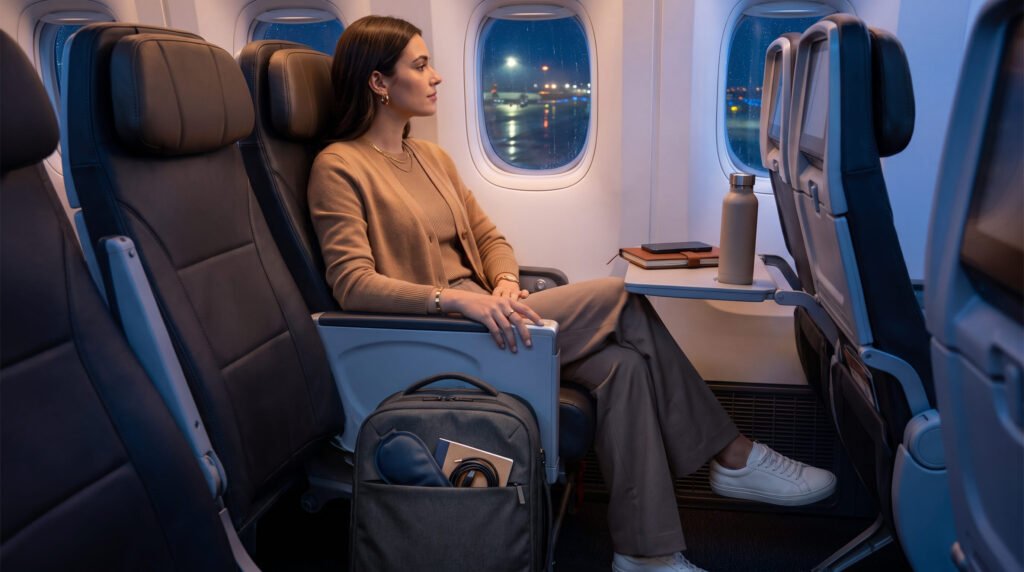
Long-haul economy flights can be surprisingly comfortable when you bring the right things—and frustrating when you do not. Limited legroom, dry cabin air, changing temperatures, long periods of sitting, limited storage, and hours without easy access to your luggage can make a simple flight feel much harder than it needs to.
The best long haul flight essentials for economy class are not necessarily the most expensive or most sophisticated travel gadgets. They are the items that help you sleep, stay comfortable, stay entertained, manage personal hygiene, protect your health and keep the things you need within easy reach.
This guide breaks down what is genuinely worth packing for a long flight, what can stay at home, how to organize your personal item, and how to build a practical economy-class flight kit without overpacking.
Quick Answer: What Are the Best Long Haul Flight Essentials for Economy Class?
For most long-haul economy flights, prioritize these essentials:
- Neck pillow or compact travel pillow
- Lightweight eye mask
- Noise-canceling headphones or comfortable earbuds
- Earplugs
- Phone and charging cable
- Power bank that complies with airline rules
- Downloaded movies, music, books or podcasts
- Reusable empty water bottle
- Lip balm and moisturizer
- Toothbrush and travel-size toothpaste
- Hand sanitizer and tissues
- Prescription medication and essential personal medicines
- Light sweater, cardigan or travel layer
- Compression socks, if appropriate for you
- Small snack
- Pen
- Passport and travel documents
- Small pouch for keeping essentials organized
The key is to create a compact in-flight comfort kit rather than filling your carry-on with things you may never use.
Long Haul Flight Essentials at a Glance
| Category | Essential | Why It Matters |
| Sleep | Eye mask | Blocks cabin light |
| Sleep | Neck pillow | Supports your head while resting |
| Noise | Headphones + earplugs | Reduces engine and cabin noise |
| Clothing | Light layer | Cabins can feel cool |
| Hydration | Empty water bottle | Useful after security |
| Electronics | Phone + cable | Entertainment and communication |
| Power | Approved power bank | Backup charging |
| Hygiene | Toothbrush + toothpaste | Refreshes you during the flight |
| Skin care | Lip balm + moisturizer | Helps with dry-feeling skin |
| Health | Prescription medication | Keeps critical medicines accessible |
| Comfort | Compression socks | May help some travelers with leg comfort |
| Food | Small snack | Useful between meals |
| Organization | Small pouch | Keeps essentials accessible |
| Documents | Passport + travel documents | Essential for the journey |
What Makes a Long-Haul Economy Flight Different?
A long-haul flight can last many hours, which changes what you need compared with a short domestic trip.
On a short flight, you can usually tolerate inconvenience because the destination arrives quickly. On a long flight, small annoyances become much more noticeable.
You may spend hours:
- Sitting in the same position
- Sleeping in an upright seat
- Listening to aircraft and cabin noise
- Moving between warm and cool environments
- Using dry cabin air
- Watching entertainment
- Eating airline meals
- Waiting between meals and drinks
- Trying to sleep according to a different time zone
That means your carry-on should solve comfort, sleep, entertainment, hydration, hygiene, health and organization rather than simply containing as many gadgets as possible.
The Golden Rule: Pack for the Flight, Not Just the Destination
One of the biggest mistakes travelers make is thinking only about what they need after landing.
Your checked luggage may contain your clothes, toiletries and other belongings, but you cannot access it during the flight.
Your personal item should therefore contain the things you might realistically need during the entire journey.
Think of it as a small mobile cabin kit.
A useful rule is:
If you would be frustrated without it during a 10–15 hour journey, consider keeping it in your personal item.
That does not mean bringing everything you own. It means prioritizing items that solve predictable problems.
1. A Comfortable Neck Pillow
A good travel pillow can make a major difference when you are trying to rest in an economy seat.
Without adequate support, your head can repeatedly fall forward or sideways while you sleep.
What to look for
Choose a pillow that:
- Supports your neck without forcing your head too far forward
- Packs relatively compactly
- Does not interfere with your headphones
- Has a comfortable fabric
- Can be cleaned easily
- Fits your sleeping position
Memory foam can provide substantial support, but inflatable and compressible designs can be easier to pack.
The best pillow is ultimately the one that supports your preferred sleeping position without consuming too much cabin space.
2. An Eye Mask
An eye mask is one of the smallest and most useful long-flight accessories.
Cabin lighting can change throughout the journey, and passengers around you may use screens or reading lights while you are trying to sleep.
A comfortable eye mask can help create a darker environment without requiring you to wait for everyone else to sleep.
Look for:
- Soft fabric
- Minimal pressure around the eyes
- An adjustable strap
- A shape that does not interfere with your headphones
A slim eye mask takes almost no space, so there is little reason not to carry one if you plan to sleep.
3. Noise-Canceling Headphones or Earbuds
Aircraft engines, conversations, meal service and nearby passengers can make sleeping difficult.
Noise-canceling headphones can reduce the amount of cabin noise you perceive and can also serve as your primary entertainment device.
If you do not want to carry large headphones, comfortable noise-isolating earbuds can be a smaller alternative.
Best approach
For long flights, consider carrying two layers of noise protection:
- Noise-canceling headphones or earbuds
- Simple foam earplugs
This gives you an alternative if your headphones become uncomfortable or run out of battery.
4. Your Phone and Charging Cable
Your phone can become the central tool in your long-haul flight kit.
Before leaving for the airport, use it to store:
- Boarding passes
- Airline information
- Hotel details
- Travel documents
- Offline maps
- Entertainment
- Important contact information
- Translation tools
- Reading material
Do not assume you will have reliable internet access throughout the flight.
Download anything important before boarding.
Also pack the correct charging cable for your phone and any other essential electronics.
5. A Power Bank—Packed Correctly
A power bank can be extremely useful when your phone battery starts dropping halfway through a long journey.
However, lithium battery rules matter.
In the United States, the FAA states that spare lithium-ion batteries and power banks must be carried in carry-on baggage, not checked baggage. Spare lithium-ion batteries up to 100 Wh are generally allowed, while larger batteries in the 101–160 Wh range require airline approval and have additional limits. Airlines may impose stricter requirements.
If your carry-on is taken at the gate and placed in the aircraft hold, remove your power bank and other spare lithium batteries and keep them with you in the cabin.
Before your flight
Check:
- The watt-hour rating of your power bank
- Your airline’s battery policy
- Whether the power bank needs protection from short circuits
- Whether you have the appropriate charging cable
Do not bring a damaged, swollen or recalled lithium battery. FAA guidance warns that damaged batteries can present a fire risk.
6. Downloaded Entertainment
Do not rely entirely on the airline’s entertainment system.
Bring a backup entertainment plan.
Download before boarding
Consider downloading:
- Movies
- TV episodes
- Podcasts
- Audiobooks
- Music
- E-books
- Offline games
- Articles
A combination works better than relying on one activity for the entire flight.
For example:
First few hours: movie
Meal period: reading
Middle of flight: sleep
Later: podcast or audiobook
Final hours: entertainment and destination preparation
This makes a long journey feel less monotonous.
7. A Small E-Reader or Book
Digital entertainment is useful, but staring at a screen for many hours is not always appealing.
An e-reader can provide a low-distraction alternative.
If you prefer physical books, choose one reasonably compact book rather than carrying multiple heavy volumes.
For one-bag travelers, an e-reader is particularly efficient because hundreds of books can occupy very little physical space.
8. A Reusable Water Bottle
Cabin air can feel dry, and having a bottle makes it easier to drink when you want rather than waiting for beverage service.
Bring an empty reusable bottle through security where permitted, then fill it after the checkpoint.
If you are departing from a U.S. airport, TSA’s current guidance allows empty drink containers through the checkpoint, after which travelers can fill them.
A collapsible bottle can be especially useful when packing space is limited.
9. Lip Balm and Moisturizer
Dry-feeling lips and skin can become particularly noticeable during a long flight.
A small personal-care kit can include:
- Lip balm
- Lightweight moisturizer
- Hand cream
- Facial moisturizer, if you normally use one
Keep liquids, gels and creams within the applicable security requirements.
For U.S. TSA screening, many liquid, gel, aerosol, cream and paste items in carry-on baggage are subject to the 3.4-ounce/100 mL rule and the 3-1-1 system, although exemptions and special procedures apply to certain items.
Always check the current security requirements for your departure airport, particularly when your itinerary involves multiple countries.
10. Toothbrush and Travel-Size Toothpaste
A toothbrush is one of the most underrated long-flight essentials.
After several hours of eating, drinking and sleeping, brushing your teeth can make you feel significantly fresher.
A simple kit can contain:
- Toothbrush
- Small toothpaste
- Floss
- Travel mouthwash, if useful to you
You do not need a full bathroom kit.
Keep it compact and easy to access.
11. Hand Sanitizer and Tissues
A small hygiene kit is useful for:
- Cleaning your hands before eating
- Wiping surfaces when appropriate
- Dealing with spills
- Refreshing yourself
- Handling unexpected messes
Pack tissues separately so you can reach them without opening your entire bag.
Hand sanitizer carried through U.S. TSA screening is generally subject to the 3.4-ounce/100 mL carry-on liquid limit.
12. Prescription Medication and Essential Medicines
Medication should not be buried inside checked luggage if you may need it during the flight.
Keep essential medication accessible in your cabin bag.
Depending on your needs, your flight kit might include:
- Prescription medication
- Regular over-the-counter medication
- Motion-sickness medication, if normally used
- Personal medical supplies
- Contact lenses and necessary supplies
- Glasses
For medications and medically necessary liquids, security procedures can differ from standard liquid rules. TSA advises travelers to declare medically necessary liquids for inspection when applicable.
Always follow your doctor’s instructions and check the rules of every country on your itinerary for prescription medicines.
13. Comfortable Layers
One of the smartest clothing decisions for a long flight is layering.
Instead of wearing one thick outfit, use several lighter layers that can be added or removed.
A practical economy-flight outfit
Consider:
- Comfortable T-shirt or breathable top
- Lightweight sweater or cardigan
- Soft trousers or relaxed travel pants
- Comfortable socks
- Supportive walking shoes
- Lightweight jacket or coat if required at the destination
Avoid clothing that is restrictive around the waist, knees or shoulders.
Your outfit should work for both the aircraft cabin and the airport after landing.
14. Compression Socks
Compression socks are frequently included in long-flight packing lists because prolonged sitting can contribute to leg and foot discomfort.
They may be useful for some travelers, particularly on long journeys, but they are not universally necessary.
Choose a properly fitted pair rather than assuming tighter automatically means better.
If you have a medical condition affecting circulation or you are unsure whether compression garments are appropriate for you, seek advice from a healthcare professional before traveling.
15. Comfortable, Easy-to-Remove Shoes
Your feet may swell or simply feel uncomfortable after sitting for many hours.
Choose shoes that are:
- Comfortable for walking through the airport
- Easy to remove if necessary
- Secure enough for walking
- Suitable for the weather at your destination
Avoid bringing a second pair into your personal item unless you genuinely need it.
Your airport shoes can often serve as your primary travel shoes.
16. A Small Travel Blanket or Scarf
You do not necessarily need a bulky travel blanket.
A lightweight scarf, large wrap or compact travel blanket can provide another layer when the cabin feels cool.
A large scarf has an additional advantage: it can work as:
- A neck layer
- A shoulder cover
- A lightweight blanket
- A destination accessory
This is a good example of a multi-purpose travel item.
17. Snacks for the Journey
Airline meals are useful, but they do not always arrive when you are hungry.
A small snack can fill the gap between meals.
Good travel-friendly choices can include:
- Nuts, where permitted
- Granola or protein bars
- Crackers
- Dried fruit
- Sandwiches or other appropriate food
- Chocolate
- Shelf-stable snacks
Be aware that food rules can become more complicated when crossing international borders. A food item allowed onto an aircraft may still be restricted when entering a country.
If you are unsure, check the destination country’s customs requirements.
18. A Pen
A pen takes almost no room and can be surprisingly useful.
You may need one for:
- Arrival forms
- Customs documentation
- Immigration paperwork
- Notes
- Unexpected travel forms
It is one of those items that costs very little space but can save time.
19. Passport and Important Documents
Your passport should remain accessible and protected.
Depending on your trip, your personal-item document section may include:
- Passport
- Boarding pass
- Visa documentation, where required
- Travel insurance details
- Hotel confirmation
- Transportation information
- Emergency contact information
- Copies of important documents
Digital copies can provide useful backup, but do not assume your phone will always be available or charged.
20. A Small Personal-Item Bag
Your personal item should function as your in-flight command center.
A useful layout is:
Quick-access compartment
Keep:
- Passport
- Phone
- Boarding pass
- Earbuds
- Pen
Comfort pouch
Keep:
- Eye mask
- Earplugs
- Lip balm
- Hand cream
- Tissues
Electronics pouch
Keep:
- Charging cable
- Power bank
- Adapters
- Small accessories
Hygiene pouch
Keep:
- Toothbrush
- Toothpaste
- Hand sanitizer
- Basic personal-care items
Health section
Keep:
- Medication
- Glasses
- Essential medical supplies
This organization prevents the classic long-flight problem of digging through an entire backpack to find one pair of earbuds.
What Should You Pack in Your Personal Item?

Your personal item should contain the things you may need during the flight, while your main carry-on or checked bag can hold items you do not need immediately.
A practical personal-item checklist:
Documents
- ☐ Passport
- ☐ Boarding pass
- ☐ Visa or entry documents
- ☐ Travel insurance information
- ☐ Hotel and transportation details
Electronics
- ☐ Smartphone
- ☐ Charging cable
- ☐ Power bank
- ☐ Headphones
- ☐ E-reader or tablet
- ☐ Universal adapter if required
Comfort
- ☐ Neck pillow
- ☐ Eye mask
- ☐ Earplugs
- ☐ Light sweater
- ☐ Scarf or wrap
- ☐ Comfortable socks
Hygiene
- ☐ Toothbrush
- ☐ Travel toothpaste
- ☐ Lip balm
- ☐ Moisturizer
- ☐ Hand sanitizer
- ☐ Tissues
Health
- ☐ Prescription medication
- ☐ Essential personal medicines
- ☐ Glasses/contact lenses
- ☐ Necessary medical supplies
Food & Hydration
- ☐ Empty water bottle
- ☐ Small snacks
What Should You Wear on a Long-Haul Economy Flight?
The best long-haul flight outfit balances comfort, temperature flexibility and practicality.
A simple formula is:
Breathable base layer + relaxed trousers + lightweight insulating layer + comfortable walking shoes.
Avoid dressing exclusively for the weather at your departure airport.
You may leave a hot city, spend hours in a cool cabin and land somewhere cold—or the reverse.
Layering gives you control throughout the journey.
What to avoid
Avoid:
- Extremely tight jeans
- Shoes that become painful after walking
- Complicated belts
- Excessive jewelry
- Clothing that wrinkles heavily
- Thick outfits that cannot be adjusted
- Shoes that are difficult to remove
The goal is not to look like you are wearing pajamas. It is to create an outfit that remains comfortable while still looking polished when you arrive.
Economy Flight Comfort: What Is Actually Worth Packing?
Not every popular travel accessory deserves space in your bag.
| Item | Worth Packing? | Why |
| Eye mask | Yes | Tiny and useful |
| Earplugs | Yes | Excellent backup for noise |
| Neck pillow | Usually | Helpful if you sleep onboard |
| Noise-canceling headphones | Usually | Entertainment + noise reduction |
| Travel blanket | Maybe | Useful if you get cold |
| Large blanket | Usually no | Too bulky |
| Tablet | Optional | Depends on your entertainment habits |
| Laptop | Only if needed | Heavy and often unnecessary |
| Multiple books | Usually no | Adds weight |
| Full toiletry bag | No | Use a compact flight kit |
| Extra shoes | Usually no | Takes valuable space |
| Large water bottle | Usually no | Bulky when full |
| Multiple chargers | Only if needed | Consolidate cables |
| Power bank | Often yes | Useful backup power |
The best long-haul kit is not the one with the most products.
It is the one with the highest usefulness per gram and per cubic inch.
What Not to Pack for a Long-Haul Flight
Overpacking your personal item can make the flight less comfortable.
You generally do not need:
- A huge toiletry bag
- Multiple pairs of shoes
- Large books
- Excessive clothing
- Full-size skincare products
- Every electronic device you own
- Multiple bulky travel pillows
- Unnecessary duplicate chargers
- Heavy accessories you will not use
Before packing an item, ask:
Will I realistically use this during the flight?
If the answer is no, consider leaving it in your main luggage.
Long-Haul Flight Essentials for Sleeping
Sleep is one of the biggest challenges of long-distance economy travel.
A practical sleep kit can include:
- Neck pillow
- Eye mask
- Earplugs
- Noise-canceling headphones
- Light layer
- Comfortable socks
- Water
- Your normal sleep-support items, if appropriate for you
Do not rely on sleeping medication simply because you are flying. If you are considering any medication or supplement for sleep, consult an appropriate healthcare professional, particularly when combining it with alcohol or other medicines.
How to Build a Long-Haul Flight Kit Without Overpacking
Instead of collecting dozens of travel accessories, divide your kit into five priorities.
1. Comfort
Choose:
- Neck support
- Eye mask
- Comfortable clothing
- Light layer
2. Entertainment
Choose:
- Headphones
- Phone
- One additional entertainment device if genuinely useful
3. Power
Choose:
- Charging cable
- Appropriate adapter
- Compliant power bank
4. Hygiene
Choose:
- Toothbrush
- Toothpaste
- Lip balm
- Hand sanitizer
- Tissues
5. Health
Choose:
- Medication
- Glasses
- Essential medical supplies
- Any personally necessary items
This system keeps the packing process simple.
How to Organize Your Bag for an Overnight Flight
Organization becomes especially important when you are tired.
Use small pouches instead of throwing loose objects into your backpack.
A good sequence is:
Top: passport, headphones, eye mask
Front pocket: phone, pen, documents
Middle: electronics pouch and comfort kit
Bottom: less frequently used items
Keep anything you expect to use during the first hour of the flight near the top.
That includes headphones, charging cable, water bottle and entertainment.
Long-Haul Flight Essentials for Different Trip Types
Your ideal kit changes slightly depending on the purpose of the journey.
For an Overnight Flight
Prioritize:
- Eye mask
- Neck pillow
- Earplugs
- Noise-canceling headphones
- Light layer
- Toothbrush
- Medication
- Comfortable socks
For a Daytime Long-Haul Flight
Prioritize:
- Entertainment
- Headphones
- Water bottle
- Snacks
- Hydrating personal-care products
- Reading material
- Light layer
For Business Travel
Add:
- Laptop if required
- Charging accessories
- Compact grooming kit
- Wrinkle-resistant change of clothes
- Work documents
- Small notebook
Avoid turning your personal item into a second office unless you actually need those items.
For One-Bag Travel
Prioritize multi-purpose products.
For example:
- Scarf that doubles as a blanket
- Phone that handles entertainment and documents
- Small pouch that handles several categories
- Lightweight layer that works for the destination
- Compact headphones
The one-bag approach is particularly useful when you want to minimize baggage weight and keep everything accessible.
Airport Security: Pack Your Essentials for Easy Screening
A good long-haul flight kit should also make airport security easier.
For U.S. TSA screening, travelers are encouraged to keep carry-on bags organized and uncluttered.
That means:
- Keep liquids together
- Keep electronics organized
- Know which items may need separate screening
- Avoid stuffing loose objects into every pocket
- Keep medication easy to identify
- Check the current rules for your airport and airline
For example, TSA guidance lists many common liquids, creams, gels and aerosols as subject to the 3.4-ounce/100 mL carry-on limit, while certain medical liquids have special procedures.
Security procedures can vary by airport, country and screening program, so always verify the rules for your specific journey.
Power Banks, Batteries and Electronics: The Important Rules
This is one category where travelers should not rely on generic packing advice.
The FAA currently states that spare lithium-ion batteries and power banks must remain in carry-on baggage and must be protected against damage and short circuits.
For lithium-ion batteries:
- Up to 100 Wh: generally allowed under U.S. federal rules for passenger use
- 101–160 Wh: airline approval is required, with additional restrictions
- Over 160 Wh: generally prohibited on passenger aircraft
Airlines may impose stricter limits, including limits on the number of power banks permitted.
If your cabin bag is gate-checked, remove spare batteries and power banks and keep them with you in the cabin.
This is an area where checking your airline’s current policy before departure is particularly important.
The 15-Minute Pre-Flight Packing Check
Before leaving for the airport, quickly confirm these essentials.
Documents
- ☐ Passport
- ☐ Boarding pass
- ☐ Visa/entry documents
- ☐ Hotel information
Comfort
- ☐ Neck pillow
- ☐ Eye mask
- ☐ Earplugs
- ☐ Light layer
Electronics
- ☐ Phone
- ☐ Headphones
- ☐ Charging cable
- ☐ Power bank
- ☐ Entertainment downloaded
Hygiene
- ☐ Toothbrush
- ☐ Toothpaste
- ☐ Lip balm
- ☐ Hand sanitizer
- ☐ Tissues
Health
- ☐ Medication
- ☐ Glasses/contact lenses
- ☐ Essential medical supplies
Food & Hydration
- ☐ Empty water bottle
- ☐ Small snacks
Then check one final thing:
Are your most important items actually inside your personal item?
If the answer is yes, you are prepared for the flight even if your larger luggage is inaccessible.
Common Long-Haul Flight Packing Mistakes
Packing Too Much
More gear does not automatically mean more comfort.
Too many accessories create clutter, weight and frustration.
Forgetting the Charging Cable
A power bank without the correct cable is essentially dead weight.
Keeping Medication in Checked Luggage
Essential medication should generally remain accessible rather than being packed somewhere you cannot reach during the flight.
Bringing Only One Entertainment Option
Your movie may not appeal to you after three hours. Give yourself alternatives.
Wearing One Heavy Layer
Layering is more flexible than one thick garment.
Ignoring Battery Rules
A power bank should not simply be thrown into checked luggage. FAA rules require spare lithium batteries and power banks to remain in the cabin.
Overpacking Toiletries
You do not need your entire bathroom on a plane.
Build a miniature flight-specific hygiene kit instead.
Putting Everything at the Bottom of the Bag
You may need your headphones, passport or medication within minutes of boarding.
Pack by frequency of access, not simply by category.
The Ideal Long-Haul Economy Flight Setup
If you want a simple, practical setup, start with this:
Wear:
Comfortable trousers + breathable top + lightweight layer + comfortable shoes.
Personal item:
Passport + phone + headphones + power bank + charging cable + eye mask + neck pillow + medication + small hygiene pouch + water bottle + snacks.
Entertainment:
Downloaded movie + podcast + book/e-reader.
Comfort:
Eye mask + earplugs + neck support + light layer.
Health:
Medication + glasses + personal medical supplies.
Organization:
Small pouches rather than loose items.
This is enough for most travelers without turning the cabin into a storage challenge.
How to Make Economy Class Feel More Comfortable
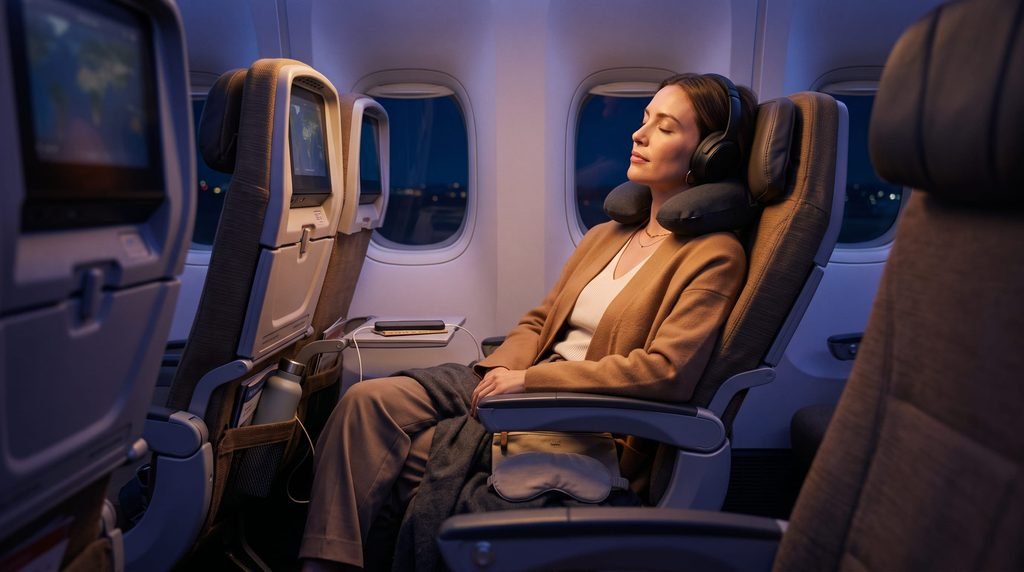
You cannot change the seat dimensions, but you can control your environment.
Control the temperature
Use layers rather than relying entirely on the cabin temperature.
Control the noise
Use headphones and keep earplugs as a backup.
Control the light
Use an eye mask when sleeping.
Control your entertainment
Download content before boarding.
Control your organization
Keep your essentials in one accessible pouch or section.
Control your hydration
Bring an empty bottle and refill it when practical.
Control your routine
Think about the destination time zone and use the flight to begin adjusting your schedule when appropriate.
The goal is not to recreate a hotel room inside economy class.
It is to eliminate as many small sources of discomfort as possible.
Final Long Haul Flight Essentials Checklist
If you want one master checklist, use this:
Documents
- ☐ Passport
- ☐ Boarding pass
- ☐ Visa/entry documents
- ☐ Travel insurance information
- ☐ Hotel/transport details
- ☐ Pen
Sleep
- ☐ Neck pillow
- ☐ Eye mask
- ☐ Earplugs
- ☐ Noise-canceling headphones
Electronics
- ☐ Smartphone
- ☐ Charging cable
- ☐ Power bank
- ☐ Tablet/e-reader if needed
- ☐ Universal travel adapter if needed
- ☐ Offline entertainment
Clothing
- ☐ Comfortable trousers
- ☐ Breathable top
- ☐ Lightweight sweater/cardigan
- ☐ Comfortable socks
- ☐ Comfortable walking shoes
- ☐ Scarf or wrap
Hygiene
- ☐ Toothbrush
- ☐ Travel toothpaste
- ☐ Lip balm
- ☐ Moisturizer
- ☐ Hand sanitizer
- ☐ Tissues
Health
- ☐ Prescription medication
- ☐ Essential personal medicines
- ☐ Glasses
- ☐ Contact lenses/supplies
- ☐ Necessary medical equipment
Food & Hydration
- ☐ Empty reusable water bottle
- ☐ Small snacks
Organization
- ☐ Electronics pouch
- ☐ Hygiene pouch
- ☐ Document pouch
- ☐ Small reusable bag for trash or dirty items
FAQs
1. What should I pack for a 12-hour economy flight?
Pack a compact combination of sleep and comfort items, headphones, phone and charging accessories, approved power bank, medication, basic toiletries, a light layer, water bottle and snacks. Keep these items in your personal item rather than checked luggage.
2. What should I wear on a long-haul economy flight?
Wear comfortable, breathable clothing in layers. Relaxed trousers, a breathable top, comfortable socks, supportive shoes and a lightweight sweater or cardigan provide flexibility when the cabin temperature changes.
3. Can I bring a power bank on a long-haul flight?
Yes, power banks are generally permitted in carry-on baggage under applicable aviation rules, but they must not be packed in checked luggage. Battery capacity and airline-specific restrictions apply. In the U.S., FAA guidance generally permits lithium-ion batteries up to 100 Wh, while larger batteries require additional conditions or approval.
4. How do I sleep comfortably in economy class?
Use a combination of neck support, an eye mask, earplugs or noise-canceling headphones, comfortable layers and a suitable sleeping position. Avoid relying on bulky accessories that consume most of your personal-item space.
5. What should I keep in my personal item on a long flight?
Keep your passport, phone, headphones, charging cable, power bank, medication, essential toiletries, eye mask, neck pillow, light layer, snacks and other items you may need during the flight. Do not place critical items in checked baggage.
Conclusion
The best long haul flight essentials for economy class are the items that solve predictable problems without adding unnecessary weight. Focus on sleep, noise, temperature, hydration, entertainment, hygiene, medication, power and easy organization.
You do not need a suitcase full of travel gadgets to make economy class more comfortable. A thoughtfully organized personal item, a few reliable comfort essentials and a little preparation before boarding can make a long journey significantly easier.
Before every flight, check your airline’s current baggage and battery policies, review the security rules for your departure airport, download your entertainment and keep your most important items within easy reach.
1 comment