
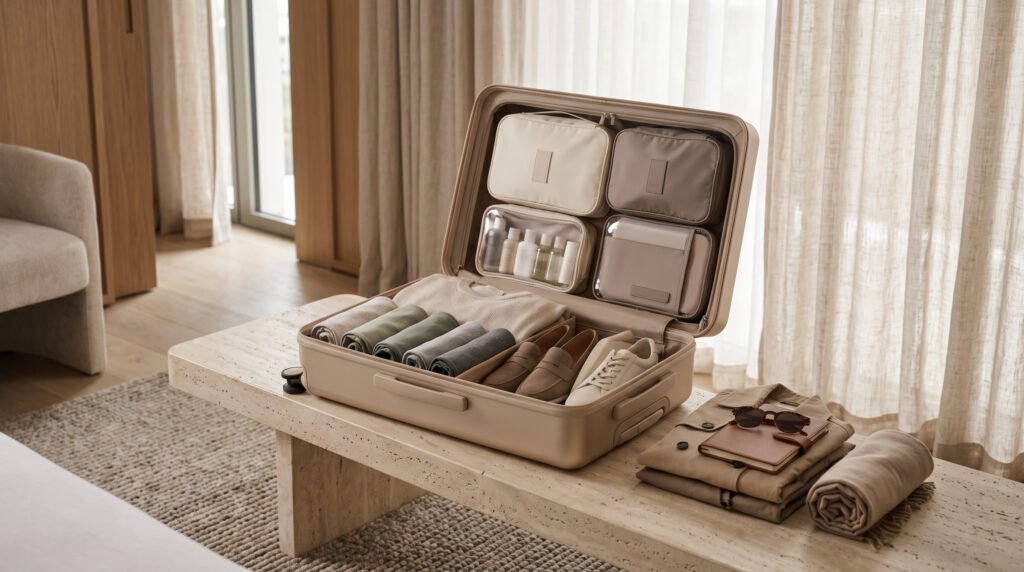
If your suitcase is always bursting at the seams before a trip begins, these space saving luggage packing hacks for overpackers can help you fit everything you genuinely need without struggling with an overstuffed bag. The secret is not simply folding clothes more tightly. It is choosing versatile items, reducing unnecessary bulk, organizing your belongings strategically, and making better use of the space inside your luggage.
Overpacking often starts with good intentions. You want an outfit for every occasion, extra shoes for different activities, backup toiletries, and clothing for weather that might never arrive. Before long, your suitcase is full, but you still feel as though something is missing.
A smarter packing system helps you break that cycle. With the right techniques, you can create more room for essentials, keep your belongings organized, reduce unnecessary baggage weight, and make unpacking easier at your destination.
Quick Answer: The Best Space-Saving Packing Hacks at a Glance
The fastest way to save luggage space is to pack fewer bulky items, roll suitable clothing, use packing cubes, choose lightweight layers, and eliminate unnecessary duplicates. Start by planning outfits around a consistent color palette, then arrange your belongings according to size, weight, and frequency of use.
Use this quick checklist before closing your suitcase.
- Choose clothing that works in multiple outfits.
- Roll T-shirts, casual trousers, pajamas, and lightweight knitwear.
- Fold structured garments that wrinkle easily.
- Use appropriately sized packing cubes to organize clothing.
- Pack socks and small accessories inside suitable shoes.
- Wear your bulkiest shoes and outerwear during transit when practical.
- Replace full-size toiletries with travel-size containers when permitted.
- Remove duplicate items and unnecessary emergency extras.
- Keep dirty laundry in a separate, compact bag.
- Weigh your luggage and check your airline’s baggage limits.
The most important rule: Reduce what you pack before trying to compress it. Compressing unnecessary belongings still leaves you carrying unnecessary weight.
1. Plan Your Outfits Before Packing Anything
One of the biggest reasons overpackers run out of luggage space is that they pack individual clothing items instead of complete outfits. A shirt looks useful on its own, but if it matches only one pair of trousers, it offers less flexibility than a top that works with several pieces.
Build a Mix-and-Match Travel Wardrobe
Choose a small group of coordinating colors so that most of your clothing works together. Neutrals such as black, navy, white, beige, gray, and olive are practical starting points, although your palette should reflect your personal style and destination.
For example, a four-day city break might include:
- Two versatile tops.
- One additional top for a different look.
- Two bottoms that coordinate with all three tops.
- One lightweight outer layer.
- One comfortable travel outfit.
- Sleepwear and appropriate underwear.
These pieces can create several combinations without requiring a separate outfit for every day. You can also change the appearance of an outfit with a scarf, belt, or small accessory rather than packing another complete look.
Follow the Two-Outfit Test
Before adding an item to your suitcase, ask yourself two questions:
- Can I wear this with at least two other items I am bringing?
- Is there a realistic occasion during this trip when I will use it?
If the answer to both questions is no, reconsider packing it.
This approach is particularly useful for people who pack several statement pieces, special-occasion outfits, or clothing that looks attractive but is difficult to combine.
Plan for Laundry
For trips lasting a week or longer, consider washing selected garments during the journey rather than packing a fresh outfit for every day. Quick-drying underwear, lightweight tops, and easy-care fabrics can make this strategy more practical.
You do not need to wash every item. Even one small laundry session can reduce the amount of clothing required for a longer trip.
2. Roll, Fold, or Bundle Your Clothes?
Different packing methods work better for different garments. Rolling is useful for many casual clothes, folding can protect structured pieces, and bundling can reduce some creases when several garments are arranged together.

Rolling: Best for casual clothing
Roll T-shirts, leggings, pajamas, casual dresses, and many lightweight trousers into compact cylinders. Arrange them side by side to see what you have and fill gaps around larger items.
Best for: everyday outfits, soft fabrics, and easy access.

Folding: Best for structured garments
Fold button-down shirts, tailored trousers, blazers, and delicate pieces according to their construction. Use tissue paper or a smooth packing layer between delicate garments if it helps minimize friction and creasing.
Best for: formal clothing, crisp collars, and wrinkle-prone fabrics.

Bundling: Best for selected outfits
Layer garments around a soft central item, then fold the outer pieces around the bundle. This can help distribute pressure and reduce some creases, but it is less convenient when you need to retrieve individual items frequently.
Best for: coordinated outfits and trips where you unpack infrequently.
Does Rolling Clothes Actually Save Space?
Rolling can make clothing easier to arrange and reduce gaps between items. However, it does not automatically make every garment occupy less volume than folding it. The outcome depends on the fabric, garment shape, and how tightly everything is packed.
For the best results, combine methods instead of treating one as universally superior. Roll soft, casual pieces; fold structured clothing; and avoid compressing delicate garments so tightly that they become difficult to wear without ironing.
3. Use Packing Cubes Without Overfilling Them

Packing cubes are among the most useful tools for travelers who struggle to keep their suitcases organized. They separate clothing into manageable groups, make items easier to locate, and help prevent your luggage from becoming disorganized every time you need a clean shirt.
They do not necessarily reduce the total volume of your belongings. Their value comes from organization and, when used carefully, controlled compression.
Assign Each Cube a Purpose
Rather than putting random items into every cube, give each one a clear function.
| Packing cube | What to put inside |
|---|---|
| Small cube | Underwear, socks, and small accessories |
| Medium cube | T-shirts, lightweight tops, and sleepwear |
| Large cube | Casual trousers, dresses, or bulkier clothing |
| Laundry pouch | Worn clothing awaiting washing |
| Slim pouch | Belts, scarves, and other small accessories |
You do not need every size. One medium cube and one small cube may be sufficient for a short trip, while longer journeys or family travel may benefit from a more flexible system.
Avoid the Overstuffed Cube Trap
A cube that is packed until its zipper strains is not necessarily saving you space. It can create awkward shapes, make the suitcase difficult to close, and encourage you to bring more than you need.
Choose cubes that fit the dimensions of your luggage, and leave enough flexibility to close them without excessive force.
For additional organization, read a related guide to choosing packing cubes for one-bag travel and match your storage system to your suitcase rather than buying a large set automatically.
4. Use Compression Bags for Bulky Clothing
Compression bags can be especially helpful when you need to pack sweaters, fleece layers, or other soft garments that take up substantial space.
Unlike ordinary packing cubes, some compression bags allow you to expel excess air, reducing the volume of soft contents. Vacuum-style bags may achieve greater compression, but they are not always convenient for travel.
When Compression Bags Make Sense
Consider using them for:
- Bulky sweaters and fleece garments.
- Soft jackets that compress without damage.
- Spare bedding or other suitable soft items on family trips.
- Seasonal clothing that occupies a large part of your luggage.
Avoid excessive compression for structured jackets, delicate knitwear, garments that crease easily, or items whose shape could be damaged.
Remember the Weight Trade-Off
Compression reduces volume, not mass. A compressed bag of clothing can still exceed your airline’s weight allowance, and tightly compressed items may expand when you open them.
Compression bags can also make your suitcase harder to organize if all your clothing is packed into one large block. Keep frequently used garments separate and leave room for items you will need during the journey.
5. Pack Shoes Without Wasting Valuable Space

Shoes can occupy a surprising amount of suitcase space because they are bulky and difficult to compress. Overpackers often bring several pairs for activities that overlap, such as sightseeing, casual dinners, and shopping.
The solution is to select shoes that perform multiple functions.
Limit Shoes to a Clear Purpose
For many short trips, two pairs may be enough: one comfortable walking pair and another suitable for dinners, events, or specific activities. Longer trips, specialist sports, hiking, formal occasions, and unusual weather may justify an additional pair.
Before packing shoes, consider:
- Can one pair handle most of my planned activities?
- Are the shoes comfortable enough for the amount of walking involved?
- Do I genuinely need a separate pair for every outfit?
- Will the destination’s weather or terrain require specialist footwear?
Do not sacrifice foot comfort or safety just to meet an arbitrary shoe limit.
Fill the Space Inside Your Shoes
Place clean socks, rolled belts, or small accessories inside suitable shoes to use otherwise empty space.
Keep anything placed inside shoes clean and contained in a small pouch when appropriate. Avoid storing toiletries or fragile electronics inside footwear, where leaks, odors, or pressure could cause problems.
Put shoes in lightweight shoe bags or reusable fabric pouches to protect your clothing from dirt. Position heavier pairs near the suitcase’s wheels when packing rolling luggage.
6. Choose Lightweight Fabrics and Layer Strategically
Clothing material affects both the amount of space your wardrobe occupies and the weight you carry.
A thick cotton sweatshirt, for example, may take up considerably more room than a lightweight insulating layer. Several bulky garments can quickly crowd out other essentials.
Build a Lightweight Layering System
Instead of packing several heavy pieces for different temperatures, choose layers that work together.
A practical system may include:
- A breathable base layer.
- A lightweight sweater or fleece.
- A weather-resistant outer shell.
- One warmer layer if the forecast requires it.
This system can adapt to changing temperatures without requiring a separate bulky outfit for every condition.
Choose Fabrics According to Your Destination
| Fabric or garment type | Packing advantage | What to consider |
|---|---|---|
| Lightweight synthetics | Often dry quickly and pack compactly | Breathability and odor retention vary |
| Merino wool | Useful for temperature changes and repeat wear | Can be expensive and needs appropriate care |
| Lightweight cotton | Comfortable for many everyday situations | May dry slowly and wrinkle |
| Thin fleece | Provides warmth without some heavy knitwear | Can still occupy significant volume |
| Linen | Comfortable in warm climates | Creases easily and may need extra care |
No single fabric is ideal for every trip. Hot, humid destinations call for different choices from cold-weather holidays, business travel, or hiking trips.
For winter travel, wear a suitable coat during transit when comfortable and layer lighter garments underneath. For tropical destinations, prioritize breathable fabrics and clothing that dries efficiently.
7. Wear Your Bulkiest Items During Transit
One simple way to free up suitcase space is to wear some of the items that would otherwise occupy the most room.
A jacket, heavier walking shoes, or a sweater can be practical travel-day choices, particularly when your departure airport is cool or your destination requires warmer clothing.
However, wearing every bulky item is not a comfortable or useful strategy. Choose garments that suit the temperature and your travel plans.
Try this approach:
- Wear your largest practical pair of shoes.
- Carry or wear your outer layer if it is comfortable.
- Choose trousers that coordinate with your travel wardrobe.
- Keep a lighter layer accessible for changing cabin temperatures.
- Avoid wearing so many layers that security screening or boarding becomes inconvenient.
Airline baggage policies can differ, and items carried separately may still be subject to restrictions. Check the specific rules for your ticket rather than assuming that wearing an item automatically resolves every baggage concern.
8. Reduce Toiletry Bulk With a Travel-Size System

Full-size toiletries are an easy way to waste luggage space, especially when you pack a separate product for every possible situation.
A compact toiletry kit should contain the products you are likely to use, in quantities appropriate for the duration of your trip.
Transfer Only What You Need
For suitable products, use clean, compatible, leak-resistant travel containers. Label containers clearly, and test the closures before placing them in your luggage.
A basic toiletry kit might include:
- Toothbrush and toothpaste.
- A small amount of shampoo and conditioner.
- Cleanser and moisturizer.
- Deodorant.
- Sunscreen appropriate for your destination.
- Essential personal-care items.
- Any necessary medications in suitable packaging.
Do not decant products if doing so compromises their stability, hygiene, or original labeling requirements. Some products and medications are better kept in their original containers.
Check Airport Liquid Restrictions
If you are flying, check the liquid, aerosol, and gel restrictions that apply at your departure airport and on your route. Security requirements can differ by country, airport, and screening system.
For flights departing from airports that apply the common US TSA carry-on liquids rule, individual containers generally must hold no more than 3.4 ounces (100 milliliters), with qualifying containers fitting within one quart-sized bag. Exceptions and special procedures may apply to certain essential items.
Do not assume that a container is permitted merely because it is partially empty. The container’s capacity matters under rules that limit individual container size.
Before departure, consult the current official guidance from the relevant airport security authority and your airline.
9. Use Every Suitable Gap in Your Suitcase
The shape of your luggage matters. A suitcase contains corners, narrow spaces, and areas between larger objects that can go unused when you pack everything in large stacks.
Follow a Layer-by-Layer Packing Method

Layer 1: Build a stable base
Place heavier, flatter items near the bottom of a rolling suitcase, close to the wheels. This helps balance the bag and prevents lighter clothing from bearing the weight of harder objects.

Layer 2: Arrange the main clothing
Add packing cubes, rolled garments, and folded pieces. Fit smaller items into suitable gaps rather than forcing everything into one large compartment.

Layer 3: Keep essentials accessible
Place items you may need first near the top or in an easy-to-reach pocket. Keep documents, medications, valuables, and essential electronics secure and accessible according to your travel requirements.
Use Empty Space Carefully
Suitable small items can fill gaps around packed clothing. Socks can go inside shoes, while belts can be placed around the perimeter of a suitcase or along a suitable garment fold.
Do not fill every gap simply because it exists. Some space is useful for preventing excessive pressure on fragile items, allowing the suitcase to close naturally, and accommodating belongings you acquire during your trip.
10. Pack Electronics and Accessories More Efficiently
Small accessories are easy to underestimate because each one seems insignificant. Chargers, adapters, headphones, cables, power banks, and spare accessories can collectively take up considerable space.
Create One Compact Tech Kit
Use a slim pouch to keep essential electronics together. Bring the cables and adapters that match the devices you are actually taking, rather than packing several interchangeable extras.
Before departure, check your device requirements and destination plug types. A compact multiport charger may replace several separate chargers if it safely supports your devices.
Consider this checklist:
- Phone charging cable.
- Appropriate wall adapter or travel plug.
- Headphones or earbuds.
- Laptop charger if needed.
- Power bank if required.
- Essential device accessories.
Power banks and spare lithium batteries are subject to airline-specific and aviation safety restrictions. Check current rules for permitted capacity, carry-on placement, and any quantity limits. Do not assume they can be packed in checked luggage.
Keep valuable electronics protected against impact and moisture, and avoid placing fragile items where they may be crushed by heavy belongings.
11. Stop Packing for Imaginary Scenarios
One of the most effective space-saving hacks has nothing to do with folding or luggage accessories: stop packing for every situation you can imagine.
Overpackers often bring backup outfits, multiple toiletries, extra shoes, and duplicate accessories because they want to be prepared. Preparation is useful, but packing for unlikely scenarios can crowd out the items that matter.
Use a Three-Category Packing Review
Divide your planned belongings into three groups.
| Category | Examples | What to do |
|---|---|---|
| Essential | Travel documents, necessary medication, weather-appropriate clothing | Pack |
| Useful | A versatile extra layer, one special-occasion outfit when planned | Keep if justified |
| Just in case | Unused duplicates, extra outfits for hypothetical events | Remove unless there is a realistic need |
For example, if your itinerary includes walking tours, casual restaurants, and one planned dinner, you probably do not need separate shoes for every activity. A versatile pair of walking shoes and one suitable alternative may be enough.
The same principle applies to beauty products, accessories, and clothing. Choose the items that solve a real problem rather than those that merely make you feel prepared.
Try the One-Item Removal Rule
Once your suitcase is packed, remove at least one nonessential item from each major category you have overpacked.
That could mean one extra top, an unnecessary toiletry, a duplicate charging cable, or an accessory that works with only one outfit.
If you struggle to decide, ask whether replacing the item at your destination would be easy and inexpensive if you unexpectedly needed it. This test is not suitable for essential medications, important documents, specialized equipment, or items that may be difficult to obtain.
12. Adjust Your Packing Strategy to Your Trip
The best packing system depends on where you are going, what you plan to do, and which baggage allowance you have purchased.
| Trip type | Space-saving priority | Practical strategy |
|---|---|---|
| Weekend getaway | Reduce clothing duplicates | Pack coordinated outfits and two versatile pairs of shoes if needed |
| One-week city trip | Mix-and-match wardrobe | Use a small set of coordinating garments and plan for laundry |
| Tropical beach holiday | Lightweight clothing | Prioritize quick-drying pieces and limit bulky footwear |
| Winter vacation | Manage bulky layers | Wear suitable outerwear and use compact storage for soft layers |
| Business trip | Protect formal clothing | Fold or bundle structured garments carefully and minimize spare shoes |
| Family holiday | Separate everyone’s essentials | Use labeled cubes and share appropriate toiletries |
| Carry-on-only journey | Control size and weight | Check airline dimensions, weight limits, and restricted items before packing |
For carry-on travel, remember that a suitcase can be within its dimensions but still exceed the permitted weight. Some airlines also impose separate limits for personal items, and allowances can vary by route, ticket type, and operating carrier.
Do not compress belongings so tightly that the suitcase expands beyond its permitted dimensions or becomes difficult to close.
13. Common Packing Mistakes That Waste Space
Even well-organized luggage can become unnecessarily bulky when a few common mistakes go unchecked.
Packing Too Many “Backup” Outfits
An extra outfit can be useful for a long journey, an event, or unpredictable weather. Several complete backup outfits, however, often duplicate clothing you already have.
Choose backups that work with your existing wardrobe instead of bringing entirely separate combinations.
Bringing Too Many Shoes
Shoes are among the least compressible items in a suitcase. Select them according to your itinerary, terrain, and comfort requirements rather than individual outfits.
Buying Packing Accessories Before Editing Your Belongings
Cubes and compression bags can improve organization, but they cannot compensate for a suitcase full of unnecessary items. Review your packing list before investing in more accessories.
Ignoring the Weight Limit
A compact suitcase can still be heavy, particularly when it contains multiple shoes, toiletries, books, or electronics. Check the airline’s weight allowance and weigh your packed luggage before leaving home.
Leaving No Room for the Return Journey
Souvenirs, gifts, and worn clothing can make your return bag harder to organize. Leave a modest amount of available space, or plan to repack after washing your clothes.
For a longer journey, a lightweight laundry pouch helps separate used clothing without requiring an entirely separate compartment.
14. A 15-Minute Suitcase Space-Saving Checklist
Use this final review before closing your luggage. It is particularly helpful if you tend to add last-minute items after everything seems finished.
Packing readiness
0/16
ClothingEvery top coordinates with multiple bottomsBulky or duplicate outfits have been removedRolling and folding methods match the garmentsWeather-appropriate layers are included
Shoes and toiletriesEach pair of shoes serves a clear purposeSuitable small items fill shoe interiorsToiletries are travel-sized where practicalLeak-prone products are securely contained
Organization and baggage rulesPacking cubes are not overstuffedDirty laundry has a designated pouchAirline size and weight limits are checkedRestricted items and battery rules are reviewed
Final reviewEssential medication and documents are accounted forFrequently needed items are accessibleThe suitcase closes without excessive forceThere is a plan for return-trip belongings
Reset checklistCopy checklist
This checklist is designed to catch the most common sources of wasted space before you leave home. If your suitcase is still difficult to close, remove unnecessary items before trying to force the zipper.
FAQs
1. What is the best way to save space when packing a suitcase?
Start by reducing the number of items you bring, then organize the remaining belongings with a mix-and-match wardrobe, rolled casual clothing, folded structured garments, and appropriately sized packing cubes. Use compression bags for suitable bulky fabrics when extra volume reduction is necessary.
2. Is it better to roll or fold clothes to save luggage space?
Neither method is always better. Rolling works well for many soft, casual garments and makes clothing easy to arrange, while folding is often preferable for structured shirts, tailored clothing, and pieces that wrinkle easily. Choose the method that suits each garment.
3. Do packing cubes actually make a suitcase hold more?
Packing cubes improve organization and can make better use of available space, particularly when clothing is arranged efficiently. Ordinary cubes do not inherently reduce clothing volume, although some compression-style cubes can reduce the space occupied by suitable garments.
4. How can I pack a week’s worth of clothes in a carry-on?
Plan a coordinated wardrobe with versatile tops and bottoms, a practical outer layer, sleepwear, and enough underwear for your needs. Wear bulky items during transit when appropriate, limit shoes, and plan for laundry if necessary. Check your airline’s carry-on dimensions and weight restrictions before departure.
5. How do I stop overpacking for a vacation?
Build a packing list around your actual itinerary, expected weather, and planned activities. Remove duplicate items, avoid packing for unlikely scenarios, and select garments that work in multiple outfits. Before closing your suitcase, review every item and remove anything without a clear purpose.
Conclusion
The most effective space saving luggage packing hacks for overpackers combine thoughtful planning with practical organization. Rolling clothes, using packing cubes, compressing suitable bulky garments, filling empty spaces, and choosing lightweight layers can all help you make better use of your suitcase.
However, the biggest improvement comes from changing what you pack in the first place. A coordinated wardrobe, a realistic toiletry kit, versatile shoes, and a clear understanding of your itinerary will usually save more space than any single packing accessory.
Before your next trip, start with a list, organize your outfits, and pack only what supports your plans. Check your airline’s baggage requirements, leave room for the return journey, and resist the urge to add unnecessary extras at the last minute.
A well-packed suitcase should make traveling easier, not create another problem to manage.
1 comment