
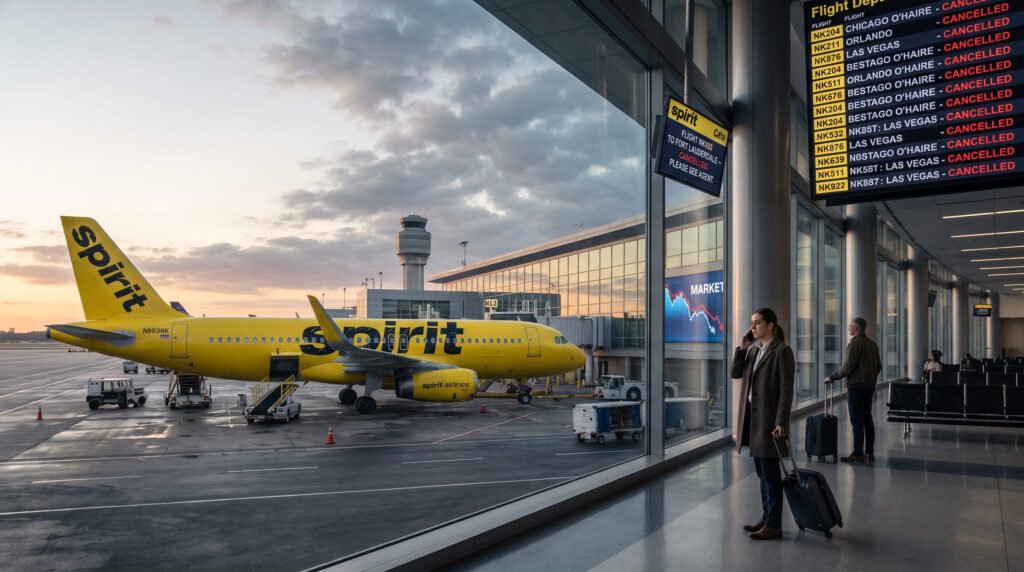
Spirit Airlines shut down all flight operations on May 2, 2026, bringing an end to more than three decades of service as one of America’s best-known ultra-low-cost carriers. The shutdown followed a second Chapter 11 bankruptcy, an extensive restructuring effort, and a last-minute deterioration in the company’s financial outlook. Spirit said sharply higher oil prices and a lack of additional funding left it without a viable path to continue operating.
The Spirit Airlines shutdown was not caused by one single problem. Years of financial pressure, weak revenue conditions, high operating costs, fleet and network challenges, and the difficult economics of ultra-low-cost air travel had already weakened the airline. The final blow came when fuel prices rose sharply and Spirit could not secure the hundreds of millions of dollars in additional liquidity it said was necessary to keep the business operating.
Quick Answer: Why Did Spirit Airlines Shut Down?
Spirit Airlines ceased operations because its financial position deteriorated beyond what its restructuring could solve. Although the company reached an agreement with creditors in March 2026 that was designed to support a future emergence from Chapter 11, rapidly rising fuel prices significantly changed its financial outlook.
By May 2, Spirit said it had no additional funding available and could not obtain the hundreds of millions of dollars in liquidity required to continue. It therefore began an orderly wind-down of operations, canceled all flights and instructed passengers not to go to the airport.
When Did Spirit Airlines Shut Down?
The official shutdown began on May 2, 2026, when Spirit Aviation Holdings announced that it was immediately beginning an orderly wind-down. The company canceled all Spirit flights and told affected passengers not to travel to the airport for those canceled services.
This was the final stage of a long financial restructuring process rather than a sudden decision made overnight. Spirit had already spent years attempting to reduce debt, control costs, adjust its network and secure enough financing to remain a viable airline.
Spirit Airlines Shutdown Timeline: 2024 to 2026
Understanding the timeline is important because Spirit’s collapse happened through several stages. The airline first entered Chapter 11 in November 2024 and successfully emerged from that bankruptcy in March 2025 after completing a court-approved restructuring.
However, the financial recovery did not last. Spirit filed for another Chapter 11 bankruptcy on August 29, 2025, placing the airline back under bankruptcy-court protection while it searched for a sustainable restructuring solution.
In March 2026, Spirit announced a restructuring support agreement and plan of reorganization, with the expectation that it could emerge from Chapter 11 by early summer. Less than two months later, the company instead began its final wind-down.
What Happened to Spirit Airlines in 2024?
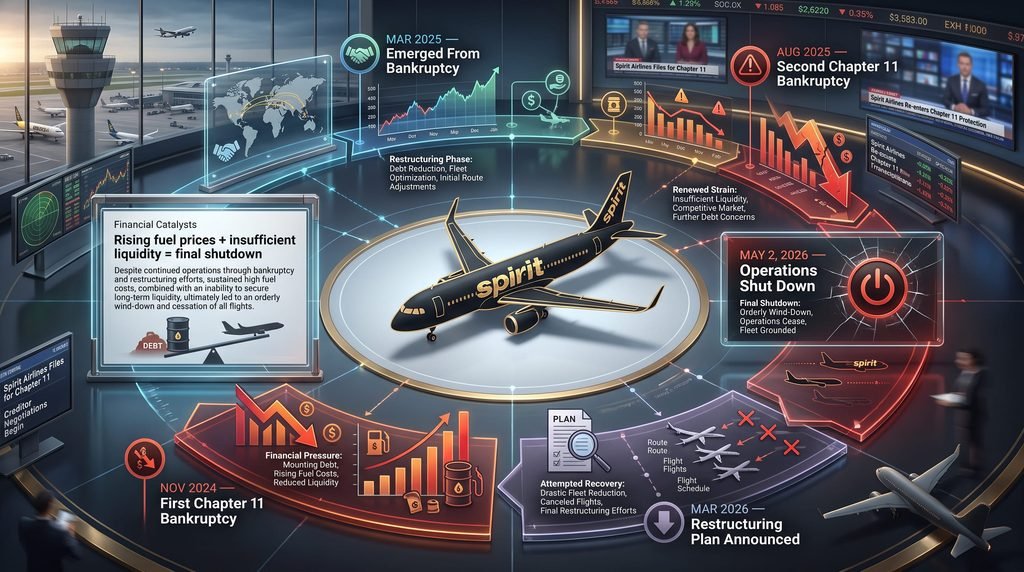
Spirit entered its first recent Chapter 11 bankruptcy in November 2024 after facing significant financial and competitive pressure. The airline subsequently completed a court-approved restructuring and emerged from that bankruptcy on March 12, 2025.
The restructuring reduced certain debt obligations and changed the company’s financial structure. However, Spirit continued to face difficult market conditions, including elevated domestic capacity and weak demand for domestic leisure travel, which contributed to a challenging pricing environment and lower revenues.
Why Did Spirit Airlines File for Bankruptcy Again in 2025?
Spirit returned to Chapter 11 in August 2025 because its earlier restructuring had not solved the underlying financial and operational problems. The company was dealing with a difficult revenue environment while also attempting to manage aircraft, financing, lease obligations and operating costs.
During the second bankruptcy, Spirit obtained debtor-in-possession financing and continued operating while developing another restructuring plan. The company’s survival depended heavily on securing sufficient liquidity and successfully implementing the proposed restructuring.
Spirit’s March 2026 Restructuring Plan
The March 2026 restructuring agreement initially appeared to offer Spirit a path forward. On March 13, the company announced a Restructuring Support Agreement and Plan of Reorganization, saying it expected to emerge from Chapter 11 by early summer.
The proposed plan included a smaller, more focused fleet and network. Spirit planned to right-size its fleet to approximately 76–80 aircraft by the third quarter of 2026, while concentrating capacity on routes and periods with stronger demand.
Why Did the Restructuring Plan Fail?
The critical problem was that Spirit’s financial circumstances changed before the restructuring could be completed. The company said that the recent material increase in oil prices had significantly damaged its financial outlook.
Spirit also stated that continuing the business would require hundreds of millions of dollars in additional liquidity, but that financing was not available. Without enough cash to fund operations and complete the restructuring, the airline concluded that an orderly wind-down was unavoidable.
Rising Fuel Prices Were the Final Trigger
Fuel is one of the most important variable expenses for an airline, making sudden oil-price increases particularly damaging to carriers operating with limited financial flexibility. For Spirit, the timing was especially difficult because the airline was already in bankruptcy and dependent on restructuring financing.
According to Spirit’s May 2 announcement, the sudden and sustained rise in fuel prices in the preceding weeks ultimately left the company without a viable path forward. This makes fuel costs an important part of the shutdown story, but they should be understood as the final trigger rather than the only underlying cause.
Spirit Airlines’ Ultra-Low-Cost Business Model
Spirit became famous for its ultra-low-cost carrier (ULCC) model. The airline attracted customers by keeping base fares low and charging separately for many optional services, including baggage, seat selection and other travel extras.
This model helped Spirit compete aggressively on price and created a recognizable brand among budget-conscious travelers. But the same strategy also left the company highly sensitive to changes in fuel prices, labor expenses, aircraft costs, maintenance requirements and ticket revenue.
Why Low-Cost Airlines Can Still Fail
A low ticket price does not necessarily mean an airline has a healthy financial position. Airlines must continuously cover aircraft ownership or leasing costs, maintenance, labor, airport fees, fuel, insurance, technology, distribution and other operating expenses.
When fares remain under pressure while costs increase, an airline can lose money even when its aircraft continue carrying substantial numbers of passengers. Spirit’s experience demonstrates how difficult it can be for a carrier to maintain a sustainable cost structure while competing primarily on low fares.
Competition Made Spirit’s Situation More Difficult
Spirit operated in an extremely competitive U.S. airline market where consumers can compare fares across numerous carriers. Traditional airlines also expanded their basic-economy products, while other low-cost carriers competed for price-sensitive passengers.
Spirit therefore faced the challenge of preserving its low-cost advantage while generating enough revenue to support its aircraft, workforce, debt obligations and network. Its March 2026 restructuring plan attempted to respond by focusing capacity on stronger demand periods and markets.
Fleet and Network Restructuring
Spirit’s proposed 2026 restructuring was not simply about reducing debt. The company planned to reshape its physical operation as well, including a smaller fleet and a more demand-focused network.
The March plan envisioned approximately 76–80 aircraft by Q3 2026 and emphasized higher aircraft utilization during peak periods while reducing less productive off-peak flying. This strategy illustrates how airlines can respond to financial pressure by matching capacity more closely with passenger demand.
What Happened to Spirit Airlines’ Employees?
The shutdown affected pilots, flight attendants, mechanics, dispatchers, airport employees, customer-service workers, baggage teams and many other aviation professionals.
Spirit’s own May 2 announcement acknowledged the work of its employees and labor partners during the restructuring process. The shutdown therefore represented not only the end of an airline brand but also a major employment disruption across the company’s network.
What Happened to Spirit Airlines Passengers?

For passengers holding tickets for canceled flights, the shutdown created an immediate need for refunds and alternative travel arrangements. Spirit stated that tickets purchased directly from the airline using a credit or debit card would be automatically refunded to the original payment method.
Passengers who booked through a travel agent were instructed to contact the agency directly. Spirit also said that treatment of certain other forms of payment, including vouchers, credits and Free Spirit points, would be addressed through the bankruptcy process.
What Should Travelers Do If Their Spirit Flight Was Canceled?
Passengers affected by the shutdown should preserve their booking confirmation, receipts and payment records and follow the applicable refund or bankruptcy instructions. Travelers who purchased through a third-party travel agency should work with that agency rather than assuming the airline will process the refund directly.
If the canceled Spirit itinerary was part of a larger trip, passengers should also review hotel reservations, connecting flights, rental cars and other prepaid travel arrangements separately. A canceled airline ticket does not automatically cancel every other reservation connected to the trip.
Will Spirit Airlines Come Back?
As of the May 2, 2026 shutdown announcement, Spirit had begun an orderly wind-down of operations, rather than continuing toward the previously planned emergence from Chapter 11. That means travelers should not treat Spirit as an operating passenger airline simply because earlier restructuring plans discussed a future relaunch or emergence.
The company’s bankruptcy process has continued beyond the flight shutdown. In August 2026, a U.S. bankruptcy court postponed a hearing concerning Google’s proposed $10 million purchase of certain Spirit internal business data after the Association of Flight Attendants-CWA objected to the sale. The hearing was rescheduled for September 9, 2026.
What Does Spirit Airlines’ Collapse Mean for U.S. Air Travel?
Spirit’s disappearance removes one of the most recognizable ultra-low-cost brands from the U.S. airline market. Its presence had helped put intense pressure on competing airlines to offer low introductory fares and compete for price-sensitive passengers.
The shutdown could therefore affect more than Spirit’s former customers. Changes in low-cost airline competition can influence route availability, fare strategies, ancillary fees and capacity decisions across the broader U.S. aviation market.
What Can Travelers Learn From the Spirit Airlines Shutdown?
The most important lesson is that an airline’s low price does not necessarily tell you how financially stable the company is. Travelers should consider the airline’s current operating status, refund policies, schedule reliability and flexibility before making important travel plans.
For expensive or time-sensitive journeys, flexible tickets, travel insurance where appropriate, backup transportation options and careful monitoring of flight status can reduce the impact of unexpected airline disruptions.
Spirit Airlines Shutdown vs Bankruptcy: What’s the Difference?
Bankruptcy does not automatically mean an airline stops flying. Chapter 11 generally allows a company to continue operating while it attempts to restructure its finances under court supervision.
Spirit demonstrated this twice: it operated through its 2024 Chapter 11 case and emerged in March 2025, then continued operating during its second Chapter 11 case filed in August 2025. The actual shutdown occurred later, on May 2, 2026, when the company determined it could no longer continue operations and began an orderly wind-down.
Why Spirit’s Shutdown Is Different From an Airline Merger
An airline can disappear from the market through a merger or acquisition without completely ending the underlying aviation business. A shutdown and liquidation are different because the carrier ceases its scheduled passenger operations rather than transferring its network into another airline.
Spirit’s May 2026 announcement specifically described the process as an orderly wind-down of operations, with all flights canceled. That makes the event fundamentally different from a conventional airline merger or rebranding.
The Bigger Lesson for the Airline Industry
Spirit’s collapse demonstrates how multiple pressures can compound over time. Weak pricing, high operating expenses, aircraft and maintenance costs, financing requirements, fuel-price volatility and changing passenger demand can each create pressure; together, they can become overwhelming.
The most important point is that Spirit Airlines did not simply fail because people stopped flying. Its shutdown resulted from a much more complicated interaction between revenue, costs, liquidity, debt, restructuring and external market conditions.
FAQs
1. Why did Spirit Airlines shut down in 2026?
Spirit shut down after its financial position deteriorated, with rising fuel prices and insufficient additional liquidity making continued operations unsustainable.
2. When did Spirit Airlines officially stop flying?
Spirit began its orderly wind-down and canceled all flights on May 2, 2026.
3. Was Spirit Airlines already bankrupt before the shutdown?
Yes. Spirit filed for Chapter 11 again on August 29, 2025, after previously emerging from a 2024 bankruptcy in March 2025.
4. Will passengers get refunds for canceled Spirit flights?
Spirit said qualifying direct credit- or debit-card purchases would be automatically refunded to the original payment method, while other cases were subject to the bankruptcy process.
5. Is Spirit Airlines coming back?
Spirit’s May 2026 announcement moved the company from restructuring toward an orderly wind-down, so travelers should not currently assume that normal Spirit passenger operations will resume.
Conclusion
The Spirit Airlines shutdown in 2026 was the result of a prolonged financial struggle that ultimately became impossible to overcome. The airline had already gone through one Chapter 11 restructuring, filed for bankruptcy again in 2025 and spent early 2026 working toward another restructuring plan designed to create a smaller and more sustainable carrier.
That plan initially offered Spirit a potential path forward, but rapidly rising fuel prices and the lack of additional liquidity changed the situation dramatically. On May 2, 2026, Spirit canceled all flights and began an orderly wind-down of its operations.
For travelers, Spirit’s collapse is a powerful reminder that the airline industry depends on a delicate balance between low fares, passenger demand, fuel prices, aircraft utilization, operating costs, debt and available cash. The story is therefore much bigger than the disappearance of one budget airline: it is a real-world example of how quickly financial pressure can turn an airline restructuring into a complete shutdown.
1 comment