
SEO Title: How to Choose the Best One Bag Travel Backpack in 2026
Choosing a one bag travel backpack is less about finding the bag with the most compartments, highest capacity, or longest feature list. It is about finding a bag that matches the way you actually travel.
A 30-liter backpack may be perfect for a minimalist warm-weather trip but frustrating for winter travel. A spacious 40-liter pack can make a great carry-on in some situations but become a poor choice if its dimensions exceed your airline’s limits or its empty weight consumes too much of your baggage allowance.
The smartest approach is to work backward from your trip: what you carry, how you move, which airlines you use, how much walking you expect, and how willing you are to do laundry.
This guide explains how to choose the right capacity, dimensions, opening style, comfort system, organization, materials, security features, and price level—and how to test a backpack before trusting it with your next trip.
What Is One-Bag Travel?
One-bag travel means taking your essential belongings in one primary piece of luggage rather than checking a suitcase and carrying multiple large bags.
For many travelers, that means a backpack that can function as both their luggage and their carry-on.
The appeal is straightforward:
- You avoid waiting at baggage claim.
- There is less luggage to move between airports, hotels, trains, and buses.
- You can navigate stairs and uneven streets more easily.
- Your belongings stay consolidated.
- Packing becomes more deliberate.
- Short connections can be less stressful because your luggage stays with you.
But one-bag travel does not mean owning the smallest possible backpack.
The goal is to carry enough for your trip without creating unnecessary bulk and weight.
That distinction is important. A 25-liter bag that forces you to leave useful essentials behind isn’t automatically better than a well-designed 35-liter bag.
How to Choose a One Bag Travel Backpack
Before comparing brands or reading hundreds of reviews, make these decisions in order:
- Define your travel style.
- Estimate the capacity you actually need.
- Check the backpack’s external dimensions.
- Compare those dimensions with your airlines.
- Decide whether you need a personal item or overhead carry-on.
- Choose the right backpack opening and structure.
- Evaluate comfort and weight.
- Prioritize useful organization.
- Consider materials, weather resistance, and durability.
- Set a realistic budget.
- Test the loaded backpack before your trip.
This process prevents a common mistake: buying a backpack because it looks impressive on a product page and discovering later that it is uncomfortable, oversized, or difficult to pack.
1. Start With Your Travel Style
Your travel style should determine your backpack—not the other way around.
Consider these questions:
- How many days do you normally travel?
- Do you travel mostly in warm or cold climates?
- Do you wash clothes during longer trips?
- Do you carry a laptop?
- Do you travel with camera equipment?
- Do you move between several cities?
- Do you use budget airlines?
- Do you spend hours walking with your bag?
- Do you stay mainly in hotels, hostels, apartments, or a combination?
- Do you need space for business clothing?
A useful starting point is:
| Travel style | Approximate capacity | Main priority |
|---|---|---|
| Minimalist weekend | 20–28L | Low weight |
| Short vacation | 28–35L | Organization + airline compatibility |
| One-week trip | 30–40L | Balance of capacity and comfort |
| Extended travel | 35–40L+ | Comfort + packing efficiency |
| Digital nomad | 30–40L | Laptop protection + organization |
| Cold-weather travel | 35–45L | Clothing volume + compression |
| Strict budget-airline travel | 20–30L | External dimensions |
These are planning ranges, not universal rules. Your clothing, electronics, footwear, climate, and airline allowance can move you toward a smaller or larger bag.
The Most Important Question
Don’t ask:
“How many liters should I buy?”
Ask:
“What do I need to carry, and what is the smallest comfortable bag that can hold it?”
That question usually produces a better result.
2. Choose the Right Backpack Capacity
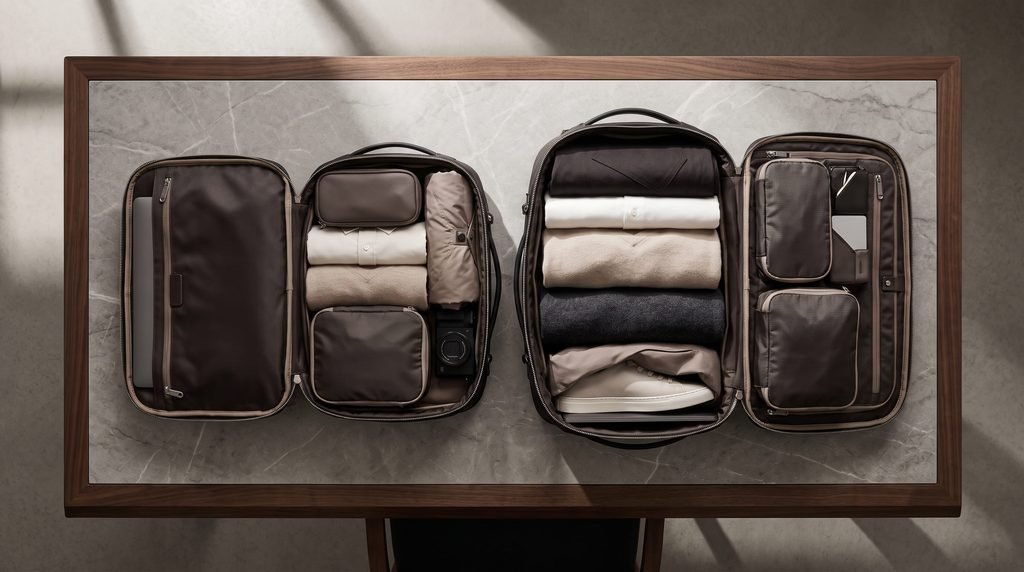
Travel backpacks are commonly described by liters, but capacity should be treated as a starting point rather than a guarantee of airline compatibility.
20–28 Liters: Minimalist Travel
This range works well for:
- weekend trips
- warm destinations
- travelers who pack very lightly
- short business trips
- personal-item strategies when dimensions allow
You will need disciplined packing.
A compact wardrobe, limited footwear, small toiletries, and lightweight electronics make this size much easier to manage.
28–35 Liters: The Versatile Middle Ground
For many travelers, this is an excellent compromise.
It can accommodate:
- several outfits
- toiletries
- a laptop
- chargers
- a light jacket
- travel documents
- compact shoes
It also gives you less temptation to fill unnecessary space.
35–40 Liters: More Forgiving
A 35–40L backpack makes sense when you need additional clothing or equipment.
It can work particularly well for:
- week-long trips
- cooler climates
- business travel
- digital nomads
- travelers who carry larger electronics
- longer trips where laundry is less frequent
The trade-off is simple: more capacity usually makes it easier to carry more.
40 Liters and Above
Larger backpacks can be useful, but they deserve more careful checking.
The bigger the bag becomes, the more important its external dimensions, empty weight, packed weight, and airline allowance become.
A large backpack that technically qualifies on paper can still become impractical when fully loaded.
Is 30L Enough for One-Bag Travel?
Yes, for many travelers.
A 30-liter backpack can work very well for several days and can support much longer trips when you use a compact wardrobe and wash clothing during the journey.
The biggest variables are not the number of days alone. They are:
- climate
- number of shoes
- clothing thickness
- toiletries
- electronics
- laundry access
- personal packing habits
A person traveling for two weeks in a warm climate may need less space than someone spending five days somewhere cold.
3. Don’t Confuse Liters With Airline Dimensions
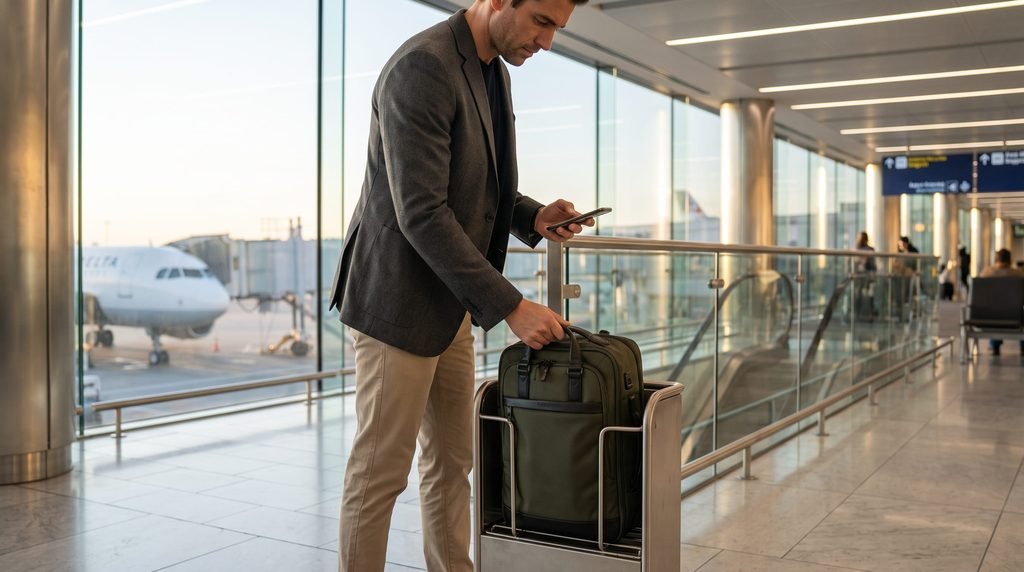
This is one of the most important rules when buying a one bag travel backpack.
Liters tell you approximately how much the backpack can hold. They do not tell you whether the backpack qualifies as a personal item or carry-on.
Two backpacks with similar capacities can have very different:
- heights
- widths
- depths
- frame structures
- external pockets
- compression systems
Airlines judge the dimensions of the bag they receive—not the number printed on the product listing.
For example, Delta currently specifies maximum carry-on dimensions of 22 × 14 × 9 inches (56 × 35 × 23 cm), including handles and wheels.
Ryanair has a substantially smaller free personal-bag allowance: 40 × 20 × 25 cm, which must fit under the seat. Its Priority option can include a larger 10 kg cabin bag measuring 55 × 40 × 20 cm.
Those examples demonstrate why there is no single universal “airline-approved backpack size.”
Your Rule of Thumb
Before buying:
- Identify the airlines you are most likely to use.
- Check the baggage allowance attached to your fare.
- Record the maximum dimensions.
- Check the backpack’s external dimensions.
- Check the weight allowance.
- Account for expansion pockets and overstuffing.
- Leave yourself some margin instead of planning around the absolute limit.
A backpack that only fits when compressed perfectly or emptied of its external pockets is not a comfortable compliance strategy.
Personal Item vs. Carry-On Backpack
These are not the same thing.
Personal Item
A personal item is generally designed to fit beneath the seat.
Depending on the airline, this might be:
- a small backpack
- laptop bag
- handbag
- compact daypack
Some airlines impose particularly tight dimensions. Spirit, for example, currently specifies a maximum personal-item size of 18 × 14 × 8 inches (45 × 35 × 20 cm).
Overhead Carry-On
A larger backpack intended for the overhead compartment usually receives a larger allowance, but the exact limit depends on the carrier, route, aircraft, and fare.
This is why a 35L or 40L backpack should never automatically be described as “carry-on compliant.”
Check the airline first, then buy the backpack.
4. Decide Between a Backpack, Suitcase, and Duffel
A backpack isn’t automatically the best luggage for every traveler.
Travel Backpack
Best for: travelers who frequently walk, use public transportation, climb stairs, or move between destinations.
Advantages:
- hands-free
- easier on stairs
- convenient for trains and buses
- adaptable to uneven surfaces
- keeps both hands available
Potential drawbacks:
- can become uncomfortable when overloaded
- weight rests on your body
- poor fit can cause pressure points
Rolling Suitcase
Best for: travelers who spend most of their time on smooth surfaces and prefer not to carry weight on their shoulders.
Advantages:
- easy to roll through airports
- convenient for business clothing
- generally easier to access while standing
- useful for travelers who prefer not to carry luggage
Potential drawbacks:
- stairs and cobblestones can be awkward
- wheels and handles add weight
- less convenient on crowded public transport
Duffel
Best for: simple packing and travelers who value flexibility over structured organization.
Advantages:
- lightweight
- flexible
- often compressible
- simple interior
Potential drawbacks:
- can be harder to organize
- shoulder carry can become tiring
- less supportive for long walks
The Better Choice
Choose the format that matches how you move, not what looks most minimalist online.
5. Choose the Right Opening Style
For most one-bag travelers, accessibility matters every day.
Clamshell Opening
A clamshell backpack opens widely, often almost like a suitcase.
This makes it easier to:
- see your clothing
- use packing cubes
- reach items at the bottom
- separate clean and dirty clothing
- pack efficiently
It is particularly useful when you repeatedly unpack and repack during a multi-city trip.
Top-Loading Backpack
A top-loading pack is accessed primarily from the upper opening.
This design can work well for hiking and outdoor travel, but it can be less convenient when you’re staying in hotels and need to access items throughout the bag.
Panel-Loading and Hybrid Designs
Some backpacks combine features of both approaches.
The important question isn’t whether one design is universally superior. Ask:
“How often will I need to access the middle or bottom of this bag?”
If the answer is frequently, a wide-opening design is usually easier to live with.
6. Prioritize Comfort Before Clever Features
A backpack can have excellent pockets and still be a terrible travel companion if it doesn’t fit your body.
Look for:
Padded Shoulder Straps
They should distribute pressure rather than concentrating it in one narrow area.
Sternum Strap
A sternum strap can help stabilize the shoulder straps and keep the load closer to your body.
Hip Belt
A functional hip belt can transfer some of the backpack’s load away from the shoulders.
This becomes increasingly useful when the backpack is heavily packed.
Adjustable Harness
An adjustable system gives you more opportunity to position the pack correctly.
Back Panel
Look for a back panel that balances support, ventilation, and comfort.
Torso Fit
Your overall height isn’t the only measurement that matters.
Torso length can affect how a backpack sits and how effectively the harness transfers weight.
If a manufacturer provides a torso range, use its sizing instructions rather than assuming your height alone determines the correct size.
7. Backpack Weight Matters More Than It Looks
A backpack that weighs several pounds before you put anything inside is already consuming part of your baggage allowance.
This becomes especially important if you regularly fly airlines with strict carry-on weight limits.
Think in terms of:
empty backpack weight + contents = actual travel weight
A lightweight bag can give you more flexibility for clothing, electronics, or other essentials.
But don’t automatically choose the lightest backpack available.
An ultralight bag can sacrifice:
- padding
- structure
- durability
- suspension
- organization
The better goal is appropriate weight for the way you travel.
If you mostly walk through airports and move between hotels, a comfortable structured backpack may be worth a little additional weight.
8. Look for Organization That Solves Real Problems
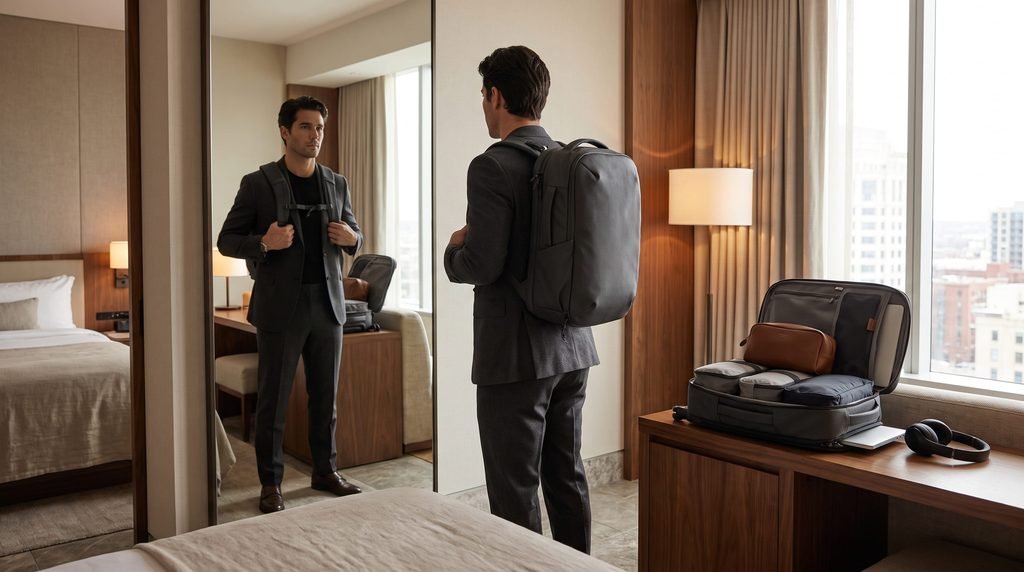
More pockets do not automatically mean better organization.
A good one-bag travel backpack should make frequently used items easy to access without turning the main compartment into a maze.
Useful Features
Depending on your needs, consider:
- padded laptop compartment
- tablet sleeve
- passport pocket
- quick-access exterior pocket
- water-bottle pocket
- internal compression
- key clip
- shoe compartment
- dirty-clothing separation
- luggage pass-through
- lockable zipper pulls
- concealed valuables pocket
Laptop Protection
If you carry a laptop, pay attention to how the compartment is positioned.
A suspended or well-padded compartment can provide more protection than a thin sleeve placed directly against the bottom of the bag.
Don’t Over-Organize
Some travelers prefer one large compartment with packing cubes.
Others want dedicated spaces for every category.
Neither approach is universally better.
Choose the organization system that matches how you naturally pack.
9. Consider Materials and Weather Resistance
The material affects weight, durability, appearance, and weather performance.
Common travel-pack materials include:
- nylon
- ripstop nylon
- polyester
- high-tenacity woven fabrics
- recycled synthetic fabrics
- waterproof laminate materials
Water-Resistant vs. Waterproof
These terms should not be treated as interchangeable.
A water-resistant backpack may handle:
- light rain
- splashes
- short exposure to moisture
A truly waterproof construction requires a much higher level of protection, usually involving fabric, seams, zippers, and construction designed specifically to prevent water ingress.
If you frequently travel in wet conditions, check the manufacturer’s actual protection claims rather than assuming a coated fabric makes the entire backpack waterproof.
Durability Isn’t Just Fabric
Also inspect:
- zipper quality
- stitching
- strap attachment points
- buckles
- seams
- base reinforcement
- warranty
- repair support
A durable backpack is a system, not simply a high-denier fabric.
10. Think About Security Without Overcomplicating It
Travel backpacks don’t need to look like security equipment.
Useful features can include:
- concealed passport pocket
- lock-compatible zipper pulls
- less exposed external organization
- secure laptop compartment
- internal valuables pocket
However, security also comes from behavior.
In crowded transportation areas:
- keep valuable electronics secure
- avoid leaving pockets open
- keep important documents accessible but protected
- use your backpack thoughtfully in crowded spaces
- don’t assume a hidden pocket makes you immune to theft
The goal is sensible risk reduction, not paranoia.
11. Set Your Budget Around How Often You Travel
There is no universal price that makes a backpack “good.”
Instead, consider how frequently you will use it.
Budget
A lower-cost backpack can make sense for:
- occasional vacations
- short trips
- travelers who are still experimenting with one-bag travel
Prioritize basic comfort, usable organization, strong zippers, and appropriate dimensions.
Mid-Range
This is often where travelers find a useful balance of:
- better harness systems
- improved materials
- stronger construction
- better organization
- more refined design
Premium
A premium backpack can make sense for frequent travelers who will use it repeatedly over many years.
You may be paying for:
- improved suspension
- better materials
- more refined construction
- lighter components
- repair or warranty support
- specialized organization
Don’t buy premium features simply because they sound impressive.
Pay for the features you will actually use.
12. Build Your Packing System Around the Backpack
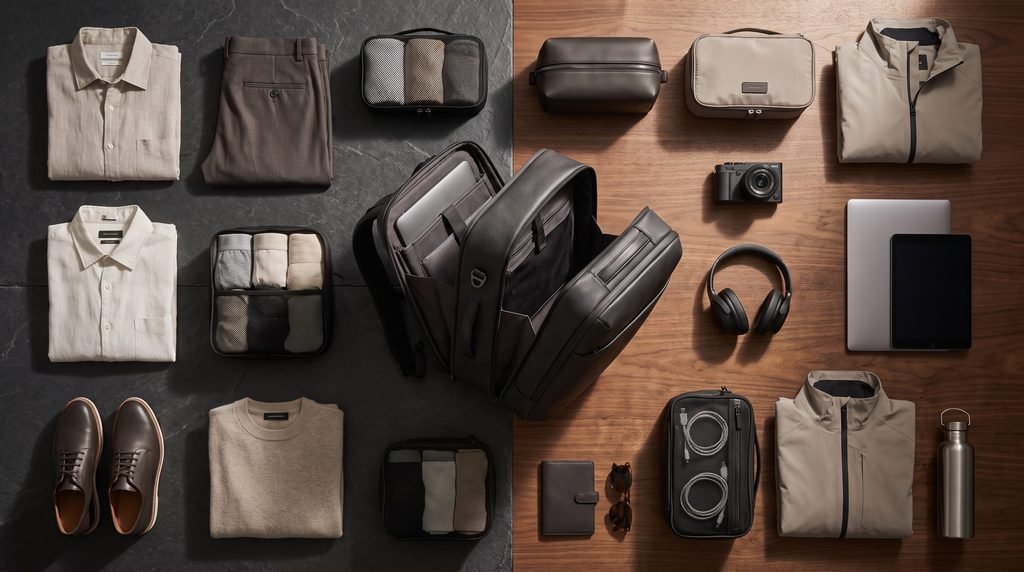
The backpack and your packing method should work together.
Use Packing Cubes Strategically
Packing cubes can turn a large compartment into manageable categories:
- tops
- bottoms
- underwear
- sleepwear
- electronics
- accessories
They are especially useful with clamshell backpacks.
Limit Footwear
Shoes can consume disproportionate amounts of space.
Whenever practical, wear your bulkiest pair during transit and pack only versatile alternatives.
Pack for Laundry
One-bag travel becomes dramatically easier when you stop treating every day of the trip as requiring a completely separate outfit.
For longer trips, a small wardrobe plus periodic laundry can reduce both volume and weight.
Use Layers
Instead of packing one enormous cold-weather garment, a layered clothing system can provide more flexibility while taking less space.
Pack Heavy Items Close to Your Back
Dense items should generally be positioned so the load stays stable and close to your body.
Avoid allowing heavy electronics or other dense objects to create an awkward center of gravity.
13. Think About Your Destination Before Choosing Capacity
The same backpack can feel completely different depending on where you’re going.
Warm-Weather City Trip
You may need:
- lightweight clothing
- sandals or compact shoes
- small toiletries
- minimal layers
A smaller backpack can work extremely well.
Cold-Weather Trip
Bulky layers, jackets, and footwear can quickly consume space.
You may need:
- larger capacity
- compression
- strategic layering
- fewer bulky items
Business Trip
Prioritize:
- laptop protection
- document organization
- wrinkle-conscious packing
- easy access
- professional appearance
Digital Nomad Travel
Your electronics can become the dominant part of the load.
Prioritize:
- laptop protection
- charger organization
- cable storage
- comfortable harness
- durable construction
Multi-City Travel
If you’re changing accommodation repeatedly, accessibility and carrying comfort become particularly important.
A bag that works beautifully for a taxi-to-hotel vacation may be less convenient when you’re walking through three train stations in one day.
14. Test the Backpack Before Your Trip
Never judge a travel backpack solely from photographs.
If possible, test it before your return period expires.
Do a Full Test Pack
Use the actual items you expect to travel with.
Don’t test the bag with towels or random household objects.
Pack:
- clothing
- shoes
- laptop
- toiletries
- chargers
- travel documents
- other regular gear
Then weigh it.
Walk With It
Wear the loaded backpack for at least 20–30 minutes.
Pay attention to:
- shoulder pressure
- hip-belt comfort
- back ventilation
- stability
- access to important pockets
- whether the bag pulls backward
- whether anything digs into your body
Test It in Real Situations
Walk upstairs.
Sit down.
Put it under a seat if intended as a personal item.
Place it in an overhead-bin-sized space if intended as a carry-on.
Open it while standing.
Try finding your charger without removing everything else.
These simple tests reveal problems that product photography cannot.
15. Check the Return Policy and Warranty
A backpack is a physical piece of equipment, and fit is personal.
Before buying, check:
- return period
- whether returns require unused condition
- warranty duration
- what the warranty covers
- repair availability
- replacement policy
- international warranty limitations
A strong warranty does not guarantee that a backpack is perfect, but it can make a meaningful difference when the bag is intended for years of travel.
A Practical One-Bag Travel Backpack Checklist
Before buying, run through this checklist:
Size
- Is the capacity appropriate for my packing style?
- Have I checked the actual external dimensions?
- Will those dimensions work with my most-used airline?
- Am I choosing a personal item or overhead carry-on?
Comfort
- Are the shoulder straps comfortable?
- Is there a useful sternum strap?
- Does the hip belt actually support the load?
- Does the torso fit correctly?
- Is the back panel comfortable?
Organization
- Does it open the way I prefer?
- Can I reach important items quickly?
- Is the laptop compartment appropriate?
- Do I need internal compression?
- Are there enough—but not too many—pockets?
Weight
- What does the empty backpack weigh?
- What will it weigh fully packed?
- Does that work with my airline’s allowance?
Durability
- Are the zippers robust?
- Are the straps securely attached?
- Is the fabric suitable for my travel?
- Is the base reinforced?
- Is the warranty worthwhile?
Real-World Testing
- Have I loaded it with my actual gear?
- Have I walked with it?
- Have I checked the fit?
- Have I tested the return policy?
What Size Backpack Is Best for One-Bag Travel?
For many travelers, 30–40 liters is a practical starting range, but the ideal size depends on what you carry and which airline rules you need to satisfy.
Choose closer to 25–30L if you:
- pack minimally
- travel in warm weather
- wash clothing regularly
- prioritize low weight
- frequently use strict personal-item allowances
Consider around 30–35L if you:
- want a versatile everyday travel size
- take short vacations
- carry a laptop
- want a balance between capacity and portability
Consider around 35–40L if you:
- travel for longer periods
- carry more layers
- work while traveling
- need additional clothing or equipment
Go larger only when your actual requirements justify it—and always check the external dimensions before assuming it will qualify as carry-on luggage.
How to Choose the Best Backpack for Your Travel Style
| Traveler | What to prioritize |
|---|---|
| Minimalist | Low weight + compact dimensions |
| First-time one-bag traveler | Easy organization + comfortable harness |
| Frequent flyer | Airline compliance + durability |
| Budget-airline traveler | Personal-item dimensions + low weight |
| Digital nomad | Laptop protection + tech organization |
| Business traveler | Structured design + laptop access |
| Cold-weather traveler | Capacity + compression |
| Multi-city traveler | Comfort + clamshell access |
| Slow traveler | Durability + comfortable carrying |
| Weekend traveler | Compact size + simplicity |
The important point is that there is no single backpack that wins every category.
Your best choice is the one that creates the fewest compromises for your particular travel pattern.
Common Mistakes to Avoid
Buying the Biggest Bag You Can Find
More space often encourages more packing.
Instead, determine what you actually carry and select the smallest comfortable capacity.
Choosing by Liter Count Alone
A 40L label doesn’t guarantee airline compatibility.
Always check external dimensions.
Ignoring Empty Weight
A heavy backpack can consume a surprising portion of a strict baggage allowance before you’ve packed anything.
Prioritizing Pockets Over Comfort
You interact with the harness every time you carry the bag.
You may only use some pockets occasionally.
Buying Without a Loaded Test
An empty backpack can feel excellent.
A fully loaded backpack can feel completely different.
Assuming “Carry-On” Means Every Airline
It doesn’t.
Airline allowances vary, including between carriers and fare types. Current examples from Delta, Ryanair, and Spirit show how dramatically baggage dimensions can differ.
Treating Water Resistance as Waterproofing
Check the actual construction and manufacturer specifications if rain protection is important.
One-Bag Travel and Airport Security
Your backpack also needs to work at the security checkpoint.
For travelers departing from U.S. airports, TSA currently maintains its 3-1-1 liquids guidance: containers generally need to be 3.4 oz / 100 mL or less, placed in one quart-sized clear bag, with one such bag per passenger.
That makes a dedicated, easy-access toiletries compartment particularly useful.
You should also keep frequently screened electronics and liquids accessible rather than burying them underneath tightly packed clothing.
Always check the security authority and airline for the airport and itinerary you’re actually using.
Should You Buy a 30L or 40L Backpack?
Choose 30L when your priority is mobility, low weight, and minimalist packing.
Choose 40L when you genuinely need additional clothing, equipment, or cold-weather capacity.
If you’re uncertain, don’t automatically choose the larger bag.
First create your realistic packing list.
Then determine how much space it occupies.
A smaller bag that comfortably holds everything you need is often easier to carry and harder to overpack.
Is One-Bag Travel Right for You?
One-bag travel is particularly attractive if you:
- change destinations frequently
- use trains and public transportation
- dislike waiting for checked luggage
- enjoy minimalist packing
- prefer mobility over maximum wardrobe variety
- travel frequently
It may be less suitable if you:
- need specialized sports equipment
- require extensive camera gear
- travel with formal wardrobes
- need medical or personal equipment that takes substantial space
- prefer bringing many outfit options
- don’t want to carry luggage on your back
There is no prize for packing everything into one backpack if doing so makes your trip uncomfortable.
The purpose is to make travel easier—not to turn packing into a competition.
FAQs
1. What is the best size for a one bag travel backpack?
For many travelers, 30–40 liters is a useful starting range. Minimalists may prefer 20–30L, while travelers carrying bulky clothing or equipment may need more. Always compare the backpack’s external dimensions with your airline’s baggage allowance.
2. Is a 40L backpack considered a carry-on?
It can be, but capacity alone does not determine whether a backpack qualifies. The backpack’s actual dimensions, weight, airline, fare, and route all matter. Check your carrier’s current baggage rules before traveling.
3. Is a 30L backpack enough for a week-long trip?
Yes, for many travelers. A 30L backpack can work particularly well with a compact wardrobe, lightweight clothing, limited footwear, and access to laundry. Cold-weather or equipment-heavy trips may require more space.
4. Is a clamshell backpack better for one-bag travel?
A clamshell design is often convenient because it opens widely and makes clothing and gear easier to organize and access. However, the best opening style depends on how you pack and how often you need to reach items inside the bag.
5. What should I look for when buying a one bag travel backpack?
Prioritize the backpack’s actual dimensions, comfortable harness, appropriate capacity, manageable empty weight, useful organization, durable construction, and warranty. Most importantly, make sure it matches the airlines and travel conditions you actually use.
Conclusion
The best one bag travel backpack is not necessarily the largest, lightest, most expensive, or most popular model.
It is the backpack that fits your body, your packing habits, your equipment, your destinations, and your airline requirements without creating unnecessary compromises.
Start with your travel style. Choose capacity based on what you actually carry. Check dimensions rather than relying on liters. Decide whether you need a personal item or overhead carry-on. Then evaluate comfort, organization, weight, durability, and price.
Finally, load the backpack with your real travel gear and walk with it before committing.
That approach turns backpack shopping from a search for the “perfect” product into something much more useful: finding the bag that is right for the way you travel.
1 comment