
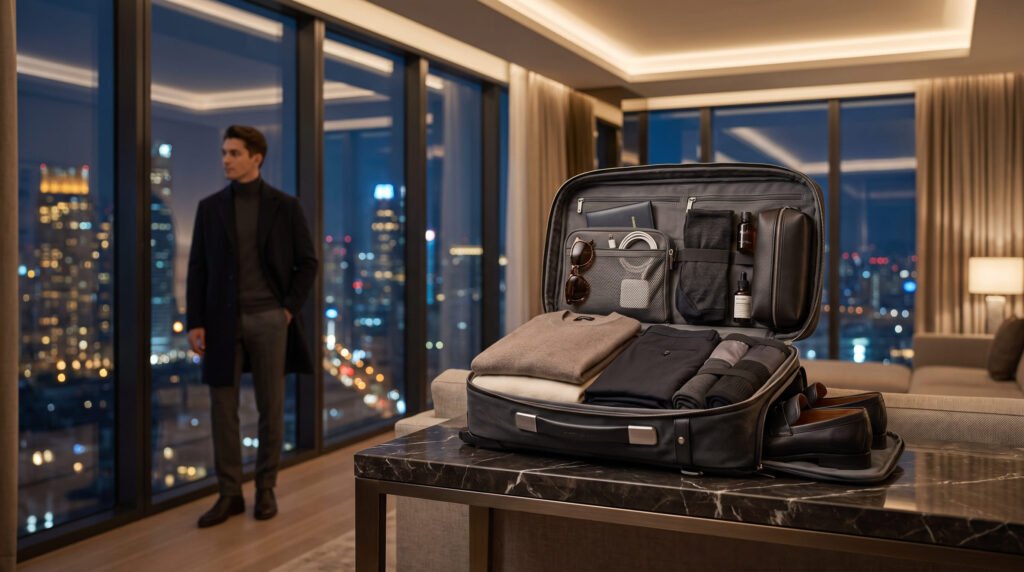
A one bag travel packing list works best when it is built around a system rather than a long checklist. The goal is not to own the smallest backpack or survive with almost nothing; it is to carry the right clothing, toiletries, technology, documents, and everyday essentials in one manageable bag.
For most trips, the smartest approach is to choose the bag around your airline’s actual limits, build a small mix-and-match wardrobe, reduce duplicate items, and plan for laundry instead of packing two weeks of clothing. Airline baggage rules vary by carrier, cabin and aircraft, so the bag that works for one flight may not comply with another.
This guide breaks down what to pack, how much clothing you need for different trip lengths, how to handle shoes and toiletries, what to leave behind, and how to pack efficiently for everything from a weekend to a two-week journey.
What Does One-Bag Travel Mean?
One-bag travel means completing a trip with one primary piece of luggage, rather than relying on checked luggage plus several additional bags.
For some travelers, that means a backpack that fits in the overhead compartment. For others, it may mean a smaller bag designed to fit beneath the seat. The important point is to define your version of “one bag” before you start packing.
The biggest advantage is flexibility. With less luggage, you have fewer things to organize, less to carry between accommodation and transport, and no need to build your entire trip around a checked suitcase.
But one-bag travel is not about owning less for the sake of it. It is about making every item work harder.
Choose Your Bag Before You Choose Your Packing List
Your bag is the physical limit that determines everything else.
A useful starting point is roughly 20–30 liters for very short trips and around 30–40 liters for longer one-bag trips, but capacity alone does not determine whether a bag qualifies as carry-on luggage. Airline dimensions and weight restrictions take priority.
IATA notes that carry-on allowances can vary by airline, cabin class and aircraft type, and that airlines’ own conditions of carriage apply.
A practical capacity framework
| Trip length | Useful planning range | Packing approach |
|---|---|---|
| 1–3 days | 20–30L | Minimal wardrobe, little or no laundry |
| 4–7 days | 28–35L | Capsule wardrobe with selective re-wearing |
| 8–14 days | 30–40L | Laundry becomes part of the plan |
| 14+ days | Around 35–40L+ | Keep the bag stable and wash clothing regularly |
These are planning ranges, not airline standards.
Before departure, check your specific airline’s current:
- Maximum dimensions
- Weight allowance
- Cabin baggage allowance for your fare
- Personal-item rules
- Gate-check procedures
A bag that is technically 35L can still exceed an airline’s dimensional or weight limits.
The Complete One Bag Travel Packing List
A practical one-bag setup can be divided into seven categories:
- Clothing
- Footwear
- Toiletries
- Electronics
- Documents and money
- Everyday carry
- Organization and backup essentials
The exact contents should change according to your destination and itinerary rather than remaining identical for every trip.
1. Clothing: Build a Small Capsule Wardrobe

Clothing usually takes up the largest amount of space, which makes it the easiest category to optimize.
The key is interchangeability. Choose colors and silhouettes that allow most tops to work with most bottoms.
Core clothing checklist
- 2–4 everyday tops
- 2–3 bottoms
- 3–5 pairs of underwear
- 3–5 pairs of socks
- 1 sleepwear option
- 1 lightweight mid-layer
- 1 weather-appropriate outer layer
- 1 versatile dressier outfit if your itinerary requires it
- Swimwear when relevant
- Hat or cap when relevant
- Lightweight laundry bag
For longer trips, increase laundry frequency rather than automatically increasing the number of garments.
How many clothes do you need?
| Trip length | Tops | Bottoms | Underwear | Socks |
|---|---|---|---|---|
| 1–3 days | 2 | 1–2 | 2–3 | 2–3 |
| 4–7 days | 3 | 2 | 3–4 | 3–4 |
| 8–14 days | 3–4 | 2–3 | 4–5 | 4–5 |
These quantities assume that you can re-wear suitable items and wash clothing during the trip.
A seven-day trip does not automatically require seven tops and seven pairs of trousers. A better system is a small wardrobe that can rotate through several outfits.
2. Choose Fabrics for the Destination
Fabric choice can matter almost as much as quantity.
For frequent washing, lightweight synthetic fabrics often dry quickly. Merino wool can also be useful for travel because of its temperature-regulating and odor-management properties, although performance varies by garment construction and manufacturer.
Cotton can still be perfectly appropriate, particularly for comfortable everyday clothing, but heavy cotton pieces can be less convenient when you need rapid drying.
For a one-bag wardrobe, prioritize clothing that is:
- Comfortable
- Lightweight
- Easy to layer
- Easy to wash
- Reasonably quick to dry
- Suitable for more than one setting
- Compatible with the rest of your wardrobe
The objective is not to choose one “perfect” travel fabric. It is to avoid packing garments that perform the same job while consuming significantly more space.
3. Shoes: Keep the Decision Strict
Shoes are among the most expensive items in your luggage in terms of space.
For many trips, one versatile pair is enough. Wear your bulkiest pair while traveling rather than placing it inside the bag.
Consider a second pair only when the itinerary genuinely requires a different function, such as:
- Formal events
- Beach or pool activities
- Hiking
- Running
- Cold-weather conditions
- Work travel with a dress-code requirement
A useful shoe test
Before packing a second pair, ask:
Will I use these for a specific activity that my main pair cannot handle?
If the answer is no, they may not justify the space.
4. Toiletries: Shrink the Kit, Not Your Routine
A minimalist toiletry kit should contain the products you genuinely use.
Basic toiletry checklist
- Toothbrush
- Toothpaste
- Deodorant
- Face cleanser
- Moisturizer
- Sunscreen
- Hair-care essentials
- Razor
- Small grooming kit
- Prescription or essential medication
- Minimal cosmetics or skincare
- Solid toiletries where practical
Decant liquids into appropriately sized containers instead of carrying full-size bottles.
For flights departing from the United States, TSA’s 3-1-1 framework generally limits carry-on liquids, gels, aerosols, creams and pastes to containers of 3.4 oz / 100 mL or less, subject to applicable exceptions and screening procedures.
International travelers should not automatically assume that every country’s security process is identical to TSA’s. Check the rules applicable to your departure airport.
5. Electronics: Pack a System, Not a Gadget Collection
Technology can quietly turn a lightweight backpack into a heavy one.
Start with the devices you actually need.
One-bag tech checklist
- Smartphone
- One laptop or tablet if required
- Multi-port charger
- Necessary charging cables
- Power bank
- Earbuds or compact headphones
- Travel adapter when required
- Small electronics pouch
- Camera only if photography is a meaningful part of the trip
Avoid bringing separate chargers for every device when one suitable multi-port charger can handle several of them.
Power banks deserve special attention
For U.S. air travel, spare lithium batteries and power banks must be carried in carry-on baggage rather than checked baggage. FAA guidance states that lithium-ion batteries rated 0–100 Wh are generally permitted, while larger batteries can require airline approval or face additional restrictions. Airlines may impose stricter rules.
If your carry-on is taken at the gate and placed in the aircraft hold, remove spare batteries and power banks and keep them with you in the cabin.
6. Documents, Money & Travel Administration
This category is small but important.
Essential documents
- Passport
- Required visa or entry documentation
- Boarding pass
- Travel insurance information, if applicable
- Accommodation details
- Transportation reservations
- Driver’s license when relevant
- Copies of important documents
- Emergency contact information
Keep critical documents accessible rather than buried beneath clothing.
Digital copies can provide useful backup, but they should not replace documents that authorities or carriers require in physical form.
7. Everyday Carry & Small Essentials
The final category includes items that make the trip easier without becoming a collection of “maybe useful” objects.
Consider:
- Sunglasses
- Reusable water bottle
- Packable tote
- Small umbrella when appropriate
- Compact laundry bag
- Travel lock where useful
- Pen
- Small first-aid essentials
- Eye mask
- Earplugs
- Small reusable shopping bag
Not every traveler needs every item.
The right question is:
What problem will this item solve on this particular trip?
How to Pack for 3 Days, 7 Days, 10 Days or 14 Days
Trip length changes your laundry strategy more than it changes your bag size.
3-Day Trip
Prioritize simplicity:
- 2 tops
- 1–2 bottoms
- 2–3 underwear
- 2–3 socks
- One main shoe
- Basic toiletries
- Essential electronics
You may not need laundry at all.
7-Day Trip
A compact capsule wardrobe works well:
- 3 tops
- 2 bottoms
- 3–4 underwear
- 3–4 socks
- One layer
- One weather shell if necessary
- One or two pairs of shoes depending on the itinerary
Plan at least one clothing refresh if your destination makes washing easy.
10-Day Trip
Do not simply add three days of clothing.
Instead:
- Keep roughly the same core wardrobe
- Add only the items needed for the weather
- Plan a laundry session
- Replace duplicates with versatile pieces
- Keep footwear under control
14-Day Trip
The bag should not become twice as large because the trip is twice as long.
A two-week one-bag system works by repeating the cycle:
Wear → Wash → Dry → Wear again
If laundry access is uncertain, identify a laundromat or accommodation laundry option before departure.
Packing for Different Climates

One-bag travel becomes more difficult when the itinerary crosses major temperature differences.
The solution is usually layering, not carrying separate wardrobes.
Hot & Humid
Prioritize:
- Lightweight breathable tops
- Quick-drying underwear
- Lightweight trousers or shorts
- Sandals if genuinely useful
- Sun protection
- Compact rain layer
Avoid heavy fabrics that stay damp for long periods.
Cool City Travel
A simple system might include:
- Base-layer top
- Regular shirt
- Lightweight sweater or fleece
- Packable outer shell
- One versatile trouser
- Comfortable walking shoes
Wear the bulkiest layer during transit.
Cold Weather
Cold-weather packing requires more discipline because insulation consumes space.
Instead of packing many thick garments, consider:
Base layer + insulating layer + outer shell
Wear the largest pieces on travel days whenever practical.
Mixed-Climate Trips
For a trip such as:
warm city → cool mountains → warm city
build the wardrobe around removable layers.
A lightweight base layer and compact insulating piece are more versatile than carrying separate warm- and cold-weather outfits.
Laundry Is Part of the Packing System
Laundry is what makes one-bag travel practical for longer trips.
You have three main options.
Sink Washing
Useful for:
- Underwear
- Socks
- Lightweight shirts
The main variable is drying time. Humidity, ventilation, fabric and room conditions can make a dramatic difference.
Never assume a garment will dry overnight simply because its label says “quick dry.”
Laundromat
Best when you need to wash several garments together.
This is especially useful after several days of travel or in humid climates where room drying is unreliable.
Hotel or Accommodation Laundry
Convenient for business travel or when time matters, but it can be substantially more expensive than self-service washing.
The key principle
Don’t pack seven or fourteen complete outfits simply because you don’t want to do laundry.
For one-bag travel, laundry is not a failure of planning. It is part of the plan.
What Not to Pack for One-Bag Travel
The easiest way to improve your packing list is often to remove things.
1. Full-size toiletries
Unless there is a specific reason you need a particular product, smaller quantities are usually more practical.
2. Multiple “nice” outfits
Pack for the actual itinerary.
If there is no formal dinner, wedding, business meeting or special event, a dedicated formal outfit may not earn its space.
3. Too many shoes
Two pairs may be appropriate. Three or four usually require a very specific itinerary to justify the volume.
4. Duplicate electronics
A laptop and tablet can make sense for some work setups, but don’t automatically carry two devices because each might be useful.
5. Heavy books
Use an e-reader or phone if digital reading works for you.
6. Bulky “just in case” equipment
Don’t pack equipment for activities that are only hypothetical.
If an activity becomes definite, consider renting or buying the necessary item at the destination when practical.
7. Too many clothing colors
A coordinated palette makes a small wardrobe considerably more versatile.
How to Build a One-Bag Capsule Wardrobe
The easiest capsule wardrobe is based on compatibility rather than a fixed number formula.
Choose:
- 2–3 core colors
- 1–2 accent colors
- Tops that work with multiple bottoms
- One versatile outer layer
- Shoes that match most outfits
For example, a neutral foundation of black, navy, charcoal, beige or ivory can make individual pieces easier to combine.
The result is more outfits from fewer garments.
A useful test is to place every clothing item on the bed and ask:
Can I create at least three different outfits with this piece?
If not, it deserves closer scrutiny.
How to Pack the Bag Efficiently
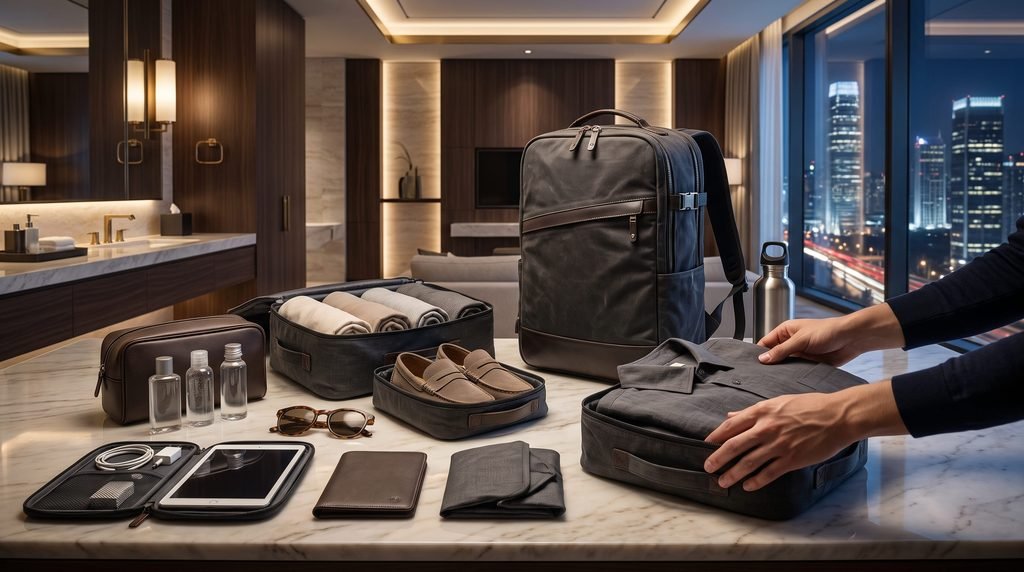
Once your items are selected, packing order matters.
Step 1: Pack the Heaviest Items First
Place shoes and other dense items toward the bottom or close to your back, depending on your bag’s internal design.
Step 2: Use Clothing Cubes Selectively
Packing cubes can keep categories organized, but they should not become an excuse to bring more clothing.
Use them to control the contents you already selected.
Step 3: Keep Liquids Accessible
If your departure airport requires liquids to be removed during screening, keeping the liquids bag near the top can make security faster.
Step 4: Protect Electronics
Keep laptops, tablets and other fragile electronics in their dedicated compartments or protective sleeves.
Step 5: Leave a Small Amount of Flexibility
Do not fill every millimeter of the bag.
A little unused space makes it easier to repack after the first day and accommodate small purchases.
Step 6: Weigh the Finished Bag
Dimensions are not the only issue.
If your airline has a weight limit, weigh the completed bag before leaving home.
Your 10-Minute Final Packing Check
Before closing the bag, run through this sequence:
Clothing
- Do all pieces coordinate?
- Do I have enough underwear and socks?
- Do I have weather-appropriate layers?
Footwear
- Can I remove one pair?
- Am I wearing the bulkiest pair?
Toiletries
- Are liquids within the applicable security limits?
- Can anything become a solid?
- Are essential medications packed?
Electronics
- Do I really need every device?
- Do I have the necessary cables?
- Is the power bank in my cabin baggage?
Documents
- Passport?
- Visa or entry documents if required?
- Boarding pass?
- Accommodation information?
Airline
- Correct bag dimensions?
- Correct weight?
- Correct fare allowance?
- Personal-item rules checked?
Destination
- Weather checked?
- Laundry option identified?
- Any special clothing or equipment actually required?
If you can answer yes to the important questions, the bag is ready.
One Bag Travel for Different Types of Travelers
First-Time One-Bag Travelers
Don’t begin by buying an expensive backpack.
Start with the luggage you already own if it meets your airline’s requirements. Learn what you actually need before investing in specialized gear.
Solo Travelers
One bag can be particularly convenient when you are responsible for all your own luggage during transfers, trains, buses and walking.
Business Travelers
Prioritize:
- One professional outfit
- Wrinkle-resistant clothing
- Compact electronics
- Charger consolidation
- Easy-access documents
The exact wardrobe depends on the dress code.
Slow Travelers
One-bag travel becomes easier when you stay several nights in each location because there is less pressure to optimize every single day.
Adventure Travelers
This approach requires more caution. Hiking, camping, climbing, skiing and specialized sports can require equipment that does not fit a conventional one-bag setup.
In those cases, the right goal may be one main travel bag plus specialized equipment, rather than forcing every trip into the same luggage format.
Common One-Bag Mistakes
Packing for every possible weather condition
Check the actual forecast and itinerary rather than preparing for every season simultaneously.
Choosing the bag before checking airline rules
A large travel backpack may be excellent for one airline and unsuitable for another.
Confusing liters with compliance
A 40L capacity does not automatically mean the bag is an approved carry-on.
Packing clothes without an outfit plan
Individual garments matter less than whether they work together.
Forgetting laundry
If your list only works when you have fourteen days of clean clothes, it is not really a one-bag system.
Bringing too many shoes
Footwear is often the fastest route to unnecessary bulk.
Ignoring weight
A compact bag can still become uncomfortable or exceed the airline’s limit when packed with heavy electronics, shoes and toiletries.
Is One-Bag Travel Worth It?
Whether one-bag travel suits you depends on your trip.
It can be a practical approach when you are moving frequently, using multiple forms of transportation, traveling between cities, or simply prefer a lighter setup.
It can be less suitable when your trip requires specialized equipment, extensive formalwear, family gear, medical equipment, or large quantities of destination-specific supplies.
The goal is not to prove that every trip can fit into one backpack.
The goal is to determine whether your actual itinerary can be served comfortably by one bag.
FAQs
1. What is the best bag size for one-bag travel?
There is no universal best size. Around 20–30L can work for short minimalist trips, while roughly 30–40L provides more flexibility for longer journeys. Your airline’s published dimensions and weight allowance matter more than the bag’s liter rating.
2. Can I travel for two weeks with one bag?
Yes. The key is to keep the core wardrobe compact and use laundry during the trip. A two-week trip does not require two weeks of separate outfits.
3. How many clothes should I pack for one-bag travel?
For a typical 4–7 day trip, around three tops, two bottoms, three to four pairs of underwear and three to four pairs of socks can form a useful starting point. Adjust the quantities for weather, activities and laundry access.
4. How many pairs of shoes should I take?
One versatile pair is often sufficient. A second pair can make sense for a specific activity, formal event or environment that your primary shoes cannot handle.
5. Are power banks allowed in carry-on luggage?
For U.S. air travel, spare lithium batteries and power banks must be carried in the cabin rather than checked baggage. Battery capacity and airline-specific restrictions also matter, so verify the rules before departure.
Conclusion
A successful one bag travel packing list is less about owning ultra-light gear and more about making deliberate decisions.
Choose the bag around your airline’s actual restrictions. Build a compact wardrobe that mixes easily. Limit footwear. Reduce toiletries. Consolidate electronics. Keep essential documents accessible. Most importantly, use laundry to extend your wardrobe rather than continually increasing the size of your luggage.
The best one-bag setup is not necessarily the smallest possible bag. It is the smallest practical system that comfortably supports your actual itinerary.
1 comment