
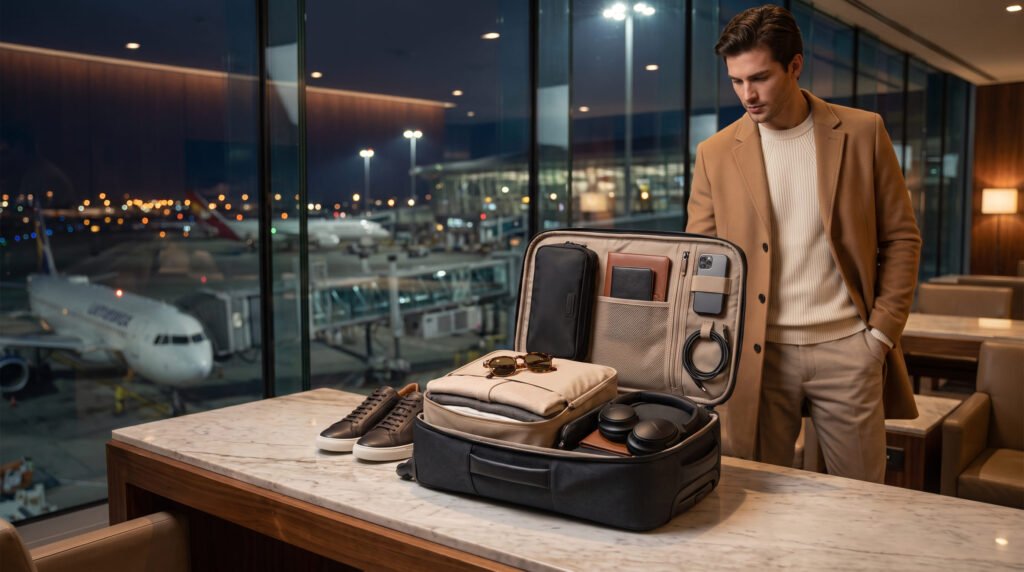
Packing an underseat bag is less about squeezing more into a smaller space and more about deciding what genuinely deserves that space. A successful personal-item setup keeps your essentials accessible, stays within your airline’s requirements, and gives you enough clothing, toiletries, technology, and comfort items for the trip without turning the bag into an overstuffed brick.
The key is to start with your airline’s personal-item rules, then build your packing list around the trip rather than choosing a bag and trying to force everything into it. With a flexible bag, a compact wardrobe, carefully edited toiletries, and a deliberate packing order, an underseat bag can work remarkably well for short trips and some longer journeys with laundry.
This guide explains how to choose the bag, what to pack, how to organize it, how many days you can realistically cover, and when an underseat-only strategy simply isn’t practical.
Quick Answer: How Do You Pack an Underseat Bag?
The most efficient approach is to pack in this order:
- Check your airline’s personal-item dimensions and fare rules.
- Choose a soft, flexible bag that fits those requirements.
- Plan your outfits before putting anything inside.
- Wear your bulkiest clothing and shoes when practical.
- Pack versatile clothing that can be mixed and repeated.
- Use one compact packing cube or compression system rather than several rigid organizers.
- Keep toiletries small and consolidate liquids.
- Carry only the technology you will actually use.
- Keep documents, medication, electronics, and other essentials easy to reach.
- Leave a little flexibility instead of filling every corner.
The biggest mistake is treating an underseat bag like a miniature suitcase. Think of it as a carefully edited travel system.
1. Check Your Airline’s Personal-Item Rules First

Before choosing what to pack, check the baggage rules for the specific airline, fare, route, and flight.
A personal item generally needs to fit beneath the seat in front of you, but the permitted dimensions and baggage allowances are not universal. For example, American Airlines currently lists a maximum personal-item size of 18 × 14 × 8 inches (45 × 35 × 20 cm), while Delta describes a personal item as something such as a small backpack, purse, briefcase, or similar item that can be stored beneath the seat.
That difference matters because a bag marketed as an “underseat” or “personal-item” bag is not automatically compliant with every airline.
Personal Item vs. Carry-On
A personal item is intended for the space beneath the seat.
A carry-on is normally the larger item designed for an overhead compartment.
If your ticket includes only a personal item, your packing strategy needs to be built around the smaller allowance. Do not assume that a personal item and a carry-on have interchangeable dimensions.
Why Actual Underseat Space Can Differ
Published dimensions are only part of the equation. The available space beneath a seat can be affected by:
- Aircraft design
- Seat configuration
- Equipment beneath the seat
- Seat position
- Bag shape
- Wheels or rigid frames
- The amount the bag can compress
A soft bag that can conform to the available space is often easier to manage than a rigid case with dimensions that leave no room for flexibility.
Best practice: check the airline’s current baggage page before every trip, especially when flying on a different carrier or using a restrictive fare.
2. Choose the Right Underseat Bag
The best underseat bag isn’t necessarily the bag with the largest advertised capacity. It is the bag that balances external dimensions, flexibility, organization, weight, and accessibility.
Backpack vs. Tote
A compact backpack is usually practical when you expect to walk through airports, use public transportation, or carry your belongings for extended periods.
A tote can work well for short trips and frequent access, particularly when you want to reach the contents without opening a full clamshell compartment.
Soft-Sided vs. Structured
For underseat travel, flexibility is valuable.
A soft-sided bag can conform more easily to the available space, while an overly rigid case may struggle when the space beneath the seat is narrower or differently shaped than expected.
That does not mean a completely unstructured bag is ideal. Some internal structure can protect electronics and prevent the contents from collapsing into a disorganized pile.
Features That Actually Matter
Prioritize:
- A compact footprint
- Comfortable straps
- A wide opening
- One useful main compartment
- A separate laptop or tablet sleeve if needed
- Small exterior access pockets
- A protected electronics area
- Durable zippers
- Minimal hardware
- A lightweight construction
Avoid choosing a bag primarily because its marketing copy claims an unusually large capacity.
For underseat travel, usable space matters more than theoretical volume.
3. Build Your Packing List Around the Trip
Before packing, answer five questions:
How long am I going?
A two-night city break requires a different strategy from a seven-day trip.
What will the weather be?
Warm-weather clothing generally consumes less space than sweaters, coats, and winter footwear.
Will I have access to laundry?
Laundry dramatically extends what a small bag can handle.
Do I need specialist equipment?
Camera equipment, hiking shoes, business clothing, sports gear, or bulky toiletries can quickly change the equation.
What will I actually wear?
If you cannot imagine wearing something during the trip, it probably should not occupy valuable underseat space.
A useful rule is:
Pack for your itinerary, not for every hypothetical situation.
4. Underseat Bag Packing List
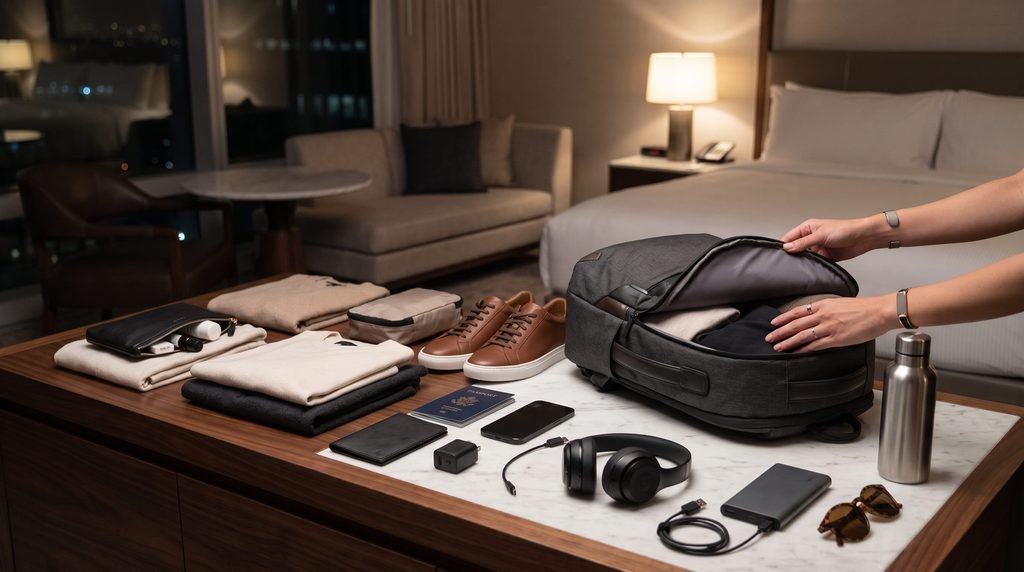
A compact packing list can be divided into six categories.
Clothing
For a short trip, consider:
- 2–4 versatile tops
- 1–2 bottoms
- Underwear for the planned number of days
- Socks
- Sleepwear
- One lightweight extra layer
- One compact weather layer when necessary
The exact quantity should depend on weather, activities, access to laundry, and personal preference.
Shoes
Shoes are among the biggest space consumers in a small bag.
If possible, travel in your bulkiest practical pair and pack only one additional pair.
Choose shoes that can work across multiple parts of the itinerary rather than bringing separate footwear for every activity.
Toiletries
Keep toiletries deliberately small:
- Toothbrush and toothpaste
- Deodorant
- Skincare essentials
- Hair products
- Sunscreen
- Minimal makeup where applicable
- Medications
- Small grooming tools
Whenever possible, choose solid alternatives or refillable travel containers.
Electronics
Consider:
- Smartphone
- One charging cable
- Compact wall charger
- Headphones
- Laptop or tablet if genuinely necessary
- Power bank when needed and permitted
- Camera only if the trip requires dedicated equipment
Multiple chargers, duplicate cables, large adapters, and unused gadgets can consume surprising amounts of space.
Documents
Keep essential documents together:
- Passport or identification
- Boarding information
- Payment cards
- Travel insurance information if applicable
- Accommodation details
- Important reservation information
Digital copies can provide a useful backup, but they should not replace documents that are legally required for your journey.
Comfort Items
Depending on your needs:
- Empty reusable water bottle
- Eye mask
- Earplugs
- Small scarf
- Compact travel pillow
- Reading material
- Small snack
Be selective. Comfort items should improve the journey without taking over the bag.
5. How to Pack Everything Efficiently

The order in which you pack can make the difference between a usable bag and a frustrating one.
Step 1: Wear the Bulkiest Practical Items
If the weather allows, wear:
- Larger shoes
- Jacket
- Heavier trousers
- Sweater or sweatshirt
Do not dress uncomfortably simply to save space, but using your clothing strategically can free substantial room.
Step 2: Create a Small Capsule Wardrobe
Instead of packing individual outfits, choose pieces that work together.
For example:
- Neutral trousers
- Two complementary tops
- One versatile layer
- One lightweight alternative bottom
- One pair of versatile shoes
A capsule approach allows the same pieces to create multiple combinations.
Step 3: Roll or Fold According to the Garment
Rolling can work well for casual lightweight clothing, while folding may be better for structured pieces.
The objective isn’t to follow one universal folding method. It is to create a compact, stable layer that can be accessed without destroying the entire bag.
Step 4: Use One Main Packing Cube
A single compact cube can keep clothing together and make it easier to remove one category without disturbing electronics or toiletries.
Too many cubes can actually waste space because every organizer has its own walls, zippers, seams, and empty corners.
Step 5: Place Heavy Items Low and Close to Your Back
For backpacks, heavier compact objects generally feel better when positioned close to the body’s center rather than hanging at the far edge.
This also helps prevent a small bag from becoming uncomfortable during airport walks.
Step 6: Fill Awkward Spaces Carefully
Small gaps can hold:
- Socks
- Underwear
- Charging cables
- Belts
- Small accessories
But don’t treat every empty space as an invitation to add another item.
Some empty space makes the bag easier to close and more adaptable during the trip.
6. How to Pack Toiletries in an Underseat Bag
Toiletries are often the silent space thief.
A collection of full-size bottles can consume a disproportionate amount of a small bag, so edit aggressively.
Start With the Essentials
Ask:
Would I replace this item immediately if I forgot it?
If the answer is no, consider leaving it behind.
Choose Solid Alternatives
Depending on your preferences, compact solid products can replace some liquid items.
Examples include:
- Bar soap
- Solid shampoo
- Solid conditioner
- Solid deodorant
- Toothpaste tablets
Keep Your Liquids Together
If you’re departing from a U.S. airport, TSA’s 3-1-1 rule generally limits carry-on liquids, gels, aerosols, creams, and pastes to containers of 3.4 ounces/100 ml or less, with those containers fitting into one quart-sized clear bag per passenger.
Keep the liquids bag somewhere accessible rather than burying it underneath clothing.
7. How Many Days Can an Underseat Bag Handle?
There is no universal number because trip length is only one variable.
1–2 Nights
This is the easiest scenario.
A compact wardrobe, one pair of shoes, minimal toiletries, and basic electronics can usually be organized without extreme compression.
3–4 Nights
Still very manageable if you choose versatile clothing.
Focus on:
- Repeating bottoms
- Interchangeable tops
- One main shoe
- Compact toiletries
- Minimal technology
5–7 Nights
Possible for a disciplined packer, but laundry becomes increasingly valuable.
Instead of carrying seven complete days of clothing, plan to wash selected items during the trip.
More Than 7 Days
At this point, the question becomes less about bag capacity and more about your willingness to:
- Do laundry
- Repeat outfits
- Limit footwear
- Buy or replace consumables at the destination
- Travel with a very minimal wardrobe
Underseat-only travel can still work, but it becomes a lifestyle choice rather than the easiest option.
8. How to Pack an Underseat Bag for Different Weather
Warm Weather
Warm-weather travel is generally the easiest environment for underseat-only packing.
Choose:
- Lightweight tops
- Lightweight trousers or shorts
- Compact sandals when necessary
- Breathable sleepwear
- Minimal layers
The main challenge may be toiletries such as sunscreen and skincare products rather than clothing volume.
Mild or Shoulder-Season Weather
Layering becomes more important.
Rather than carrying multiple sweaters, use:
- Lightweight base layer
- Long-sleeve top
- Compact jacket
- One versatile outer layer
Wear the larger layer during transit when practical.
Cold Weather
Cold-weather trips are the hardest.
Coats, sweaters, boots, gloves, and heavier fabrics consume significant space.
For these trips, underseat-only packing may require:
- Wearing the largest outer layers
- Choosing lightweight insulating layers
- Limiting footwear
- Planning laundry
- Using a compact wardrobe
- Accepting that a larger carry-on may be more practical
Do not choose an underseat-only strategy simply because it sounds minimalist if your destination genuinely requires bulky clothing.
9. How to Pack an Underseat Bag for Business Travel
Business travel changes the equation because clothing often needs to look polished while electronics take up valuable space.
A practical strategy is to build around one color family.
For example:
- One pair of tailored trousers
- One second bottom
- Two or three shirts or tops
- One lightweight blazer or jacket
- One versatile pair of polished shoes
- Minimal accessories
Wear the heavier professional layer when practical.
For technology, decide whether you genuinely need both a laptop and tablet. If one device can perform both functions, eliminating the duplicate can create significant room.
A small garment folder or carefully folded shirt system can help protect formal clothing, but avoid filling the bag with bulky organizational products.
10. How to Handle TSA, Liquids and Batteries
An underseat bag is still subject to airport security rules.
For U.S. departures, check TSA’s current guidance before packing liquids, gels, aerosols, powders, electronics, food, and other potentially restricted items.
Keep electronics organized so they can be removed easily if screening instructions require it.
Power Banks Need Special Attention
Power banks and spare lithium batteries must remain in carry-on baggage rather than checked baggage under current U.S. FAA guidance.
If your carry-on is unexpectedly gate-checked, remove spare lithium batteries and power banks and keep them with you in the cabin.
Battery rules can also vary by airline and international jurisdiction, so travelers should check the airline’s requirements before departure.
11. What to Do If Your Personal Item Is Gate-Checked
Even when you plan to travel with an underseat bag, circumstances can change.
If airline staff ask you to surrender a bag for gate checking, immediately identify anything that must remain in the cabin.
Keep accessible:
- Passport or identification
- Medication
- Phone
- Laptop or other essential electronics
- Power bank
- Spare batteries
- Important documents
- Valuables
A good underseat packing system therefore has two layers:
Things you can safely hand over if necessary and things that must stay with you.
This is another reason not to bury electronics and critical items beneath your clothing.
12. Common Underseat Packing Mistakes
Mistake 1: Buying the Biggest Bag Possible
Maximum capacity isn’t always maximum usability.
A large, boxy bag may technically meet a listed measurement while being difficult to push beneath a particular seat.
Mistake 2: Packing Complete Outfits
Complete outfits often create unnecessary duplication.
Build a coordinated wardrobe instead.
Mistake 3: Bringing Too Many Shoes
One pair worn and one compact backup is often a more efficient starting point than packing several specialized pairs.
Mistake 4: Carrying Full-Size Toiletries
Transfer, consolidate, replace, or eliminate whenever practical.
Mistake 5: Packing “Just in Case” Items
The phrase “just in case” is responsible for much of unnecessary luggage.
Ask what problem each item solves and whether another item already solves it.
Mistake 6: Filling Every Gap
A completely stuffed bag is harder to close, harder to access, and less adaptable.
Mistake 7: Ignoring the Return Trip
A bag that barely closes before departure may become impossible after adding receipts, small purchases, snacks, or souvenirs.
Leave some capacity available.
Mistake 8: Forgetting the Airport Security Stage
A beautifully organized bag becomes frustrating if liquids and electronics are buried beneath everything else.
Pack with security screening in mind.
13. The 10-Minute Underseat Bag Test
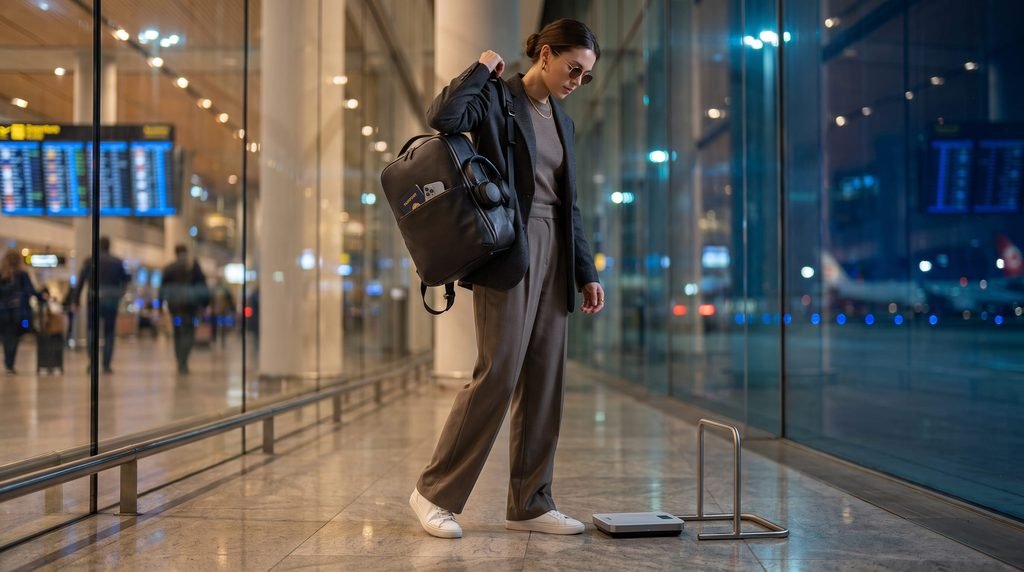
Before leaving home, perform a final test.
Size
Confirm that the packed bag meets your airline’s current personal-item requirements.
Closure
Zip or close the bag without excessive force.
Accessibility
Can you reach:
- Passport
- Phone
- Wallet
- Medication
- Electronics
- Liquids
without unpacking everything?
Comfort
Carry it for 10–15 minutes.
If the bag is already uncomfortable before the trip starts, adding airport walking and travel-day fatigue won’t improve the experience.
Necessity
Remove anything you packed because of uncertainty rather than actual need.
Flexibility
Leave a little room.
The best underseat bag is not the one packed to 100 percent capacity. It is the one that remains manageable throughout the journey.
14. When Underseat-Only Travel Isn’t the Right Choice
Minimalism is useful only when it supports the trip.
Consider a larger carry-on or checked bag when you need:
- Heavy winter clothing
- Multiple pairs of specialized shoes
- Formalwear
- Sports equipment
- Professional camera equipment
- Extensive medical or personal-care supplies
- Equipment for children
- Gifts or bulky items
- A long trip without laundry
- Specialized outdoor gear
There is no prize for making a trip unnecessarily difficult.
The goal is not simply to own less luggage. The goal is to carry exactly what your journey requires with as little unnecessary bulk as possible.
15. A Simple Underseat Bag Packing Formula
For a short leisure trip, use this as a starting framework:
Wear
- Bulkiest practical shoes
- Heaviest trousers
- Jacket or outer layer
Pack
- 2–4 versatile tops
- 1–2 additional bottoms
- Underwear
- Socks
- Sleepwear
- One lightweight layer
Toiletries
- Toothbrush
- Small toothpaste
- Deodorant
- Skincare essentials
- Required medications
- Minimal grooming products
Technology
- Phone
- One charger
- Compact adapter if required
- Headphones
- Laptop/tablet only if necessary
- Power bank if needed and permitted
Documents
- Passport/ID
- Boarding information
- Payment cards
- Essential reservation details
Optional
- Empty water bottle
- Eye mask
- Earplugs
- Compact snack
- Small reading device
Use this as a framework rather than a rigid checklist. Your destination and itinerary should determine the final contents.
16. The Best Way to Think About Underseat Travel
The most effective underseat packing strategy is not about learning one perfect folding technique.
It is a sequence of decisions:
Check → Edit → Coordinate → Compress → Organize → Access → Test
First, check the airline.
Then edit the packing list.
Coordinate your clothing so fewer pieces create more outfits.
Compress only where it genuinely saves space.
Organize the bag by function.
Keep airport essentials accessible.
Finally, test the packed bag before you leave.
That approach is more reliable than simply buying a smaller bag and hoping everything fits.
FAQs
1. What size bag fits under an airplane seat?
There is no single universal underseat-bag size. Airlines publish their own personal-item requirements, and actual space can vary by aircraft and seat configuration. Always check the operating airline’s current baggage policy before flying.
2. Can I travel with only an underseat bag?
Yes, particularly for short trips, warm-weather travel, and itineraries where laundry is available. Longer trips, cold climates, formalwear, specialist equipment, and bulky footwear can make an underseat-only setup considerably more difficult.
3. How many days can you pack in an underseat bag?
A disciplined traveler can often manage several days by using a compact capsule wardrobe, repeating versatile pieces, limiting shoes, and doing laundry when necessary. There is no fixed maximum because weather, clothing size, personal preferences, and equipment requirements all affect capacity.
4. What should I pack in an underseat bag?
Prioritize identification and travel documents, medication, essential electronics, a compact wardrobe, minimal toiletries, and the items you need during the flight. Avoid duplicate clothing, excessive footwear, full-size toiletries, and unnecessary gadgets.
5. Can I put a power bank in my underseat bag?
For U.S. air travel, power banks and spare lithium batteries must be carried in the cabin rather than checked baggage. Airline and international requirements can be more restrictive, so check the applicable carrier’s current battery policy before departure.
Conclusion
Learning how to pack an underseat bag is ultimately an exercise in editing. Start with the airline’s requirements, then build around the actual trip: the weather, duration, activities, laundry access, and technology you genuinely need.
Choose flexible luggage, create a small interchangeable wardrobe, control toiletries, limit shoes, and keep important items accessible. Most importantly, don’t confuse minimalist packing with deliberately making your journey uncomfortable.
A well-packed underseat bag should feel compact, organized, accessible, and realistic. When every item has a purpose and the bag still has a little breathing room, traveling with a personal item becomes far easier—and far more repeatable.
1 comment