
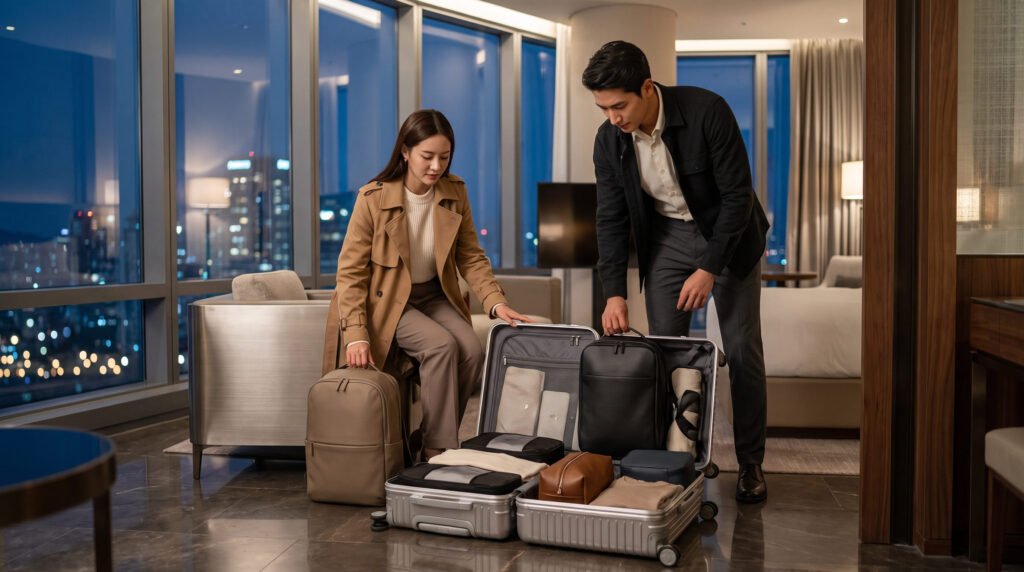
Traveling with one bag each as a couple can make a trip noticeably simpler. Fewer bags mean less time at baggage claim, easier hotel changes, and less to carry through airports, train stations, and city streets. But packing light as two people is not simply a matter of owning smaller luggage. It requires deciding what each person truly needs, what can be shared, and how to distribute everything without creating one overloaded bag.
A good one bag travel couple setup treats your luggage as a shared system. Each traveler keeps personal essentials separate, while the couple combines items that do not need to be duplicated—such as certain toiletries, chargers, adapters, laundry supplies, and first-aid items.
This guide explains how to choose your bags, build two compact wardrobes, divide shared gear, manage laundry, stay within airline requirements, and create a realistic packing system for trips from a long weekend to two weeks or more.
What Does One-Bag Travel Mean for a Couple?
For most travelers, one-bag travel means using one primary carry-on per person rather than checking luggage. Depending on the airline and fare, each traveler may also be permitted a personal item.
For a couple, that creates several possible configurations:
- One carry-on backpack per person
- One rolling carry-on per person
- One backpack and one rolling carry-on
- Two compact carry-ons plus personal items
- An especially minimalist setup where one traveler uses a main bag and the other relies heavily on a personal item
The right configuration depends on your destination, transportation, trip length, clothing requirements, and how much weight each person is comfortable carrying.
The important principle is simple: one bag does not mean packing the same amount of stuff into two smaller suitcases. It means deliberately reducing duplication and using the available space intelligently.
How Many Bags Does a Couple Actually Need?
There is no universal number because airline allowances are based on the specific passenger, itinerary, fare and carrier.
For many couples, the easiest arrangement is:
Person 1: one carry-on + personal item if permitted
Person 2: one carry-on + personal item if permitted
This provides enough capacity for most ordinary city trips while keeping each traveler responsible for their own essential belongings.
A couple can sometimes reduce the amount further by sharing more equipment, but there is a practical limit. Combining too many belongings into one person’s bag can create an uneven load and make the system frustrating.
Two Travel Backpacks
Backpacks are particularly useful when your itinerary involves trains, stairs, public transportation, or frequent hotel changes.
Best for: mobile travelers, city-hopping, rail trips and minimalist travelers.
Potential drawback: all the weight is carried on your body.
Two Rolling Carry-Ons
Rolling luggage is convenient when most of your journey takes place on smooth airport floors, roads and hotel corridors.
Best for: conventional city vacations, business trips and travelers who prefer not to carry weight on their shoulders.
Potential drawback: wheels are less convenient on cobblestones, stairs and uneven streets.
One Backpack and One Rolling Carry-On
This can work well when the couple has different physical preferences or packing requirements.
One person might carry flexible clothing and shared equipment in a backpack while the other uses a roller for heavier or more structured items.
There is no requirement for couples to have matching luggage. Choose the bags based on how you travel, not how coordinated they look.
The Most Important Rule: Separate Shared and Personal Items
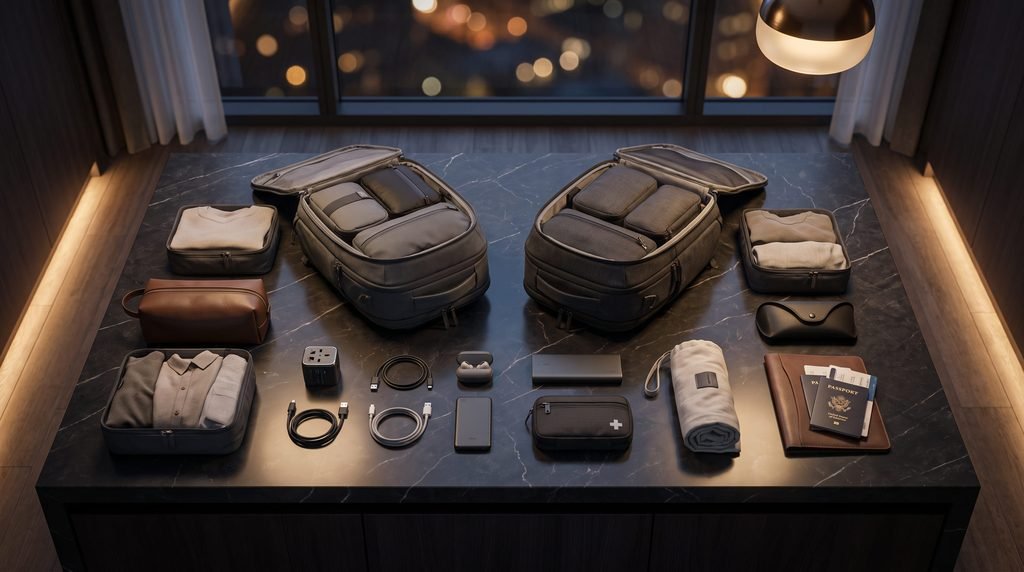
The easiest way for a couple to overpack is to create two completely independent packing lists.
Instead, divide everything into two categories.
Personal Items
Each traveler should generally keep their own:
- Underwear
- Socks
- Personal medications
- Preferred clothing
- Personal electronics
- Passport and essential documents
- Glasses or contact-lens supplies
- Personal hygiene products they cannot share
- Activity-specific equipment
Shared Items
Depending on the trip, couples can often share:
- Travel adapter
- Certain charging cables
- Toiletries
- First-aid supplies
- Laundry detergent
- Laundry bag
- Small travel umbrella
- Shared entertainment
- Some electronic accessories
- Backup cables
- Reusable travel accessories
Do not share something simply because it technically can be shared. The goal is to remove genuine duplication without creating inconvenience.
For example, two travelers may not need two large bottles of shampoo, but each person may still want their own preferred skincare products.
Build a Couple’s Capsule Wardrobe

A capsule wardrobe is one of the most effective ways to make one-bag travel work.
Instead of packing individual outfits for every day, select clothing that can be combined into multiple outfits.
A practical capsule should prioritize:
- Neutral or coordinating colors
- Layerable pieces
- Lightweight fabrics
- Quick-drying clothing
- Comfortable walking shoes
- Pieces that work across multiple settings
For example, a simple city-trip wardrobe might include a small collection of tops, two or three versatile bottoms, underwear and socks, one warmer layer, sleepwear, and a limited number of shoes.
The exact number should change according to climate and laundry access.
Use the Same Color Strategy
Couples can make their wardrobes more flexible by choosing complementary colors.
For example, if one person mainly packs black, navy and cream while the other uses beige, white and olive, many accessories and outer layers can visually coordinate without requiring matching outfits.
The objective is not to dress identically. It is to make every packed item useful with several others.
How Many Clothes Should You Pack?
Trip duration alone should not determine how many clothes you bring.
A seven-day trip without laundry may require more clothing than a fourteen-day trip where you can wash clothes every few days.
A useful starting framework is:
| Trip length | General approach |
|---|---|
| 3–4 days | Minimal wardrobe, usually no major laundry |
| 5–7 days | Compact capsule with optional laundry |
| 8–10 days | Capsule wardrobe with at least one laundry cycle |
| 11–14 days | Repeat outfits and plan regular laundry |
| 2+ weeks | Pack for the first several days, then wash and repeat |
These are planning frameworks rather than strict packing quotas.
Your climate, activities, fabric choices and access to laundry should determine the final quantity.
Shoes: The Easiest Category to Overpack
Shoes are among the least space-efficient items in a carry-on.
For most ordinary trips, each person should carefully question every additional pair.
A practical arrangement might be:
- Comfortable walking shoes worn during transit
- One compact alternative pair
- Optional activity-specific footwear when genuinely required
For beach trips, hiking trips, weddings or business travel, the requirements may be different.
The key question is:
Does this pair solve a real problem that another pair cannot?
If not, leave it behind.
Divide the Weight Instead of Splitting Everything 50/50
A common mistake is trying to make both bags identical.
They do not need to weigh the same.
Instead, distribute items according to:
- Weight
- Volume
- Frequency of access
- Personal ownership
- Physical comfort
- Airline limits
For example, one person might carry more clothing while the other carries more shared electronics and toiletries.
The goal is a balanced travel system, not two identical packing lists.
Before leaving home, pack both bags completely and weigh them.
Then physically carry them.
A bag that technically fits the airline’s dimensions can still be unpleasant if it is unnecessarily heavy.
Keep Frequently Needed Items Accessible
A beautifully organized bag is not necessarily useful if you have to unpack half of it every time you need something.
Keep commonly accessed items near the top or in an exterior compartment where appropriate:
- Passport
- Boarding information
- Headphones
- Phone charger
- Small toiletries needed during transit
- Medication
- Travel documents
Pack less frequently used clothing deeper inside.
Packing cubes can help separate categories, but they should not become an excuse to bring more.
TSA, Liquids and Airline Rules for Couples
Airline and airport rules should always be checked against the exact itinerary before departure because baggage dimensions, fare allowances and restricted-item rules can change.
For U.S. airport security, TSA’s current 3-1-1 framework generally allows liquids, aerosols, gels, creams and pastes in containers of 3.4 ounces (100 ml) or less, packed in a quart-size bag, with one such bag permitted per passenger.
That means a couple should not assume that two passengers can simply combine all their liquids into one oversized liquids bag.
Pack Toiletries as a Couple
Instead of carrying two complete toiletry kits, identify what can genuinely be shared.
Possible shared items include:
- Shampoo
- Conditioner
- Toothpaste
- Sunscreen
- Basic first-aid supplies
- Certain grooming products
Keep personal products separate when necessary.
Solid toiletries can also reduce liquid volume when they suit your preferences and destination.
Power Banks Need Special Attention
Lithium batteries and portable chargers are another area where airline rules matter.
Airlines can impose their own restrictions on portable chargers and power banks, including limits on quantity and watt-hours. For example, current policies differ among major U.S. carriers, so travelers should verify the rules of their operating airline before departure.
Never assume that a rule from one airline automatically applies to another.
Create a Laundry Strategy Before You Leave
Laundry is what makes longer one-bag trips practical.
Instead of asking:
“How many outfits do we need for two weeks?”
ask:
“How many days do we need to dress between laundry cycles?”
For many couples, washing clothing every few days can dramatically reduce the amount packed.
Simple Couple Laundry System
Bring:
- One compact laundry bag
- Small amount of suitable detergent or laundry sheets
- Quick-drying clothing where practical
- A plan for when laundry will happen
If your accommodation has laundry facilities, use them when convenient.
If not, hand-washing a few lightweight items can extend the useful life of a small wardrobe.
Avoid packing an enormous supply of laundry products. You are building a travel system, not moving your laundry room.
One-Bag Packing for 3–4 Days
A long weekend is the easiest scenario for a couple.
You can usually prioritize:
- A small clothing capsule
- One main pair of walking shoes
- Minimal toiletries
- Essential electronics
- One layer for weather changes
- Little or no laundry equipment
The biggest mistake is treating a three-day trip like a three-week expedition.
Check the forecast and actual activities before packing.
One-Bag Packing for 7 Days
For a week-long trip, a compact capsule becomes more important.
Each traveler can focus on versatile clothing that works across several outfits.
A couple can share:
- Toiletries
- Charging accessories
- Travel adapter
- First-aid basics
- Laundry supplies
One laundry cycle may also be useful if the trip includes warm-weather clothing, active travel or limited luggage capacity.
One-Bag Packing for 10 Days
At ten days, the temptation is to add more clothes.
Usually, a better solution is to improve the laundry plan.
Pack enough versatile clothing for the first several days, then wash and rotate.
This approach keeps the luggage closer to the size of a one-week trip instead of allowing it to expand simply because the calendar has more days on it.
One-Bag Packing for Two Weeks
A two-week trip does not necessarily require twice as much clothing as a one-week trip.
Instead, build around:
- A compact wardrobe
- Repeatable outfits
- Lightweight layers
- Limited shoes
- Regular laundry
- Shared equipment
This is where couples benefit most from coordinating rather than packing independently.
For example, there is little reason for both travelers to bring separate versions of every low-frequency item.
How to Pack for Different Climates
Warm Weather
Prioritize:
- Lightweight tops
- Breathable bottoms
- Compact swimwear
- Sandals if genuinely useful
- Sun protection
- Lightweight layers for air-conditioned spaces
Cold Weather
Cold-weather packing is more difficult because jackets, sweaters and footwear consume significant space.
Wear your bulkiest practical layers during transportation rather than packing them.
Focus on:
- Layering
- A versatile outer shell
- Compact insulating layers
- Warm accessories
- Shoes that work across multiple outfits
Mixed Weather
Mixed-weather trips require discipline.
Instead of packing a complete wardrobe for every possible condition, build around layers that can be combined.
A lightweight base layer plus a versatile mid-layer and weather-resistant outer layer can often cover more situations than several bulky individual garments.
A Practical One-Bag Travel Couple Packing List
Clothing — Each Person
- Versatile tops
- Two or more bottoms depending on trip length
- Underwear
- Socks
- Sleepwear
- Lightweight layer
- Weather-appropriate outer layer
- Activity-specific clothing when required
Shoes — Each Person
- Main walking shoes
- One compact secondary pair if necessary
- Specialized footwear only when the trip genuinely requires it
Shared Toiletries
- Toothpaste
- Shampoo
- Conditioner
- Sunscreen
- Basic grooming supplies
- First-aid essentials
- Small laundry supplies
Shared Electronics
- Travel adapter
- Selected charging cables
- Shared charging accessories
- Portable charger or power bank where appropriate
- Small electronics organizer
Documents
Each traveler should maintain access to their own essential travel documents, while digital backups can be organized centrally.
Consider:
- Passport
- Visa or entry documentation when required
- Booking information
- Travel insurance information
- Emergency contacts
- Copies or secure digital backups of important documents
What Couples Should Not Share
Sharing is useful, but not everything should become communal.
Keep separate:
- Prescription medication
- Personal identification
- Essential personal documents
- Personal hygiene products that require individual use
- Special-purpose clothing
- Personal electronics that are genuinely needed
- Items one traveler cannot function without
A good rule is:
Share the redundancy, not the essentials.
If one shared item is lost and both travelers become unable to use something important, the packing system may have gone too far.
Common One-Bag Couple Packing Mistakes
1. Packing Two Complete Sets of Everything
This defeats the purpose of coordinated packing.
2. Bringing Too Many Shoes
Shoes quickly consume both volume and weight.
3. Packing for Imaginary Situations
Pack for the activities you actually expect to do.
4. Ignoring Laundry
Without a laundry strategy, clothing requirements expand rapidly.
5. Making One Person Carry Everything Shared
Shared gear should be distributed intelligently.
6. Choosing a Bag by Capacity Alone
A larger bag is not automatically better. Dimensions, comfort, weight and airline compatibility matter.
7. Ignoring Personal-Item Allowances
Your personal item can provide valuable capacity, but only when the airline and fare permit it.
8. Forgetting to Weigh the Finished Bags
Always test the completed setup before departure.
9. Packing Too Many “Just in Case” Items
Every backup item should have a clear reason for occupying limited space.
10. Making Both Bags Identical
Different people have different needs. Optimize the couple’s combined luggage rather than forcing symmetry.
How to Test Your Couple’s One-Bag Setup
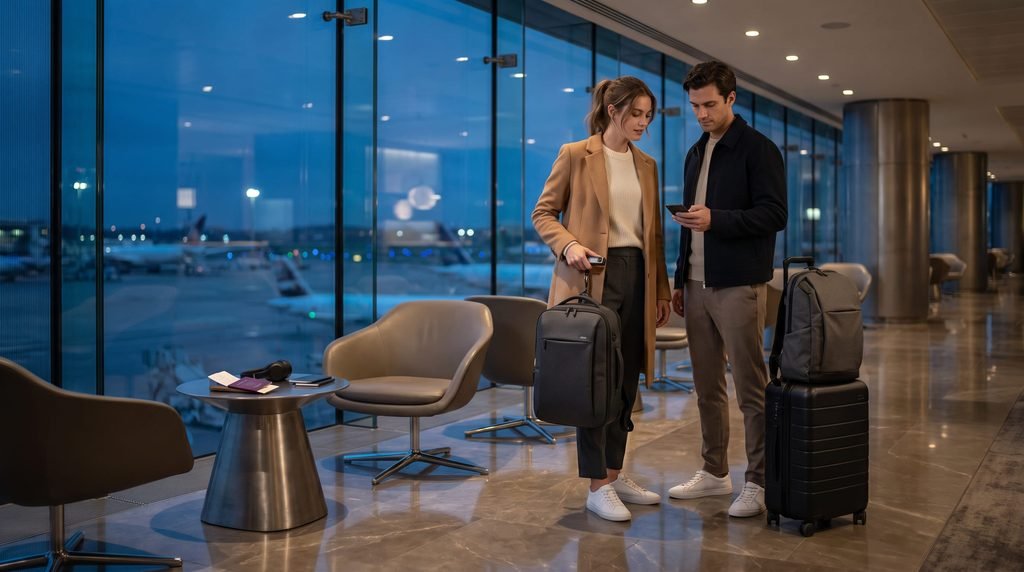
Before leaving home, perform a final test.
Step 1: Pack Everything
Do not estimate. Put the actual items inside the bags.
Step 2: Close Every Compartment
If the bag barely closes at home, it is unlikely to become easier at the airport.
Step 3: Weigh Each Bag
Compare the result with the exact airline’s current allowance.
Step 4: Carry the Bags
Walk around with them for several minutes.
Step 5: Check Accessibility
Make sure passports, medications and essential travel items are easy to reach.
Step 6: Remove Five Things
Look for items that are duplicates, rarely used, bulky or easily replaced.
This final edit is often where the biggest space savings happen.
Who Is One-Bag Couple Travel Best For?
One-bag travel works particularly well for couples who:
- Move between several destinations
- Use trains or public transportation
- Change hotels frequently
- Prefer minimalist travel
- Want to avoid checked baggage
- Enjoy building capsule wardrobes
- Can comfortably repeat outfits
- Are willing to do laundry
It can be less practical when the trip requires extensive specialist equipment, formal wardrobes, bulky winter gear, sports equipment or other items that cannot reasonably be minimized.
The goal is not to prove that you can own the smallest bag.
The goal is to carry only what supports the trip you are actually taking.
Final Pre-Flight Checklist for Two
Before leaving for the airport, confirm:
- Both bags meet the airline’s current size requirements
- Both bags are within the relevant weight limits
- Personal-item allowances have been checked
- Liquids comply with applicable security rules
- Power banks meet the operating airline’s requirements
- Passports are accessible
- Required visas or entry documents are ready
- Prescription medications are packed
- Chargers and adapters are accounted for
- Laundry supplies are included if needed
- Weather-appropriate layers are available
- No unnecessary duplicate gear remains
A successful one-bag system should feel organized rather than restrictive.
When two travelers coordinate their wardrobes, share genuinely duplicative equipment, plan laundry and distribute weight intelligently, a surprisingly small amount of luggage can support a substantial trip.
The best one bag travel couple strategy is not about packing as little as possible. It is about making every item earn its place while ensuring both travelers still have what they need to travel comfortably.
FAQs
1. How do couples pack one bag each for a trip?
Start by separating personal items from shared gear. Build a compact capsule wardrobe for each person, limit shoes, combine genuinely shareable toiletries and electronics, plan laundry, and distribute the final weight between both bags.
2. Can a couple share one carry-on bag?
They can physically share a bag, but airline baggage allowances are generally assigned according to the passenger and specific fare or itinerary. Check the operating airline’s current rules before relying on a shared-bag arrangement.
3. How many clothes should a couple pack for two weeks?
There is no universal number. A compact wardrobe combined with regular laundry is generally more practical than packing fourteen separate outfits per person. Climate, activities and laundry access should determine the final quantity.
4. What should couples share when packing?
Commonly shareable items include selected toiletries, travel adapters, charging accessories, first-aid supplies and laundry equipment. Essential personal items such as medication, identification and personal electronics should remain individually accessible.
5. Is one-bag travel practical for couples?
Yes, it can be practical when the trip, climate and activities suit a minimalist packing strategy. It becomes easier when the couple coordinates clothing, limits footwear, shares appropriate gear and plans laundry rather than trying to pack for every possible situation.
Conclusion
One-bag travel as a couple works best when you stop thinking of your luggage as two separate packing lists. Build two personal wardrobes, identify genuinely shared items, distribute weight intelligently, and use laundry to prevent clothing from taking over the bags.
Before departure, test the complete setup against your airline’s current requirements and make sure both travelers can comfortably manage their luggage.
The result is not simply lighter baggage. It is a more flexible way to travel—with fewer things to organize, fewer bags to move, and more freedom to focus on the trip itself.
1 comment