
Packing clothes efficiently is less about squeezing your suitcase harder and more about controlling the shape of what goes inside it. The Ranger Roll packing method does exactly that by turning clothing into compact, self-contained rolls that are easy to organize and retrieve.
Unlike ordinary rolling, the Ranger Roll uses part of the garment’s own hem as a locking cuff. That keeps the finished bundle from unraveling inside a suitcase or backpack. The technique is commonly associated with military-style packing and has become popular for carry-on and one-bag travel.
The method is particularly useful for T-shirts, underwear, socks, casual pants, leggings, and other soft garments. It is less suitable for structured jackets, formalwear, or fabrics where maintaining a precise shape matters more than compactness.
This guide explains exactly how to Ranger Roll clothes, which garments work best, when to use another packing method, how to combine Ranger Rolls with packing cubes, and what the technique can—and cannot—do for your luggage space.
What Is the Ranger Roll Packing Method?
The Ranger Roll is a clothing-packing technique in which you create a small cuff at the hem of a garment, fold the garment into a narrow rectangle, roll it tightly, and then pull the cuff over the finished roll to lock it closed.
That final locking step is what separates a Ranger Roll from ordinary rolling.
A conventional clothing roll can loosen as you pack other items around it. A Ranger Roll becomes a compact bundle that can be picked up, moved, and stacked without immediately coming apart.
The technique does not actually shrink the fabric. Instead, it changes the shape and arrangement of clothing, allowing soft garments to occupy awkward spaces more efficiently. Rolling can also make individual pieces easier to identify than a traditional flat stack.
For travelers with a soft-sided backpack, duffel, or compact carry-on, that difference can be especially useful because cylindrical rolls can fit into corners and irregular spaces that flat stacks may leave unused.
Does Ranger Rolling Really Save Space?
Yes, it can improve packing efficiency—but it is important to understand what “saving space” actually means.
A Ranger Roll does not compress cotton, wool, or synthetic fibers into a smaller amount of material. The clothing still has essentially the same physical mass. What changes is the shape, distribution, and organization of that clothing.
A flat-folded T-shirt creates a relatively broad rectangular block. A Ranger Roll creates a compact cylinder that can be positioned in different directions. Several small rolls can therefore fill gaps around shoes, along the sides of a backpack, or inside the corners of a suitcase.
The result depends heavily on the bag and the garments you’re packing. A well-organized Ranger Roll system can use available space efficiently, but it does not guarantee a specific percentage of additional capacity.
The biggest benefit is often organization
Instead of opening your suitcase and moving an entire clothing stack to find one T-shirt, you can identify individual rolls immediately.
That makes the technique particularly useful when:
- You’re changing hotels frequently.
- You’re living out of a backpack.
- You want to access individual outfits quickly.
- You are packing a small carry-on.
- You prefer organizing clothes by category.
- You want to avoid unpacking your entire bag.
How to Ranger Roll a T-Shirt
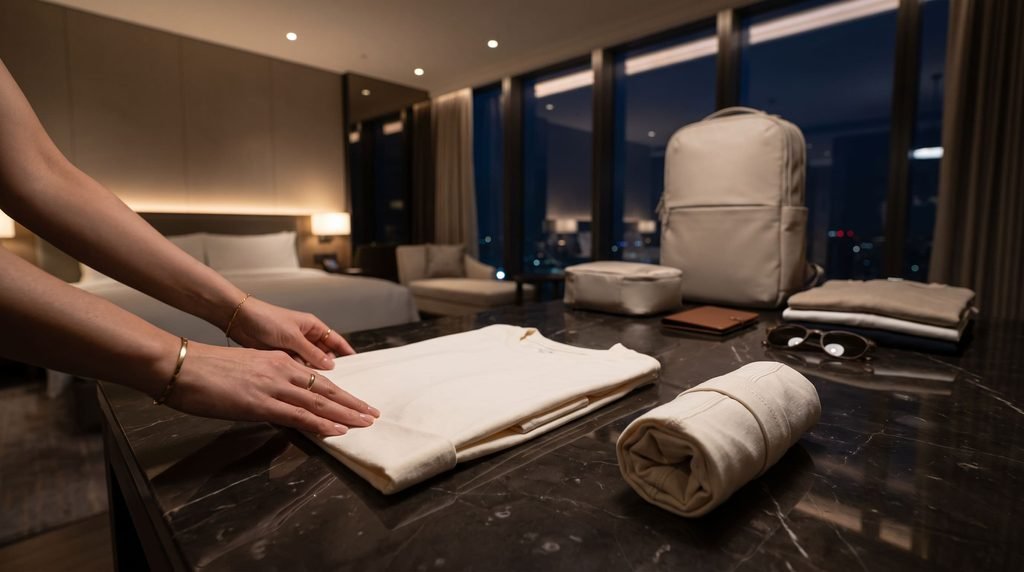
A T-shirt is the easiest garment to learn with. Once you understand the basic sequence, the same principle can be adapted to many other soft garments.
Step 1: Lay the T-Shirt Flat
Place the shirt on a clean, flat surface with the front or back facing upward.
Smooth the fabric with your hands. You don’t need to iron it; simply remove major folds and straighten the seams.
Step 2: Create the Locking Cuff
Take the bottom hem of the shirt and fold it upward by roughly 2–3 inches, turning this section outward so it forms a pocket-like cuff.
This cuff will eventually wrap around the finished roll.
The exact width does not need to be perfect. The important thing is creating enough fabric to pull securely over the completed roll.
Step 3: Fold the Sides Toward the Center
Fold one side of the shirt inward toward the middle.
Fold the sleeve neatly back over itself so it stays within the new rectangular shape.
Repeat on the other side.
You should now have a long, relatively narrow rectangle with the cuff still visible at the bottom.
Step 4: Start Rolling
Begin at the collar end and roll toward the cuff.
Keep the roll firm and even, but don’t stretch the fabric aggressively. Smooth wrinkles with your hand as you move.
A consistent roll produces a more stable finished bundle.
Step 5: Lock the Roll
When you reach the cuff, hold the completed roll firmly.
Pull the cuff up and over the outside of the roll.
The fabric cuff should wrap around the bundle and hold it closed.
That’s the defining feature of the Ranger Roll.
How to Ranger Roll Different Types of Clothes
The basic principle remains the same, but different garments require slightly different preparation.
T-Shirts
T-shirts are arguably the easiest garments for Ranger Rolling.
Fold the sleeves inward, create the hem cuff, form a narrow rectangle, and roll from the collar toward the cuff.
Lightweight cotton, merino, polyester, and similar casual fabrics generally work well.
Long-Sleeve Shirts
Lay the shirt flat and fold the sleeves inward so they don’t extend beyond the main body.
Create the cuff at the bottom, fold the garment into a narrow rectangle, and roll evenly toward the cuff.
Avoid making the roll excessively tight if the fabric is delicate or highly prone to creasing.
Pants
For casual pants, fold the legs together so you have one long shape.
If the pants have a bulky seat or pockets, fold those areas inward enough to create a reasonably even rectangle.
Roll toward the waistband or cuff according to the construction of the garment, then use the waistband or prepared cuff to secure the bundle.
Jeans
Jeans can be Ranger Rolled, but they create much denser and heavier bundles than T-shirts.
Fold one leg over the other and smooth the fabric. If the waistband is suitable for creating the locking section, use it as the securing cuff.
Because denim is heavy, avoid placing several pairs in one small area of a backpack. Concentrating too much dense clothing in one section can make the bag uncomfortable to carry.
Underwear
Underwear is an excellent candidate for Ranger Rolling because individual pieces are small and easy to lose inside a larger bag.
Fold the sides inward, create a small cuff from the waistband, roll the garment tightly, and pull the waistband over the roll.
For trips where organization matters, you can place several underwear rolls together inside a small packing cube.
Socks
Socks can be rolled individually or paired.
For a simple approach, place one sock over the other, smooth them into a narrow shape, and roll from the toe toward the cuff. Use the outer sock cuff to secure the roll if the fabric allows it.
Avoid stretching elastic unnecessarily.
Leggings
Leggings and other lightweight stretch garments are particularly easy to roll because they naturally form a narrow bundle.
Fold the legs together, smooth the fabric, fold the garment into a manageable rectangle, and roll evenly.
Because stretchy fabrics can hold tension, there’s usually little reason to make the roll extremely tight.
Hoodies and Sweatshirts
Bulky hoodies require more judgment.
You can Ranger Roll a thin sweatshirt, but thick fleece or heavyweight cotton can create a large, dense cylinder that may not use space efficiently.
For a bulky hoodie, compare the finished Ranger Roll with a simple flat fold before packing. Sometimes the flat shape works better when the suitcase has a large open compartment.
Dresses and Skirts
Soft knit dresses and casual skirts can often be rolled successfully.
Structured dresses, formalwear, pleated garments, or pieces with delicate construction are better treated more carefully.
If the garment depends on a specific silhouette or crisp folds, use a gentle fold or lay it flat instead.
Which Fabrics Work Best for Ranger Rolling?
Ranger Rolling works best when the fabric is soft, flexible, and reasonably resistant to creasing.
| Fabric / Garment Type | Ranger Roll Suitability | Why |
| T-shirt cotton | Excellent | Flexible and easy to shape |
| Merino wool | Excellent | Soft, flexible, and travel-friendly |
| Polyester blends | Excellent | Usually resilient and easy to roll |
| Jersey knit | Excellent | Naturally flexible |
| Leggings | Excellent | Stretchy and compact |
| Casual shorts | Excellent | Simple shape |
| Lightweight sweatshirt | Good | Works when not excessively bulky |
| Jeans | Good | Rollable but dense |
| Linen | Moderate | Can crease noticeably |
| Dress trousers | Moderate | May need careful folding |
| Silk | Low to moderate | Delicate and crease-sensitive |
| Blazers | Poor | Structured construction works better flat |
| Suit jackets | Poor | Preserve shape with appropriate garment packing |
| Formal dresses | Poor to moderate | Depends on construction |
Fabric behavior matters more than the label “roll-friendly.” A lightweight linen T-shirt and a heavy linen jacket will behave very differently.
Which Clothes Should You Not Ranger Roll?
Ranger Rolling is useful, but it isn’t a universal packing solution.
Structured Blazers
A blazer has internal construction that is designed to maintain shape. Aggressively rolling it can create unwanted creases and distort the garment.
Suit Jackets
For business travel, preserve the jacket’s shape rather than forcing it into a compact cylinder.
Delicate Formalwear
Garments made from delicate or highly crease-prone fabrics may benefit from careful folding, garment bags, or another protective packing method.
Crisp Dress Shirts
A casual button-down may tolerate rolling, but a formal shirt that needs a sharp collar and clean lines may be better folded properly.
Heavy Bulky Sweaters
A thick sweater can become an awkward, space-hungry cylinder. Compare rolling with a flat fold and choose whichever shape fits your particular bag more efficiently.
Ranger Roll vs. Traditional Rolling vs. Folding
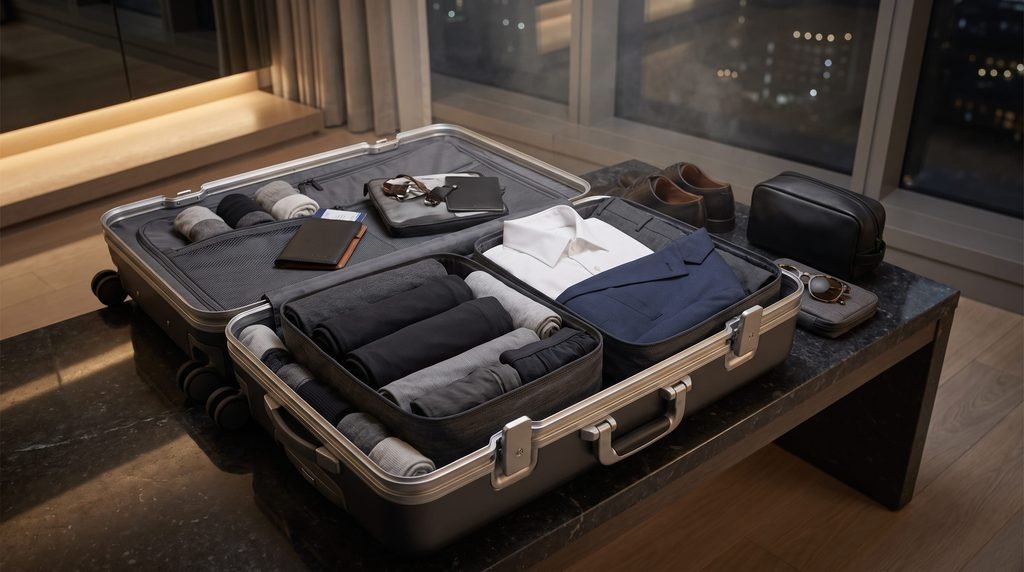
There is no single packing method that works best for every garment.
| Method | Best For | Main Advantage | Main Limitation |
| Ranger Roll | T-shirts, underwear, casual clothes | Compact and stays closed | Less suitable for structured clothing |
| Traditional Roll | Casual soft garments | Simple and flexible | Can unravel |
| Flat Fold | Shirts, formalwear, structured clothes | Preserves shape | Can leave unused gaps |
| Bundle Packing | Complete outfits | Can reduce individual fold lines | Less convenient for frequent access |
| Packing Cubes + Rolls | Organized one-bag packing | Easy categorization | Cubes can waste space if overfilled |
The smartest approach is usually hybrid packing.
Ranger Roll the garments that benefit from it. Fold or lay flat the garments that need shape protection.
How to Pack Ranger Rolls in a Carry-On
Once the clothes are rolled, packing them efficiently becomes the next step.
1. Pack Dense Items Low
Heavy garments such as jeans and thick layers can go toward the bottom of a suitcase or closer to your back in a backpack, depending on the bag’s design.
This helps create a more balanced load.
2. Use Rolls to Fill Irregular Spaces
The cylindrical shape of Ranger Rolls makes them useful around:
- Suitcase corners
- Backpack edges
- Spaces beside packing cubes
- Gaps around shoes
- Narrow sections near zippers
Don’t force rolls into spaces so tightly that you cannot remove them easily.
3. Use Packing Cubes Selectively
A packing cube can keep several Ranger Rolls together by category.
For example:
Cube 1: T-shirts and tops
Cube 2: Underwear and socks
Cube 3: Sleepwear and lightweight layers
However, you don’t need a cube for every roll. In a backpack with irregular internal space, loose rolls may sometimes fit better.
4. Keep Your First Outfit Accessible
Don’t bury the clothes you’ll need immediately after arrival.
Place your first-day outfit near the top or in an easily accessible cube.
This is particularly useful when arriving late, changing flights, or moving directly from the airport to accommodation.
5. Leave Some Flexibility
A bag packed completely rigidly can become difficult to close after you buy souvenirs or add a jacket.
Aim for an organized system with a little room for adjustment rather than packing every available gap to maximum density.
A Simple Ranger Roll Packing System for One-Bag Travel
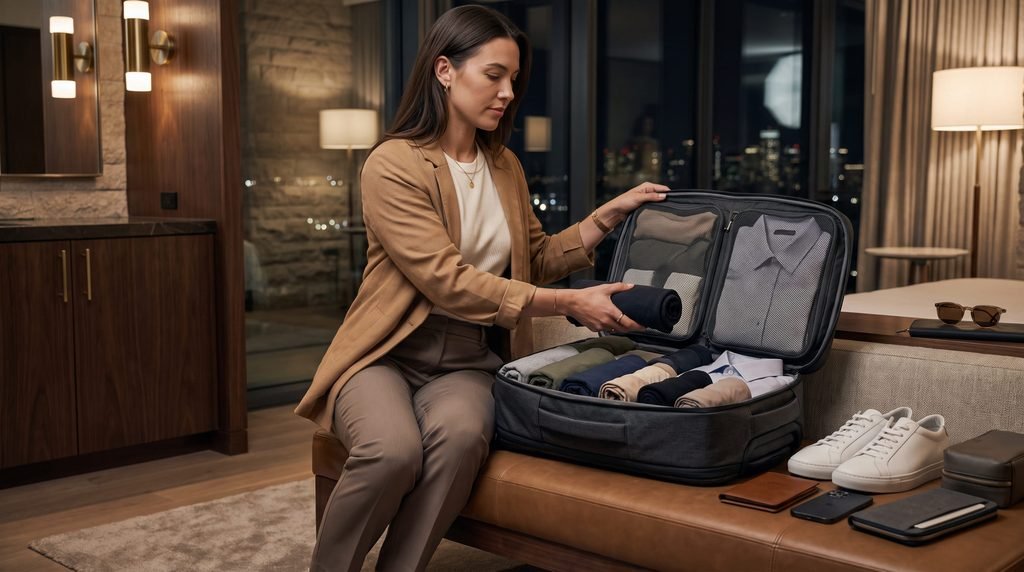
For a compact trip, organize your clothing into functional groups rather than simply rolling everything you own.
A practical system could look like this:
Everyday Tops
Ranger Roll your T-shirts and casual tops together.
Bottoms
Roll lightweight pants, shorts, and leggings individually where practical.
Small Essentials
Keep underwear and socks together in a dedicated small cube or compartment.
Layers
Pack thin sweaters, overshirts, or lightweight jackets according to how bulky they are.
Structured Clothing
Fold dress shirts, blazers, and other structured pieces separately.
Sleepwear
Keep sleepwear together so it is easy to access at night.
This approach gives you the organizational advantage of Ranger Rolling without forcing every garment into the same shape.
Does Ranger Rolling Prevent Wrinkles?
Not completely.
This is one of the most important distinctions to understand before using the technique.
Ranger Rolling can reduce some of the hard creases created by repeatedly folding clothing along the same straight lines. It can also keep garments from shifting and becoming badly crushed in certain packing situations.
But a tightly rolled garment can still develop wrinkles.
Wrinkle results depend on:
- Fabric type
- Garment construction
- How tightly you roll it
- How long it stays packed
- How much pressure surrounds it
- Whether the fabric was already wrinkled
For wrinkle-sensitive clothing, use a gentler roll or another packing method.
And remember: “wrinkle-resistant” is not the same as “wrinkle-proof.”
Common Ranger Roll Mistakes
Mistake 1: Rolling Without a Cuff
If you simply roll the garment, you are doing a traditional roll rather than a true Ranger Roll.
The cuff is what locks the finished bundle.
Mistake 2: Making the Roll Too Tight
More tension isn’t always better.
Overly aggressive rolling can stretch elastic fabrics and create unnecessary pressure on delicate garments.
Aim for compact and secure rather than rock-hard.
Mistake 3: Ignoring Fabric Type
A method that works beautifully for a T-shirt may be a poor choice for a blazer.
Choose the packing technique based on the garment.
Mistake 4: Overfilling the Bag
Ranger Rolling does not override your bag’s capacity.
If the suitcase is difficult to close, the solution isn’t necessarily to roll everything tighter. Remove unnecessary items.
Mistake 5: Confusing Packing Efficiency With Airline Compliance
A better packing technique does not change an airline’s baggage allowance, weight limit, or external size requirement.
Always check the current requirements for your specific carrier and itinerary before departure.
Mistake 6: Packing by Shape Instead of Use
A perfectly organized suitcase is not useful if your essentials are buried underneath everything else.
Think about when you’ll need each item, not just how neatly it fits.
Ranger Roll for a Weekend Trip
For a three-day trip, the technique can make a small carry-on or personal travel bag easier to organize.
A simple approach might include:
- 2–3 everyday tops
- 1–2 bottoms
- Underwear for each day plus a spare
- Socks as needed
- Sleepwear
- One lightweight layer
- Travel outfit
- Minimal shoes
Ranger Roll the soft clothing and keep structured or bulky items separate.
The goal isn’t to pack as many garments as possible. It is to pack the smallest useful wardrobe without creating a disorganized bag.
Ranger Roll for a Longer Trip
For longer travel, don’t automatically multiply your clothing quantities by the number of days.
Instead, build a small mix-and-match wardrobe and use laundry when practical.
Ranger Rolling becomes especially useful when you are carrying several interchangeable tops, underwear, socks, and casual bottoms.
For longer one-bag trips, the combination of:
repeatable outfits + lightweight fabrics + selective Ranger Rolling + laundry
is generally more effective than simply trying to make every individual garment as small as possible.
Should You Use Ranger Rolls Inside Packing Cubes?
Yes, but you don’t have to.
Packing cubes and Ranger Rolls solve different problems.
Ranger Rolling controls the shape of individual garments.
Packing cubes control the organization of multiple garments.
Using both can work well for travelers who want easy access and category-based organization.
However, don’t compress a cube simply because you can. A cube that is packed so tightly that the rolls become difficult to remove may reduce the practical benefit of the system.
Is Ranger Rolling Better for Backpacks or Suitcases?
It can work with both.
Backpacks
Ranger Rolls can be particularly useful in soft-sided backpacks because the individual bundles can conform to irregular spaces.
They’re also convenient when you’re frequently accessing individual garments.
Suitcases
Suitcases often have larger rectangular compartments, so flat folds and packing cubes can sometimes use the main compartment more efficiently.
Ranger Rolls are still useful for filling corners, organizing small clothing categories, or creating easy-access bundles.
Duffel Bags
Duffels are another strong use case because their flexible walls allow rolls to occupy irregular shapes.
When Should You Use Another Packing Method?
Choose another technique when it solves the specific problem better.
Use flat folding when:
- The garment is structured.
- You need to preserve a crease.
- The bag has a large rectangular compartment.
Use bundle packing when:
- You want complete outfits grouped together.
- You are less concerned about accessing individual pieces.
Use packing cubes without rolling when:
- Your clothes already stack efficiently.
- You prefer simple organization.
- The garments are better preserved in a folded shape.
Use a combination of methods when your luggage contains a mixture of casual and formal clothing.
That hybrid approach is often more practical than treating the Ranger Roll as a universal answer.
The Best Way to Think About Ranger Rolling
The Ranger Roll isn’t a magic compression trick.
Its real strength is that it gives soft clothing a compact, stable, movable shape.
That makes it easier to organize a small bag, fill awkward spaces, separate clothing categories, and access individual garments without disturbing everything around them.
For one-bag travel, the best result usually comes from combining the technique with a carefully edited wardrobe, smart packing cubes, appropriate fabric choices, and realistic luggage limits.
Use the Ranger Roll where it makes sense. Fold what needs folding. Protect what needs protecting. The goal isn’t the neatest possible suitcase—it is a bag that works smoothly throughout the trip.
FAQS
1. What is the Ranger Roll packing method?
The Ranger Roll is a clothing-packing technique that creates a cuff at the garment’s hem, rolls the clothing into a compact cylinder, and then pulls the cuff around the roll to keep it secured. It is especially useful for soft travel clothing such as T-shirts, underwear, socks, and casual pants.
2. Does Ranger Rolling actually save space?
It can improve how efficiently clothing occupies a bag, but it does not physically shrink the fabric. The main advantage comes from changing flat garments into compact shapes that can fit around corners and other irregular spaces more effectively.
3. Does Ranger Rolling prevent wrinkles?
No packing method can guarantee wrinkle-free clothing. Ranger Rolling may reduce some hard fold lines in suitable garments, but wrinkle results depend on the fabric, garment construction, packing pressure, and how long the clothing remains packed.
4. What clothes should you not Ranger Roll?
Structured garments such as blazers, suit jackets, some formal shirts, and delicate formalwear are usually better folded or packed using a method designed to preserve their shape. Thick sweaters may also be more space-efficient when folded.
5. Is Ranger Rolling better than folding clothes?
Neither method is universally better. Ranger Rolling is particularly useful for soft, flexible clothing and compact bags, while folding can be better for structured, delicate, or crease-sensitive garments. A hybrid packing system is often the most practical choice.
Conclusion
The Ranger Roll packing method is a simple technique with a useful advantage: it turns individual soft garments into compact bundles that stay together and are easy to organize.
Its greatest value comes from using it selectively. Ranger Roll T-shirts, underwear, socks, leggings, and suitable casual clothing, while treating structured and delicate garments differently. Combine the rolls with sensible packing cubes, an edited travel wardrobe, and smart placement inside your bag.
Most importantly, don’t chase maximum compression at the expense of practicality. The best packing method is the one that lets you carry what you need, find it quickly, protect your clothes, and move comfortably throughout the trip.
1 comment