
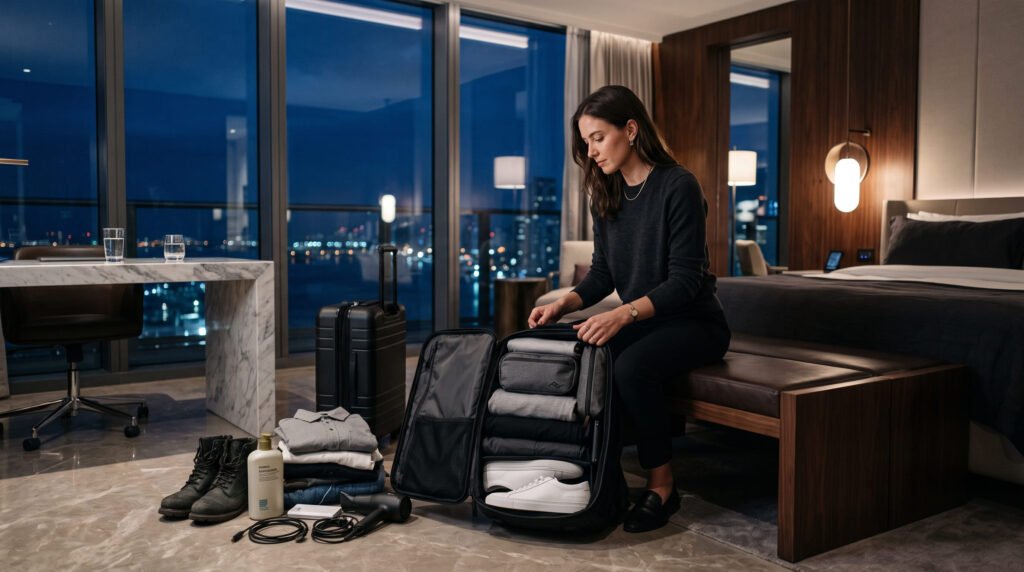
Overpacking rarely happens because a traveler owns too little luggage. It happens because every item seems useful when viewed in isolation. An extra shirt feels sensible, a second pair of shoes feels reassuring, and a “just in case” jacket can seem impossible to leave behind.
Learning how to stop overpacking is less about owning less and more about making better decisions before a trip. The most effective approach is to pack around your actual itinerary, choose your luggage limit early, build a small wardrobe that works together, plan for laundry, and question items that exist only for hypothetical situations.
This guide explains how to develop a practical one-bag mindset, decide what deserves space, reduce unnecessary clothing and gear, and create a packing system you can reuse for almost any trip.
What Causes Overpacking in the First Place?
Overpacking usually begins before the suitcase comes out.
The problem is often the gap between what a trip requires and what a traveler imagines might happen. You may pack for rain that is unlikely, a formal dinner that was never planned, several possible outfit combinations, or activities you have not actually scheduled.
Another common mistake is treating trip length as a direct measure of how much clothing you need. A 14-day trip does not automatically require twice as many clothes as a seven-day trip, particularly if you can wash clothing along the way.
The better question is not:
“What might I possibly need?”
It is:
“What does this specific trip actually require?”
That shift is the foundation of one-bag travel.
The One-Bag Mindset: Pack for the Trip You Are Taking
A one-bag mindset does not mean owning as few possessions as possible or forcing every journey into a tiny backpack.
It means treating luggage space as a limited resource and deciding deliberately how to use it.
Before packing, define five things:
- Where you are going
- What the weather will be like
- What you will actually do
- Where you will stay
- What baggage allowance applies to your ticket
A city break, business trip, beach holiday, winter vacation and hiking trip all require different packing strategies.
Minimalist packing works best when it is trip-specific rather than ideology-driven.
Start With Your Luggage Limit
One of the easiest ways to stop overpacking is to choose your bag before choosing your belongings.
A large suitcase gives you permission to keep adding things. A defined luggage limit forces decisions earlier.
For one-bag travel, the right capacity depends on your destination, clothing requirements, personal needs and airline restrictions. Bag volume alone is not enough: external dimensions and weight limits can matter just as much.
Always check the baggage rules for the airline and fare you are actually flying. Carry-on and personal-item allowances vary between airlines and can differ by route and ticket type. IATA also notes that baggage allowances are ultimately airline-specific.
The goal is not to find the smallest possible bag.
The goal is to find a realistic bag that is large enough for your essentials but restrictive enough to discourage unnecessary additions.
Build Your Packing List From the Itinerary
Before putting anything into the bag, review your actual plans.
Write down the activities that genuinely require different clothing or equipment:
- Airport and travel days
- Everyday sightseeing
- Restaurants or evenings out
- Business meetings
- Hiking or outdoor activities
- Beach or swimming
- Exercise
- Formal events
- Cold-weather activities
Then identify which activities overlap.
A single pair of versatile trousers may work for sightseeing and dinner. A lightweight layer may work over several tops. Comfortable walking shoes may also be suitable for casual evenings.
This approach prevents you from creating a separate outfit for every possible moment.
Build Outfits, Not Piles of Clothes
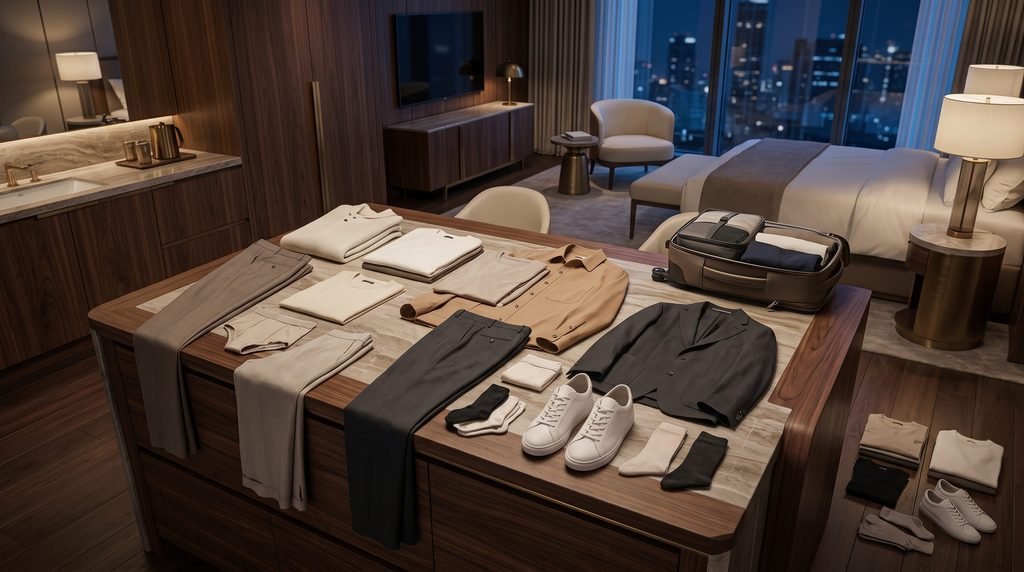
One of the most effective ways to stop overpacking clothes is to stop thinking about individual garments.
Instead of saying:
“I should bring six shirts.”
Build actual combinations.
For example, choose a small group of tops, bottoms and layers that can be mixed together. Neutral or coordinated colors often make this easier, but the principle works with any personal style.
A compact travel wardrobe might include:
- A few versatile tops
- Two or three compatible bottoms
- One lightweight layer
- One warmer layer when necessary
- Underwear and socks appropriate to your laundry schedule
- One main pair of walking shoes
- A second pair only when the itinerary genuinely justifies it
The exact numbers should change according to climate, trip type and personal requirements.
The important principle is outfit flexibility.
If a garment works with only one other item, it deserves more scrutiny than one that works across several outfits.
Stop Packing for Every Day of the Trip
This is one of the biggest mindset changes in minimalist travel.
If you are traveling for 14 days, you do not necessarily need 14 days of clothing.
Instead, think in terms of a clothing cycle.
Wear, wash, dry, and repeat.
Laundry might happen:
- At the hotel
- At an apartment or vacation rental
- At a laundromat
- Through a hotel laundry service
- With simple sink washing for selected lightweight garments
A seven-day wardrobe can therefore support a much longer trip when washing is practical.
The key is to check laundry access before departure rather than assuming it will be convenient.
Use a Laundry Strategy Instead of Carrying More Clothes
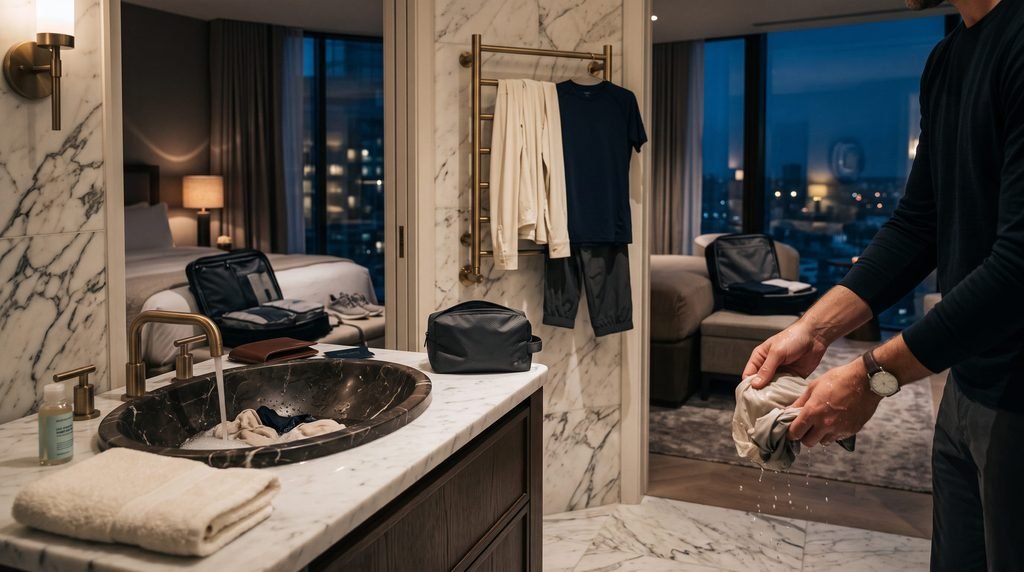
Laundry becomes especially valuable when traveling for more than a week.
A practical system is to identify the point at which you will run low on clean essentials and schedule washing before that happens.
For example, rather than carrying a large number of shirts, you might pack a smaller rotation and wash part of it during the trip.
Quick-drying fabrics can be particularly useful when hand washing is involved, although fabric choice should still depend on climate, comfort and personal preference.
Laundry also changes the way you think about emergency clothing.
Instead of asking, “How many outfits do I need for the entire trip?” ask:
“How many days do I need to cover between laundry opportunities?”
That is usually a much smaller number.
Apply the “Would I Actually Use This?” Test
Before an item enters the bag, ask:
- What specific situation will I use this for?
- Is that situation actually part of my trip?
- Can something else I am already carrying do the same job?
- If I need it unexpectedly, is there a realistic alternative?
- Is its space and weight justified?
This is more useful than simply asking whether something is “useful.”
Almost everything can be useful under the right circumstances.
The real question is whether it is useful enough for this particular trip.
Eliminate the “Just in Case” Pile
“Just in case” is one of the most expensive phrases in packing.
It can turn a compact travel bag into a collection of hypothetical solutions.
Common examples include:
- Extra outfits
- Multiple jackets
- A second pair of shoes
- Specialized equipment without a planned activity
- Too many toiletries
- Duplicate chargers
- Extra accessories
- Books you probably will not read
- Clothing for weather that the forecast does not support
This does not mean every low-frequency item should be removed.
Medication, essential documents, necessary medical equipment, safety items and destination-specific necessities may be used rarely but remain essential.
The better distinction is between low-frequency essentials and hypothetical conveniences.
Limit Your Shoes Before They Take Over the Bag
Shoes are among the easiest ways to consume luggage space.
Before packing another pair, consider:
- How many activities actually require it?
- Can your main shoes handle multiple situations?
- Will you genuinely wear the second pair?
- Is the second pair solving a real problem?
For many trips, one comfortable, versatile pair may do most of the work.
A second pair can make sense for specific needs such as formal events, beach destinations, hiking or specialized activities. The point is not to impose a universal shoe limit; it is to make every pair earn its space.
Reduce Toiletries Without Sacrificing Essentials
Toiletries often become miniature versions of the overpacking problem.
Travelers may bring full-size products, multiple grooming options, backup products and items that are readily available at the destination.
Start by separating toiletries into:
Essential: medication, hygiene basics, products you genuinely need.
Useful: items that improve comfort but are replaceable or optional.
Duplicate: products that perform overlapping functions.
Where permitted and appropriate, use smaller containers for products you actually need. For air travel, remember that liquid restrictions depend on the applicable security authority and airport; travelers departing from the United States should check current TSA guidance before packing liquids.
The goal is not to become uncomfortable.
It is to stop carrying a full bathroom when a small, deliberate kit will do.
Simplify Your Electronics
Technology can quietly turn one-bag travel into heavy travel.
Before packing every device, identify what you will actually use.
Consider:
- Phone
- Laptop or tablet
- Charging cable
- Appropriate charger
- Power bank when needed
- Headphones
- Destination-specific adapters
Avoid carrying separate accessories when one solution can serve multiple devices.
If you bring a laptop, ask whether you genuinely need it for the trip. If your phone can handle the tasks you expect to perform, leaving another device behind may save meaningful space and weight.
Choose Versatile Items Over Specialized Ones
A versatile item earns its place by solving several problems.
Examples include:
- A lightweight layer that works across temperatures
- Shoes suitable for both sightseeing and casual dining
- A day bag that doubles as an in-transit personal item
- Clothing that works for multiple activities
- A charger capable of handling several devices
This does not mean every item needs to perform five different jobs.
It simply means that when two items occupy similar amounts of space, the more versatile one often provides greater value.
Don’t Confuse Minimalism With Being Unprepared
One-bag travel should not become a competition to see who can survive with the fewest possessions.
There are situations where carrying additional equipment is entirely reasonable.
You may need:
- Cold-weather gear
- Specialized outdoor equipment
- Professional camera equipment
- Business attire
- Clothing for a wedding
- Child-related essentials
- Medical supplies
- Accessibility equipment
The objective is not to eliminate necessary belongings.
It is to eliminate unnecessary belongings.
A well-packed bag can still contain everything required for a comfortable and responsible trip.
Use the Destination to Your Advantage
Travelers often pack as though every possible need must be solved before leaving home.
But many destinations have access to ordinary essentials.
Depending on where you are traveling, you may be able to purchase or replace:
- Basic toiletries
- Simple clothing
- Snacks
- Laundry supplies
- Umbrellas
- Charging cables
- Other everyday necessities
This does not mean you should deliberately arrive without essentials.
It means you should consider replaceability when deciding whether an item deserves valuable luggage space.
Prescription medication, critical documents and specialized necessities should never be treated as casually replaceable.
Pack According to Climate, Not Calendar
A common packing mistake is using the number of days to determine clothing quantity while ignoring the weather.
A five-day winter trip can require more specialized clothing than a two-week warm-weather journey.
Check:
- Expected daytime temperatures
- Nighttime temperatures
- Rain
- Wind
- Humidity
- Snow or extreme conditions
- Indoor heating or air conditioning
- Your planned activities
Then build your clothing system around those conditions.
Layering is often more efficient than packing multiple complete outfits for every possible temperature.
Make Your Packing List Smaller Before You Make Your Bag Larger
When everything does not fit, the instinct is often to upgrade to a bigger suitcase.
Try editing first.
Remove:
- Duplicate clothing
- Hypothetical outfits
- Unused accessories
- Excess toiletries
- Duplicate electronics
- Low-value convenience items
- Items without a specific use
- Clothing that works with nothing else
Only after editing should you consider whether the bag itself is genuinely too small.
This single habit can prevent luggage from growing every time your packing list does.
The 10-Minute Final Packing Audit
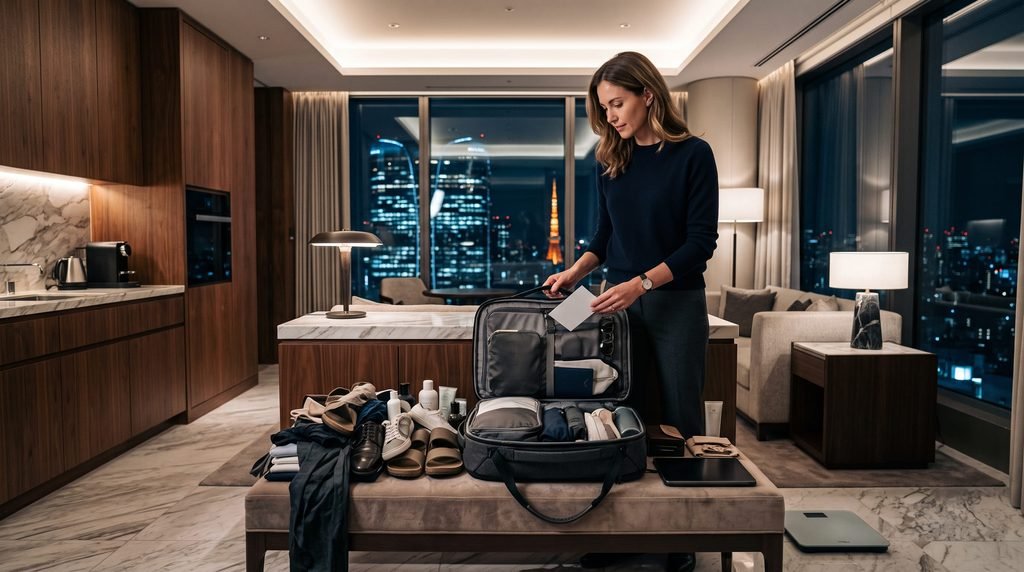
Once the bag appears finished, stop adding things.
Then perform one final audit.
Check 1: Weather
Does every clothing category match the forecast and realistic conditions?
Check 2: Itinerary
Is each specialized item connected to an actual activity?
Check 3: Duplicates
Do two items perform essentially the same job?
Check 4: Shoes
Will every pair actually be worn?
Check 5: Toiletries
Can the kit be reduced without compromising genuine needs?
Check 6: Electronics
Are you carrying devices and accessories you will actually use?
Check 7: Laundry
Could washing allow you to remove another clothing item?
Check 8: Airline Rules
Does the bag meet the relevant size and weight restrictions?
Check 9: Essentials
Are documents, medication, required equipment and critical items accounted for?
Check 10: The “What If?” Test
Which items are still in the bag primarily because something unlikely might happen?
Those are your first candidates for removal.
Create a Master One-Bag Packing List
The biggest advantage of a good packing system is that you do not need to reinvent it for every trip.
After each journey, make three notes:
Used constantly: Keep these on the master list.
Used occasionally: Keep them available for specific trip types.
Never used: Question whether they deserve a place next time.
Over several trips, your list becomes increasingly personal.
You learn how many clothes you actually wear, which toiletries you genuinely need, which electronics stay untouched, and which “emergency” items repeatedly come home unused.
Your packing list becomes based on evidence from your own travel, not assumptions.
How to Stop Overpacking Without Becoming Uncomfortable
The most sustainable approach is not extreme minimalism.
It is intentional packing.
Keep what is necessary. Keep what makes the trip significantly better. Remove what exists only because you are afraid of being without it.
A useful hierarchy is:
Essential → Frequently useful → Versatile → Replaceable → Hypothetical
Pack heavily from the first categories and scrutinize the last two.
That gives you the benefits of one-bag travel without turning every journey into a minimalist challenge.
Who Benefits Most From One-Bag Travel?
One-bag travel can be particularly useful for:
Frequent Travelers
A repeatable system reduces packing time and makes departures easier.
City Travelers
Traveling with less luggage can make trains, buses, stairs and crowded streets easier to navigate.
Carry-On Travelers
A smaller, organized setup can help travelers stay within applicable baggage restrictions.
Slow Travelers
Longer stays often make laundry and repeatable outfits especially practical.
Business Travelers
A coordinated wardrobe and streamlined electronics setup can reduce unnecessary bulk.
Travelers Who Move Frequently
If you change hotels every few days, carrying less can simplify every transition.
It may be less suitable when a trip genuinely requires specialized equipment, extensive cold-weather clothing or substantial family gear.
Common One-Bag Packing Mistakes
Packing for the Entire Trip Without Laundry
Trip length is not the same thing as clothing requirements.
Taking Too Many Shoes
Shoes are bulky and often underused.
Packing Individual Items Instead of Outfits
A large collection of clothes does not guarantee a large number of useful outfits.
Carrying Full-Size Toiletries
Many travelers bring more product than they can realistically use.
Keeping “Just in Case” Items
Hypothetical scenarios are one of the fastest ways to fill luggage.
Ignoring Airline Restrictions
A bag that fits physically may still exceed a weight or fare-specific restriction.
Trying to Minimize Everything
Removing genuinely useful or necessary items defeats the purpose. One-bag travel should make the journey easier, not less comfortable.
The Simple Formula for Packing Lighter
A practical one-bag system can be reduced to this:
Trip requirements → baggage limits → outfits → laundry → essentials → versatile items → final edit
Start with what the trip demands.
Then work within the physical limits of your luggage.
Build a wardrobe around actual outfits rather than individual pieces. Use laundry to break the connection between trip length and clothing quantity. Add genuine essentials and versatile gear. Finally, remove anything that exists mainly because you are imagining problems that may never occur.
That is how how to stop overpacking becomes a repeatable skill rather than another packing resolution you forget before the next trip.
FAQs
1. How do I stop overpacking for a trip?
Start with your actual itinerary, weather, activities, accommodation and baggage allowance. Build outfits rather than packing individual items, plan for laundry, eliminate duplicates and question anything packed only for a hypothetical situation.
2. How many clothes should I pack for a one-week trip?
There is no universal number because climate, activities and laundry access vary. A better approach is to create a small mix-and-match wardrobe that covers the period between realistic laundry opportunities rather than packing one complete outfit for every day.
3. Can I travel for two weeks with one carry-on?
Yes, many travelers can do so when the destination and itinerary allow it. The key is a versatile wardrobe, sensible laundry planning, limited footwear and careful attention to the airline’s current size and weight requirements.
4. What should I leave out of my travel bag?
Start with duplicate clothing, unnecessary shoes, excess toiletries, unused electronics, specialized equipment without a planned use and “just in case” items. Do not remove genuine essentials such as required medication, important documents or necessary medical and accessibility equipment.
5. What is the best way to pack light without forgetting essentials?
Create your essential list before trying to minimize it. Separate genuine necessities from conveniences, check the destination and itinerary, then reduce duplicates and hypothetical items. A final checklist for documents, medication, weather, electronics and required equipment can prevent over-editing.
Conclusion
Learning how to stop overpacking is ultimately about making decisions before your luggage makes them for you.
Choose a realistic bag, understand the trip you are actually taking, build coordinated outfits, use laundry strategically, prioritize versatile items and challenge every “just in case” addition. Keep genuine necessities without apologizing for them, and remove the belongings that add weight without meaningful value.
The best one-bag packing system is not the one that contains the fewest things. It is the one that contains everything you genuinely need—and very little that you do not.
1 comment