
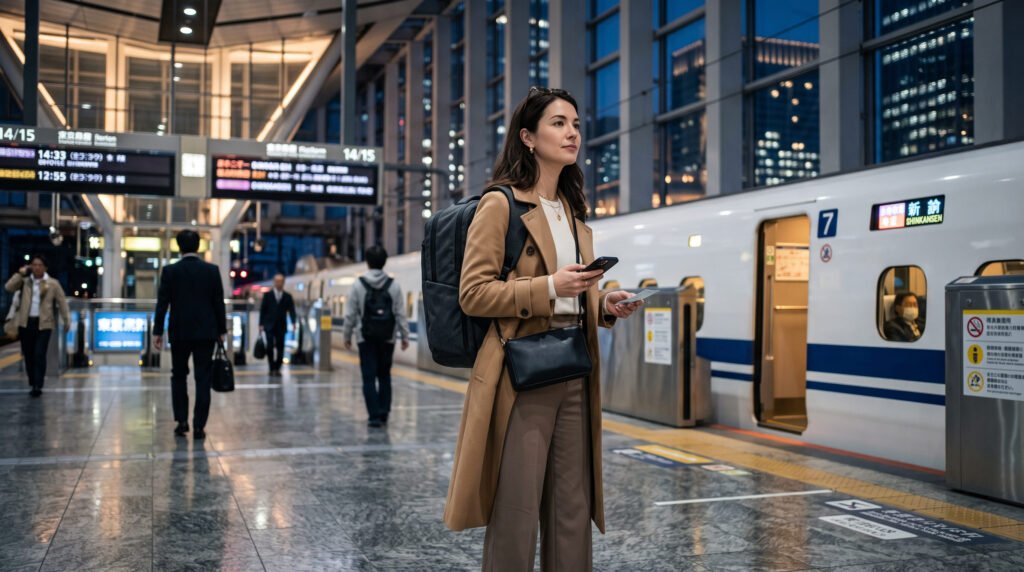
Japan rewards travelers who pack with intention. Between efficient rail networks, compact city hotels, coin laundries, convenience stores, and luggage-delivery services, you rarely need to carry a huge suitcase from one destination to the next.
That makes one-bag travel Japan an especially practical approach—but only if you build your bag around how Japan is actually experienced. A trip that combines Tokyo, Kyoto, Osaka, mountain areas, temples, restaurants, and long train days can involve far more walking and changing conditions than a simple city break.
The goal is not to pack as little as physically possible. It is to bring enough to stay comfortable while removing everything that creates unnecessary weight, bulk, or duplication.
This guide explains how to choose your bag, build a versatile Japan travel wardrobe, handle laundry, manage trains and luggage forwarding, prepare for different seasons, and adjust your packing strategy for trips from a few days to several weeks.
Is Japan Good for One-Bag Travel?
Yes—particularly for travelers planning a multi-city itinerary.
Japan’s combination of urban infrastructure, public transportation, convenience stores, hotels, laundries, and luggage-delivery services makes it possible to travel with considerably less than you might expect.
The important distinction is between one-bag travel and extreme minimalism. You do not need to reduce your possessions to a tiny personal item. A practical carry-on backpack in roughly the 25–35-liter range is enough for many travelers, while colder-weather trips may justify more capacity.
One-bag travel works especially well when your itinerary includes several stops. Instead of dragging a large suitcase through stations and transferring between trains, you can keep your essentials with you and move through the country more easily.
It is particularly suitable for:
- First-time visitors moving between several cities
- Solo travelers
- Couples who prefer flexible transportation
- Travelers who expect to walk extensively
- People comfortable doing laundry during a trip
- Minimalists who prefer fewer possessions
- Travelers staying in hotels with laundry facilities
It becomes less convenient when you are carrying specialized photography equipment, winter sports gear, formal clothing, large souvenirs, or equipment for several different outdoor activities.
How Big Should Your Japan Travel Bag Be?
For most travelers, 25–35 liters is the sweet spot for one-bag travel in Japan.
The ideal size depends less on the number of days and more on your clothing system, season, and willingness to do laundry.
| Bag capacity | Best suited to |
| 20–25L | Warm-weather minimalists and very light packers |
| 25–30L | Most minimalist Japan trips |
| 30–35L | Cooler weather and travelers wanting more flexibility |
| 35–40L | Bulky winter layers, camera equipment, or less-minimal packing |
A smaller bag encourages discipline, but going too small can become counterproductive. If you have to compress everything aggressively, carry items outside the bag, or wear uncomfortable layers simply to save space, the system has gone too far.
Also check your airline’s actual carry-on dimensions and weight allowance before departure. A bag that qualifies as carry-on with one airline may not meet another carrier’s requirements.
The 25–30L sweet spot
For a typical spring, summer, or autumn itinerary through Tokyo, Kyoto, Osaka, and similar destinations, a 25–30L backpack can work extremely well.
You can pack a compact wardrobe, toiletries, electronics, documents, and a few organizational accessories while keeping the bag manageable on trains and in crowded stations.
When 30–35L makes more sense
Choose more capacity if you are traveling during colder months, visiting multiple climates, carrying a camera setup, or simply prefer a little more breathing room.
The extra space should be used for genuinely bulky items—not as an invitation to add another five outfits.
What to Pack for Japan With One Bag
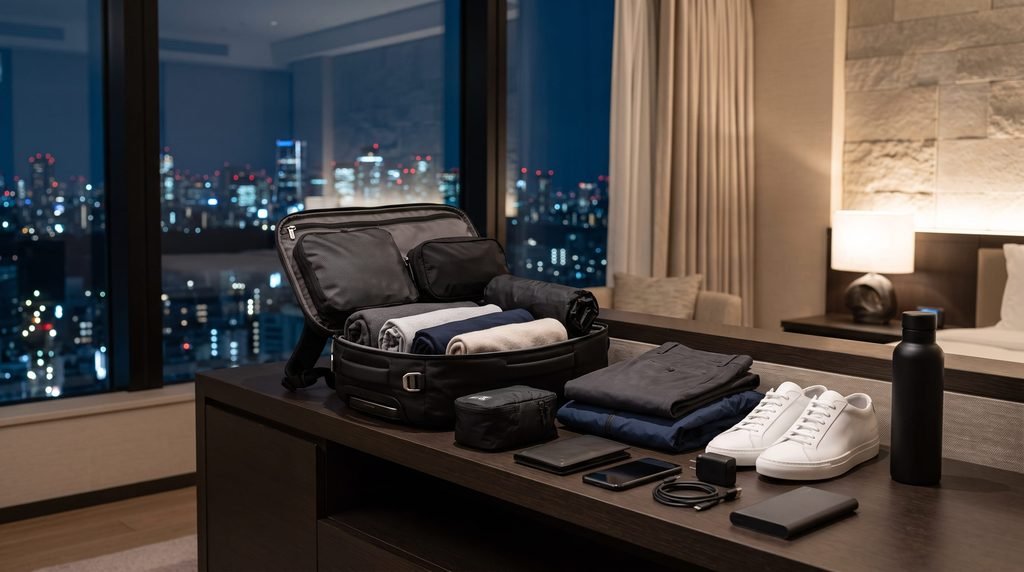
The strongest one-bag system is based on repeatable outfits rather than individual occasions.
Instead of asking, “What might I wear each day?” ask:
“What small group of clothes can create the most useful combinations?”
For a typical 7–14 day trip, a practical starting point is:
Clothing
- 4–5 tops
- 2–3 pairs of versatile trousers or shorts, depending on season
- 5–7 pairs of underwear
- 4–6 pairs of socks
- 1 lightweight sleep layer
- 1 versatile mid-layer
- 1 weather-appropriate outer layer
- 1 compact rain layer when needed
You can reduce these quantities further if you are comfortable doing laundry every few days.
The exact numbers should change with the season. Summer clothing can be light and compact, while winter layers consume substantially more space.
Build around a capsule wardrobe
Choose colors and pieces that work together.
For example:
- One dark trouser
- One lighter trouser
- Four neutral tops
- One lightweight sweater
- One weatherproof outer layer
That combination gives you substantially more outfit possibilities than six unrelated shirts and three specialized pairs of trousers.
Avoid packing clothing for hypothetical situations. If an item only works with one other piece, question whether it deserves valuable bag space.
Shoes for One-Bag Travel in Japan
Shoes are one of the easiest ways to destroy a minimalist packing strategy.
For most travelers, one comfortable primary walking shoe is enough.
Japan can involve long days on foot, stairs, station transfers, temple visits, and uneven surfaces. Prioritize comfort over fashion versatility.
Your primary shoe should ideally be:
- Comfortable for extended walking
- Broken in before departure
- Reasonably lightweight
- Suitable for your expected weather
- Easy enough to remove when required
A second pair can make sense if you have a specific reason—such as formal dinners, hiking, rainy conditions, or winter travel—but it should earn its space.
Temple and traditional-building visits are another reason to think about footwear. Some temple buildings require visitors to remove their shoes, so clean, comfortable socks are surprisingly important. JNTO specifically advises visitors to wear good socks because shoes may need to be removed.
Minimal Toiletries for Japan
Toiletries should be treated as consumables rather than collectibles.
Pack only what you genuinely prefer to have with you.
A compact toiletry kit can include:
- Toothbrush
- Small toothpaste
- Deodorant
- Minimal skincare
- Sunscreen
- Basic grooming items
- Any essential medication
- Small laundry supplies if desired
For many ordinary toiletries, you do not need to carry large quantities for a multi-week trip.
The one exception is anything specific to your personal needs. If you rely on a particular product or medication, do not assume you can easily replace it with an identical formulation after arrival.
Be careful with medication
Japan has specific rules governing the import of medicines, and the rules depend on the substance, quantity, and type of medication.
Japan’s Ministry of Health, Labour and Welfare states that certain personal-use medicines can be brought in within specified quantities without an Import Confirmation, while controlled substances and some other medicines require advance procedures.
Do not rely on a generic “medicine is fine” packing rule. Check the active ingredients and current Japanese requirements for anything you regularly take before departure.
Electronics for One-Bag Japan Travel
You can keep the electronics kit surprisingly small.
A practical setup might include:
- Smartphone
- Phone charging cable
- Compact wall charger
- Power bank
- Earbuds or headphones
- Travel adapter if required for your devices
- Optional camera
- Optional tablet or laptop
Your smartphone can handle navigation, translation, reservations, tickets, communication, and photography, so carrying several overlapping devices usually adds weight without adding much functionality.
eSIM or mobile data
Having reliable mobile data can make Japan considerably easier to navigate, particularly when checking train routes, translating signs, locating restaurants, and accessing reservations.
Choose a connectivity option before departure and make sure your phone is compatible with it.
Portable charger
A compact power bank is particularly useful on long sightseeing days. Navigation, photography, translation, and mobile data can consume battery quickly.
Keep your charging setup simple: one charger, the necessary cables, and one compact battery.
Documents, Money and Travel Essentials
Your one-bag system should keep the most important items easy to access.
Carry:
- Passport
- Required visa or travel authorization documents
- Flight information
- Accommodation details
- Travel insurance information
- Payment cards
- Some Japanese yen
- Emergency contact information
- Copies or secure digital records of important documents
Do not put your passport, wallet, medication, or essential electronics deep inside your backpack where accessing them requires unpacking half the bag.
A small personal-access pouch makes airport days and hotel check-ins much easier.
Do You Need Cash in Japan?
Do not assume Japan is entirely cashless.
Cards and electronic payments are widely useful, and transportation IC cards can simplify many everyday purchases and journeys. PASMO, for example, can be used for participating train and bus networks as well as cashless purchases, although acceptance varies by operator.
It is still sensible to carry some yen for situations where cash is required or simply more convenient.
The minimalist solution is not carrying a large amount of cash. Keep a modest reserve and use your preferred payment methods where accepted.
How to Do Laundry During One-Bag Travel in Japan
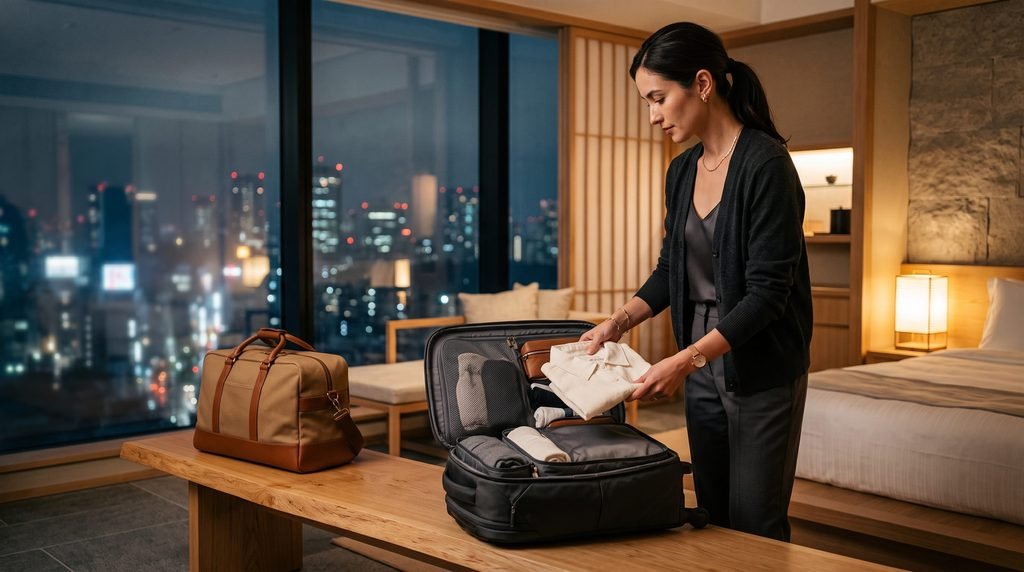
Laundry is the secret behind making a one-bag trip last two or three weeks without packing three weeks of clothing.
Instead of calculating clothing based on the total length of your trip, calculate it around your laundry cycle.
For example, a traveler staying 14 days does not necessarily need 14 outfits.
A better system might be:
Wear → wash → dry → repeat.
Hotel laundry
Some hotels provide washing machines or dedicated laundry rooms. Check your accommodation before arrival if laundry access is important to your packing strategy.
Coin laundries
Coin-operated laundries can be useful when your accommodation does not provide washing facilities.
They are especially valuable during longer stays because they let you maintain a small wardrobe without carrying extra clothing.
Hand washing
A sink-wash system can work for underwear, socks, and lightweight shirts.
Bring a small amount of concentrated detergent if you prefer doing minor washes yourself, but do not turn your trip into a daily laundry chore. The goal is convenience, not perfection.
The ideal laundry rhythm
For many travelers, washing every few days is a comfortable compromise.
That allows you to keep your clothing quantity low while avoiding the feeling that you are constantly doing laundry.
How to Handle Japanese Trains With One Bag

One-bag travel becomes particularly attractive when your itinerary involves Japan’s extensive rail network.
A compact backpack is easier to manage through stations, on escalators, across platforms, and during transfers than a large suitcase.
Shinkansen
The key is to keep your bag compact enough that you can carry it comfortably for short periods when necessary.
Shinkansen luggage rules
On certain Shinkansen services, baggage with total dimensions exceeding 160 cm requires a seat reservation with an oversized-baggage storage area. JNTO advises passengers using the affected services to reserve the appropriate luggage space in advance.
This is another reason a properly sized one-bag setup can be convenient: staying below oversized-baggage thresholds simplifies your journey.
Keep your essentials accessible
During train travel, place:
- Passport
- Wallet
- Phone
- Headphones
- Water
- Small snack
- Reservation information
somewhere accessible without opening the main compartment.
You should not need to unpack your entire backpack every time you want your phone.
Should You Use Luggage Forwarding in Japan?
For a true minimalist trip, luggage forwarding is optional—but it can be extremely useful.
Japan has established luggage-delivery services that allow travelers to send bags between hotels and other eligible destinations rather than carrying them throughout the trip.
Yamato Transport
Yamato’s TA-Q-BIN services can send luggage between participating accommodations and other locations. The company advises travelers to confirm that their hotel or ryokan can receive luggage and to allow sufficient time for delivery.
When luggage forwarding makes sense
Consider it when:
- You have bulky winter luggage
- You are moving between several hotels
- You are visiting a destination where carrying luggage is inconvenient
- You want to travel hands-free for a day or two
- You have purchases that make your bag temporarily larger
- You are heading toward an airport
For example, Yamato’s airport TA-Q-BIN service can send bulky luggage to participating Japanese airports, with weight and service restrictions that should be checked before using it.
When you probably do not need it
If your entire setup is already a 25–30L backpack that you can comfortably carry, forwarding your only bag may add unnecessary logistics.
The best luggage strategy is often:
Travel light first; use forwarding as a tool when circumstances require it.
Japan One-Bag Packing by Season
Japan’s climate varies substantially from north to south, so there is no single universal “Japan packing list.”
JNTO notes that Japan stretches from northern Hokkaido to subtropical Okinawa, producing major regional differences in weather.
Spring
Spring can be one of the easiest seasons for one-bag travel because temperatures are often moderate, but conditions vary considerably by location and month.
Pack:
- Lightweight tops
- One sweater or fleece
- Lightweight trousers
- Comfortable walking shoes
- Compact rain layer
- Light outer jacket
If you are visiting during cherry-blossom season, remember that bloom timing varies by region rather than occurring simultaneously throughout Japan.
Summer
Summer is where lightweight packing becomes particularly attractive.
Expect heat and humidity in many destinations.
Prioritize:
- Lightweight breathable shirts
- Lightweight trousers or shorts
- Breathable underwear
- Extra socks
- Sun protection
- Compact rain protection
- Comfortable walking shoes
Avoid bringing heavy fabrics that take a long time to dry.
JNTO describes Japanese summer as hot and humid and advises travelers to stay hydrated; typhoons can also affect travel plans later in the summer.
Autumn
Autumn is another excellent season for a capsule wardrobe.
Start with lightweight layers and add:
- Thin sweater
- Light jacket
- Long trousers
- Comfortable walking shoes
- Compact rain protection
Conditions can change considerably between regions, so check the forecast for each part of your itinerary rather than packing for an abstract “Japan autumn.”
Winter
Winter is the season that most challenges one-bag travel.
For Tokyo, Osaka, Kyoto, and other relatively moderate destinations, a layering system can work well:
- Thermal or lightweight base layer
- Long-sleeve tops
- Warm mid-layer
- Insulating jacket
- Weather-resistant outer layer
- Warm socks
- Comfortable closed shoes
But winter in Hokkaido, the Japanese Alps, or heavy-snow areas requires a different system. JNTO notes that Hokkaido and areas along the Sea of Japan can receive substantial snowfall, while Pacific-side cities can have much milder conditions.
If you are combining cities with skiing or serious winter activities, one-bag packing becomes much more difficult because specialized equipment is bulky.
What Changes for a 7-, 14-, or 21-Day Japan Trip?
This is one of the most important principles of one-bag travel:
Trip duration does not need to determine clothing quantity.
3–5 days
You can often avoid laundry entirely.
Pack a compact capsule and prioritize flexibility.
7 days
A small laundry cycle can keep your bag compact.
A 25–30L bag is often sufficient for warm or mild conditions.
10–14 days
Do not double your wardrobe.
Instead, pack approximately the same clothing system and plan one or two laundry sessions.
21+ days
Think of your bag as a small personal wardrobe, not a suitcase containing three weeks of clothes.
Regular laundry becomes part of the trip.
This approach is what allows one-bag travel to scale beyond a traditional long-weekend packing list.
What Not to Pack for Japan
The easiest way to improve your bag is often to remove items rather than add them.
Consider leaving behind:
Too many clothes
You probably do not need a different outfit for every day.
Multiple heavy shoes
Unless your itinerary genuinely requires them, shoes consume too much space.
Full-size toiletries
Bring compact quantities and replenish when appropriate.
Bulky “just in case” equipment
If an item has no clear purpose in your itinerary, question whether it belongs in your bag.
Excessive electronics
A phone, charger, power bank, and perhaps a camera or tablet are enough for many travelers.
Huge travel accessories
Oversized neck pillows, multiple organizers, unnecessary containers, and duplicate pouches can quickly consume the capacity you were trying to save.
An oversized suitcase
A large suitcase can be useful for certain travelers, but it should not be the default simply because you are traveling for two or three weeks.
Common One-Bag Japan Mistakes
Packing for every possible weather condition
Check the actual regions and dates you are visiting.
Bringing too many shoes
Your feet need comfort, not a complete footwear collection.
Ignoring laundry
If you refuse to wash clothing, one-bag travel becomes unnecessarily difficult.
Packing heavy winter clothing without considering your itinerary
If your trip includes both mild cities and snowy mountain destinations, plan the transition carefully.
Forgetting how much walking is involved
A stylish but uncomfortable shoe can become one of the biggest mistakes of the trip.
Making the backpack too heavy
A bag can be technically carry-on compliant and still be miserable to carry.
Treating every destination as identical
Tokyo, Kyoto, Hokkaido, Okinawa, the Japanese Alps, and smaller rural areas can have very different weather and logistical requirements.
A Practical One-Bag Japan Packing Checklist
Before closing your backpack, use this checklist:
Clothing
- 4–5 versatile tops
- 2–3 bottoms
- 5–7 underwear
- 4–6 socks
- Sleepwear
- Mid-layer
- Weather-appropriate outer layer
Shoes
- Comfortable primary walking shoes
- Optional second pair only if justified
Toiletries
- Toothbrush
- Toothpaste
- Deodorant
- Skincare
- Sunscreen
- Grooming essentials
- Required medication
Electronics
- Smartphone
- Charger
- Charging cable
- Power bank
- Earbuds/headphones
- Adapter if needed
- Optional camera/tablet/laptop
Travel essentials
- Passport
- Visa/entry documents if applicable
- Payment cards
- Japanese yen
- Travel insurance information
- Reservations
- Emergency information
Organization
- 2–3 packing cubes if useful
- Laundry bag
- Small day bag or packable tote
- Compact toiletry pouch
Then ask one final question:
Would I still pack this if I had to carry the bag through three train stations today?
If the answer is no, reconsider it.
Who Is One-Bag Travel in Japan Best For?
First-time visitors
Excellent if your itinerary includes multiple cities and you want to simplify transfers.
Solo travelers
Particularly convenient because there is no second person’s luggage to manage.
Couples
Two compact bags can make moving between hotels significantly easier than sharing one large suitcase.
Budget travelers
Less luggage can make public transportation easier and reduces the temptation to overpack.
Slow travelers
One-bag travel works especially well when you stay several nights in each destination and establish a simple laundry rhythm.
Luxury travelers
You can still travel one-bag, but formal clothing, specialized equipment, and larger beauty kits may require a larger setup or strategic luggage forwarding.
Is One-Bag Travel in Japan Worth It?
For many travelers, yes.
The real advantage is not simply having less luggage. It is reducing friction.
A smaller backpack is easier to carry through stations, easier to store, easier to organize, and less mentally demanding. You spend less time deciding what to wear and more time actually exploring.
Japan’s infrastructure makes the approach particularly workable because travelers can supplement their packing strategy with laundry, local purchases, and luggage-delivery services when necessary.
The best one-bag Japan setup is therefore not the smallest possible bag.
It is the smallest bag that lets you travel comfortably, dress appropriately, stay organized, and handle your itinerary without constantly wishing you had packed something else.
FAQs
1. Is Japan good for one-bag travel?
Yes. Japan is particularly suitable for one-bag travel because travelers can combine efficient public transportation with hotel laundry, coin laundries, local shopping, and luggage-forwarding services. A compact 25–35L backpack works well for many travelers, although colder climates and specialized activities may require more space.
2. What size backpack should I take to Japan?
For most travelers, a 25–35L backpack is a practical range. Around 25–30L is ideal for a minimalist warm-weather or mild-season trip, while 30–35L provides more flexibility for cooler conditions. Always compare the bag’s dimensions and weight with your airline’s current carry-on rules.
3. How many clothes should I pack for two weeks in Japan?
You do not need two weeks of separate outfits. A compact capsule wardrobe with roughly four to five versatile tops, two to three bottoms, several pairs of underwear and socks, plus appropriate layers can work when combined with regular laundry.
4. Do I need luggage forwarding in Japan?
No, not if your backpack is already comfortable to carry. Luggage forwarding becomes more useful when you have bulky bags, multiple hotel changes, heavy winter clothing, or an itinerary where carrying luggage would be inconvenient. Participating accommodations can often arrange forwarding, but confirm their requirements in advance.
5. What should I not pack for Japan?
Avoid excessive clothing, multiple unnecessary shoes, full-size toiletries, duplicate electronics, bulky accessories, and “just in case” items that have no clear purpose. The most effective one-bag strategy is to build a small wardrobe around layers, laundry, and pieces that work together.
Conclusion
One-bag travel Japan works best when you stop thinking of packing as preparing for every possible situation and start treating it as a flexible system.
Choose a comfortable bag, build a small interchangeable wardrobe, plan for laundry, bring reliable walking shoes, keep your electronics simple, and adjust your layers to the actual regions and season you are visiting. Use Japan’s luggage-forwarding infrastructure when it genuinely makes your itinerary easier rather than treating it as mandatory.
For a typical multi-city trip, the goal is not to see how little you can survive with. It is to carry everything you need and almost nothing you don’t.
1 comment