
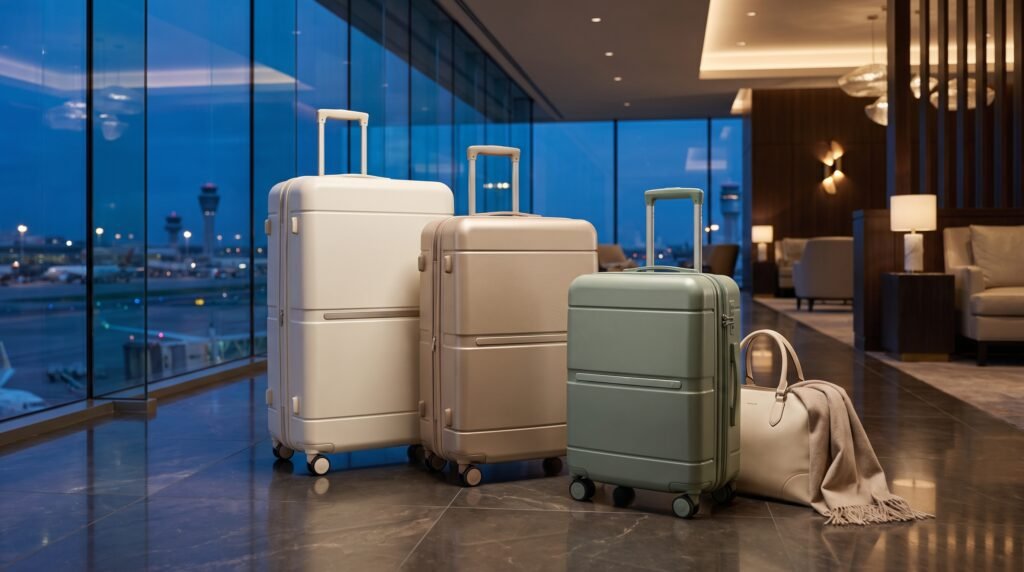
Lightweight hard side luggage aesthetic sets combine a polished appearance with practical features for modern travel. From minimalist cream suitcases and elegant champagne finishes to muted sage, soft pink, and sophisticated black, the right luggage set can make packing feel more organized while complementing your personal travel style.
However, attractive luggage is only part of the decision. A suitcase should also be light enough to handle comfortably, durable enough for regular journeys, easy to maneuver through airports, and appropriately sized for your airline’s baggage rules.
This guide explains how to choose lightweight hard-shell luggage sets that balance aesthetics, functionality, and value. You’ll learn which colors and finishes look most refined, how to compare materials, what features matter most, and how to build a coordinated luggage collection for weekend escapes, international holidays, and longer trips.
Quick Answer: What Makes a Great Lightweight Hard-Side Luggage Set?
The best lightweight hard-side luggage aesthetic set combines a lightweight shell, smooth-rolling spinner wheels, a comfortable telescopic handle, practical interior organization, and a timeless design.
Look for these features when comparing options:
- Lightweight construction: Polypropylene is often a useful choice when minimizing suitcase weight is a priority.
- Refined aesthetics: Choose coordinated colors, understated finishes, and clean silhouettes.
- Reliable mobility: Four spinner wheels and a stable handle make navigating airports easier.
- Functional interiors: Compression panels, zippered compartments, and adjustable straps help keep belongings organized.
- Suitable sizing: A carry-on, medium checked suitcase, and large checked suitcase cover different trip lengths.
- Practical durability: Examine shell flexibility, zipper quality, wheel construction, handles, and warranty terms rather than judging appearance alone.
The ideal set is one you’ll enjoy using repeatedly, not simply one that looks beautiful in a product photograph.
Lightweight Hard-Side Luggage Sets at a Glance
| Feature | What to look for |
|---|---|
| Best shell material for weight-conscious travelers | Polypropylene |
| Best balance of structure and weight | A well-designed polypropylene or polycarbonate shell |
| Most versatile color palette | Cream, taupe, charcoal, black, or muted sage |
| Elegant statement colors | Champagne, dusty rose, or deep burgundy |
| Most useful set configuration | Carry-on, medium checked, and large checked suitcase |
| Convenient wheel design | Four smooth-rolling spinner wheels |
| Best finish for everyday use | Subtle texture or a refined matte finish |
| Most important practical detail | Empty suitcase weight and usable interior capacity |
| Best overall buying strategy | Compare individual suitcase specifications before purchasing the set |
These are general selection guidelines, not a ranking of independently tested products. Actual weight, capacity, durability, and performance vary by model.
What Are Lightweight Hard-Side Luggage Aesthetic Sets?
Lightweight hard-side luggage aesthetic sets are coordinated collections of suitcases with rigid outer shells, designed to combine a structured appearance with manageable weight and practical travel features.
Unlike soft-sided luggage, which typically uses flexible fabric, hard-shell luggage maintains a more defined shape. It is available in numerous finishes, including matte neutrals, metallic tones, glossy pastels, textured surfaces, and minimalist monochrome designs.
A coordinated set often includes two or three suitcase sizes, although some collections also offer matching cosmetic cases, travel organizers, or personal-item bags.
The appeal is straightforward: you get a consistent visual style across different types of travel while keeping your luggage collection organized.
Why travelers choose aesthetic hard-shell luggage
A well-designed luggage set can offer several advantages:
- A coordinated travel wardrobe: Neutral or complementary suitcase colors work well with different travel outfits.
- A polished appearance: Clean lines and understated hardware create a sophisticated look.
- Structured storage: The rigid exterior helps the suitcase maintain its shape.
- Easy identification: A distinctive color or finish can make your suitcase easier to recognize at baggage claim.
- Versatility: Different suitcase sizes accommodate short breaks, business trips, and extended holidays.
Aesthetic luggage is not automatically better made, though. Design, construction, and usability should carry equal weight in your decision.
The Most Beautiful Luggage Aesthetics for Modern Travel
The right luggage color and finish depend on your wardrobe, travel habits, and preferred visual style. These design directions offer a useful starting point.

1. Minimalist ivory and cream
Cream luggage has a clean, understated appearance that pairs beautifully with neutral travel wardrobes. It works particularly well with beige coats, white sneakers, camel accessories, and monochrome outfits.
Choose a subtly textured or matte surface if you want to reduce the visual prominence of minor scuffs. Light colors may still show dirt and transfer marks more readily than darker shades.

2. Champagne and warm beige
Champagne tones create a sophisticated look without the brightness of highly reflective gold. They work especially well in coordinated collections with brushed-metal details and warm neutral accessories.
For a timeless appearance, choose a muted champagne finish instead of an overly shiny metallic surface.

3. Muted sage and soft green
Sage green offers a subtle alternative to traditional black or gray luggage. Its restrained color feels contemporary and works with cream, taupe, navy, and earthy travel accessories.
This is a good option for travelers who want a recognizable suitcase without choosing a vivid or heavily patterned design.

4. Dusty rose and blush pink
Dusty rose adds a softer, more expressive touch to a coordinated luggage collection. Pair it with ivory, gray, taupe, or champagne accessories for a cohesive appearance.
If you travel frequently, inspect the finish carefully and consider how visible scratches or dark marks might be against a pale pink shell.

5. Matte black and charcoal
Black and charcoal luggage suit travelers who prefer a versatile, understated appearance. Dark finishes coordinate easily with business attire, casual clothing, and nearly any travel accessory.
The trade-off is that dark suitcases can look similar on baggage carousels. A distinctive luggage tag or colored strap can make identification easier.
Matte versus glossy finishes
Both finishes can look attractive, but they create different visual effects and maintenance considerations.
| Finish | Advantages | Considerations |
|---|---|---|
| Matte | Understated, modern, often visually forgiving | Some textured surfaces may be harder to clean |
| Glossy | Reflective, polished, eye-catching | Scratches, fingerprints, and scuffs may be more noticeable |
| Textured | Adds visual interest and may disguise minor surface marks | Deep grooves can collect dirt |
| Metallic | Distinctive and elegant | Appearance and scratch visibility vary by coating |
| Ribbed or fluted | Creates a structured, architectural look | Inspect grooves, corners, and surface quality |
No finish is completely scratch-proof. Material, coating, handling, and maintenance all influence how a suitcase looks over time.
Which Material Is Best for Lightweight Hard-Side Luggage?
Shell material is one of the most important factors when choosing a lightweight suitcase. Polypropylene, polycarbonate, and ABS are common options, each with different characteristics.
Polypropylene: A weight-conscious option
Polypropylene is a lightweight thermoplastic often used in hard-shell luggage. Its flexibility can help it deform slightly under pressure rather than behaving like a completely rigid shell.
It is worth considering if you want to minimize the suitcase’s empty weight while retaining a structured exterior.
However, performance varies by design and shell thickness. A lightweight suitcase with poorly constructed wheels, corners, or handles may be less satisfactory than a slightly heavier, better-engineered model.
Polycarbonate: Lightweight construction with flexibility
Polycarbonate is another common luggage material. It can provide a useful balance of weight, impact resistance, and flexibility.
It is often worth comparing when you want a premium hard-shell suitcase that can handle the demands of frequent travel.
Keep in mind that polycarbonate models vary in thickness, construction, and overall weight. A material label alone does not establish how durable a particular suitcase will be.
ABS: Often used in budget-friendly luggage
ABS is a common plastic used in more affordable hard-shell suitcases. It can offer a rigid structure and attractive finish at a relatively accessible price point.
Some ABS models may be heavier or less resistant to repeated impacts than comparable well-designed alternatives, although the exact difference depends on the product.
ABS can still be reasonable for occasional trips if the suitcase has suitable construction, good wheels, and a warranty that matches your needs.
Material comparison
| Material | Weight considerations | General characteristics | Best suited to |
|---|---|---|---|
| Polypropylene | Often lightweight | Flexible shell construction | Travelers prioritizing manageable luggage weight |
| Polycarbonate | Can be lightweight | Flexible, impact-resistant thermoplastic | Frequent travelers seeking a balance of weight and structure |
| ABS | Varies by model | Rigid, commonly used in budget luggage | Occasional travel and cost-conscious purchases |
| Aluminum | Often heavier | Rigid metal construction, premium appearance | Travelers who prioritize a distinctive metal design over minimum weight |
Important: These are general material characteristics, not guarantees. Compare the finished suitcase’s weight, shell design, hardware, capacity, and warranty before making a purchase.
How to Choose the Right Luggage Set Size
A coordinated luggage set is most useful when each suitcase serves a clear purpose. Buying three large cases simply because they come together may leave you with unnecessary bulk and storage demands.
Carry-on suitcase
A carry-on is useful for weekend trips, short business travel, and longer journeys where you prefer to pack light.
Look for:
- A manageable empty weight.
- Interior compression straps.
- Smooth wheels and a comfortable handle.
- A size that meets your airline’s current cabin baggage allowance.
- Enough room for your usual clothing, toiletries, and travel accessories.
Do not assume that every suitcase marketed as a carry-on will fit every airline’s restrictions. External dimensions, including wheels and handles, matter.
Medium checked suitcase
A medium suitcase is a versatile option for many week-long holidays, depending on your clothing, footwear, and destination.
It can provide room for extra outfits without the bulk of a large checked case. It is particularly useful when traveling in mixed weather or packing slightly bulkier clothing.
Large checked suitcase
A large suitcase is better suited to extended stays, family travel, bulky clothing, or journeys where additional belongings are necessary.
However, more capacity can encourage overpacking. A large case may also be awkward to maneuver when fully loaded and can approach an airline’s checked baggage weight limit more quickly than expected.
Which set configuration should you buy?
| Travel pattern | Practical configuration |
|---|---|
| Frequent weekend trips | Carry-on only |
| Short holidays and occasional longer trips | Carry-on plus medium checked suitcase |
| Varied trip lengths | Carry-on, medium, and large suitcase |
| Family travel | A mixed set with sizes suited to each traveler |
| Minimalist one-bag travel | One lightweight carry-on rather than a full set |
| Long stays or bulky seasonal clothing | Medium and large checked cases, subject to airline limits |
For frequent one-bag travelers, a single well-chosen carry-on can be more useful than a complete set. Choose the configuration that fits your actual travel habits.
The Essential Features of a High-Quality Lightweight Suitcase
A beautiful shell cannot compensate for uncomfortable handling or poor organization. Evaluate the features you will use throughout every journey.
1. Four spinner wheels
Four-wheel spinner luggage can be pushed or rolled beside you on many smooth surfaces, making it convenient in airport terminals, hotel corridors, and train stations.
Look for wheels that rotate smoothly and feel securely attached. Larger wheels may handle some uneven surfaces better, but wheel size alone does not determine performance.
Two-wheel luggage can also be a good choice if you prefer pulling your suitcase behind you, especially on certain uneven surfaces.
2. Telescopic handle
The handle should extend and retract without excessive wobbling or sticking. If possible, check whether it has comfortable height settings for your body.
A handle that feels unstable when the suitcase is empty may become more frustrating when the case is fully packed.
3. Secure zippers and closures
Zippers should travel smoothly around corners and close without requiring excessive force.
If a model uses a frame closure instead, inspect how securely the two halves meet. Neither design automatically guarantees superior security or durability.
For checked luggage, consider a lock compatible with your intended destinations and travel requirements.
4. Interior organization
A well-organized suitcase should make it easy to separate different categories of belongings.
Useful features include:
- Adjustable compression straps.
- A zippered divider panel.
- Separate compartments for small items.
- A lined interior that can be wiped or cleaned according to the manufacturer’s instructions.
- Sufficient depth for folded clothing and travel organizers.
More compartments are not always better. Extra dividers can add weight and reduce usable packing space.
5. Reinforced handles and corners
Handles, wheel mounts, corners, and zipper tracks experience considerable handling during travel.
Look closely at how these components connect to the shell. A suitcase can have a premium exterior finish but still feel poorly constructed around its most frequently used parts.
6. Warranty and repair support
Before purchasing a set, read the warranty rather than relying on a general claim of durability.
Check whether coverage includes wheels, handles, zippers, shell defects, and replacement parts. Also determine whether damage caused by airline handling is excluded.
A longer warranty is not necessarily more comprehensive, so review the actual terms.
How to Find Lightweight Luggage Without Sacrificing Capacity
One of the easiest mistakes when shopping for a luggage set is comparing appearance and dimensions while ignoring empty weight.
The suitcase itself contributes to your baggage allowance before you pack a single item.
Compare empty weight and usable capacity
Suppose two carry-on suitcases offer similar interior capacity, but one weighs noticeably less. The lighter case leaves more of your weight allowance available for clothing, shoes, toiletries, and electronics.
For checked luggage, the same principle applies. A lighter large suitcase can make it easier to stay within the airline’s weight limit.
Compare these specifications together:
- Empty suitcase weight.
- Usable internal capacity.
- External dimensions.
- Wheel and handle construction.
- Maximum permitted baggage weight for your flight.
- The weight of any included accessories.
Liters and kilograms provide a more meaningful comparison than labels such as “ultralight” or “extra spacious” alone.
Avoid unnecessary extras
Matching cosmetic cases, laundry bags, and packing cubes can look appealing, but every additional item adds weight or occupies space.
Consider whether the accessories will genuinely improve your packing routine. A compact toiletry pouch you already own may be more useful than a bulky accessory included in a set.
How to Match Your Luggage Set With Your Travel Style
The most successful luggage aesthetic is one that suits the way you travel rather than a look chosen solely for photographs.

Minimalist and neutral
Choose ivory, beige, taupe, or charcoal with clean lines and minimal hardware. Pair your luggage with neutral packing cubes and understated travel accessories for a consistent look.

Professional and business-ready
Black, charcoal, navy, and muted metallic accents suit business trips and frequent airport transfers. Prioritize a lightweight carry-on, a practical laptop bag, and easy-access document storage.

Soft, contemporary luxury
Sage, dusty rose, and champagne work well with cream accessories, textured fabrics, and muted travel wardrobes. Choose one dominant color and repeat it through smaller accessories rather than mixing too many finishes.

Practical and understated
Matte black or charcoal is a versatile choice for frequent travelers who want a restrained aesthetic. Add a distinctive luggage tag for easier identification without changing the clean overall look.
How to Pack a Lightweight Hard-Side Suitcase Efficiently
A lightweight suitcase is most useful when its contents are organized efficiently. The goal is to bring what you need without wasting interior space or making the case unnecessarily heavy.
Step 1: Plan outfits before packing
Choose complete outfits based on the destination, weather, and planned activities.
Prioritize versatile clothing that works in multiple combinations. For example, neutral trousers, a few coordinated tops, and one adaptable outer layer can reduce the number of separate garments you need.
Step 2: Use packing cubes selectively
Packing cubes can separate tops, underwear, accessories, and other small items.
They also make it easier to locate belongings without unpacking the entire suitcase. However, cubes do not eliminate weight, and overfilling them can make clothing harder to fit into the case.
Step 3: Roll suitable clothing
Rolling T-shirts, casual tops, and some lightweight garments can help organize available space.
Structured garments, delicate fabrics, and clothing that creases easily may benefit more from careful folding. Choose the method that suits each item rather than rolling everything automatically.
Step 4: Keep heavy items low and stable
Place heavier belongings near the wheel end when the suitcase is upright, helping distribute the load more evenly.
Avoid concentrating heavy objects on one side or leaving fragile items loose between hard objects.
Step 5: Keep essentials accessible
Place items you may need during transit in your personal item or an accessible compartment, subject to security rules.
Travel documents, medication, electronics, and a change of essential clothing are often better kept close at hand than buried beneath everything else.
Step 6: Weigh your packed luggage
Use a luggage scale before leaving home, particularly when traveling with checked baggage or on airlines with strict weight allowances.
Remember that baggage allowances vary by airline, ticket, route, and fare class. Confirm your actual allowance before departure.
For more efficient organization, a related one-bag travel packing list or carry-on-only packing guide can help you decide what deserves space in your suitcase.
Airline Size and Weight Rules to Check Before Buying
Even the most attractive luggage set can be inconvenient if its dimensions or weight do not suit your usual flights.
There is no single universal carry-on size or checked baggage allowance that applies to every airline.
Before purchasing, verify the following:
- Carry-on dimensions: Check the maximum permitted external measurements, including wheels and handles.
- Carry-on weight: Some airlines impose a cabin baggage weight limit, while others use different rules.
- Personal-item dimensions: A separate backpack or handbag may need to fit beneath the seat.
- Checked baggage allowance: Confirm both the permitted weight and the size limit.
- International connections: Different carriers on the same itinerary may have different baggage requirements.
- Fare restrictions: Basic or discounted fares may include fewer baggage benefits.
If you regularly fly between countries or use different carriers, choosing a compact suitcase with a modest empty weight can provide additional flexibility. It still needs to comply with the actual rules for each flight.
For U.S. departures, the Transportation Security Administration (TSA) provides security screening guidance, but the airline determines its baggage size and weight allowances. Check current official guidance before traveling, especially if your itinerary or security requirements have changed.
Common Mistakes When Buying Aesthetic Luggage Sets
A coordinated set should make travel easier, not introduce new problems. Avoid these common purchasing mistakes.
Choosing color before construction
A beautiful finish can distract from poor wheel quality, a wobbly handle, or limited interior organization.
Compare practical specifications first, then choose your preferred color from the models that meet your requirements.
Buying a set with unnecessary sizes
A three-piece set may look like better value, but you may rarely use its largest suitcase.
Consider your typical trip length, storage space at home, and whether you usually check baggage. Buying fewer pieces can be more economical and practical.
Ignoring empty weight
Two suitcases of similar dimensions can differ considerably in weight.
Always check the specifications of the individual suitcase sizes rather than assuming every piece in a lightweight collection is equally light.
Assuming a hard shell cannot be damaged
Hard-shell luggage can crack, dent, scuff, or suffer damage around wheels and handles. A rigid exterior does not guarantee that belongings will remain undamaged under every impact.
Use protective sleeves for particularly delicate items and pack breakables carefully.
Overlooking replacement parts
A suitcase may remain usable for years, but wheels, handles, and other components can eventually require repair.
Check whether replacement parts and repair services are available before committing to an unfamiliar brand.
Confusing aesthetic accessories with security
A matching luggage strap or decorative tag can improve identification, but it does not necessarily prevent theft.
Keep valuables with you where practical, use suitable locks when appropriate, and avoid placing irreplaceable items in checked baggage.
How to Maintain Your Hard-Side Luggage Set
Regular maintenance helps preserve both the appearance and functionality of your luggage.
After each trip:
- Wipe the shell with a soft cloth and a cleaning solution approved by the manufacturer.
- Remove dirt from wheels and inspect them for obstructions.
- Check handles, zippers, and corners for visible damage.
- Allow the interior to dry completely if it becomes damp.
- Empty all pockets and remove crumbs, paper, and other debris.
When storing your luggage:
- Store suitcases in a dry location away from excessive heat.
- Nest smaller cases inside larger ones if the manufacturer permits it.
- Keep heavy objects off the shell when practical.
- Store removable accessories separately if they may scratch the interior or exterior.
- Avoid leaving a damp suitcase closed for extended periods.
For pale cream, blush, and champagne finishes, address marks promptly using the manufacturer’s recommended cleaning method. Harsh chemicals and abrasive sponges can damage coatings or alter the finish.
How to Choose the Best Set for Your Budget
Price alone does not establish quality, and an expensive design does not guarantee better travel performance.
When comparing luggage collections, evaluate the cost of the entire set alongside the features of each individual piece.
Budget-friendly options
A budget set can be suitable for occasional holidays if it offers a practical empty weight, secure closures, stable wheels, and adequate interior organization.
Check the return policy and warranty carefully. If a set includes three cases but only one meets your needs, the apparent savings may not be meaningful.
Mid-range options
This category is worth exploring if you travel regularly and want a combination of attractive design, manageable weight, and practical construction.
Compare materials, wheel design, repair availability, and the quality of the handles. Look for evidence of how the particular model is constructed rather than relying solely on brand reputation.
Premium options
Premium luggage may offer more refined finishing, distinctive design, additional organization, or better repair support, depending on the brand and model.
Consider whether those features justify the price for your travel frequency. A well-designed mid-range suitcase may suit your needs better than an expensive model with unnecessary weight or features.
A practical buying checklist
Use this checklist before placing an order.
- The color and finish suit my preferred travel aesthetic.
- The empty weight is appropriate for my usual flights.
- The dimensions meet the baggage requirements I need.
- The interior provides enough usable space.
- The wheels rotate smoothly and feel secure.
- The telescopic handle feels stable.
- The shell, corners, and closures appear well constructed.
- The warranty terms are clear.
- Replacement parts or repair options are available where needed.
- Every suitcase in the set has a practical purpose.
- The total cost represents good value for my actual needs.
Final Thoughts
The best lightweight hard side luggage aesthetic sets combine thoughtful construction, manageable weight, practical organization, and a design you’ll enjoy using for years.
Start by deciding which suitcase sizes you genuinely need. Compare shell materials, empty weights, wheel quality, interior capacity, and airline requirements before choosing a finish. Then select a color palette that complements your travel style, whether that’s understated ivory, warm champagne, muted sage, or classic charcoal.
Ultimately, the right luggage set should do more than look beautiful. It should make packing simpler, moving through airports more comfortable, and every journey feel a little more organized.
FAQs
1. What is the lightest material for hard-side luggage?
Polypropylene is often a good option for travelers seeking lightweight hard-shell luggage. However, actual weight depends on shell thickness, suitcase size, wheels, handles, and overall construction. Compare the empty weight of specific models before buying.
2. Are lightweight hard-shell suitcases durable enough for international travel?
Yes, many lightweight hard-shell suitcases are suitable for international travel. Durability depends on the material, shell design, wheel mounts, handles, closures, and handling conditions. Choose a well-constructed model and review its warranty and repair options.
3. Which luggage colors look the most luxurious?
Ivory, cream, champagne, taupe, sage, and matte black can all create a refined appearance. The best choice depends on your personal style and maintenance preferences. Lighter colors may show dirt more readily, while dark finishes can be difficult to distinguish on baggage carousels.
4. Is a three-piece hard-side luggage set worth buying?
A three-piece set can be worthwhile if you regularly take trips of different lengths or need multiple suitcase sizes for family travel. If you mostly take short trips or travel with one bag, purchasing a single carry-on or a two-piece set may offer better value.
5. How do I choose a lightweight hard-side carry-on that meets airline requirements?
Check your airline’s current carry-on dimensions and any applicable weight limit. Include wheels and handles when measuring the suitcase, and verify requirements for every carrier on your itinerary. Compare empty weight and usable capacity so you have sufficient room for your belongings without exceeding the applicable limits.
1 comment