
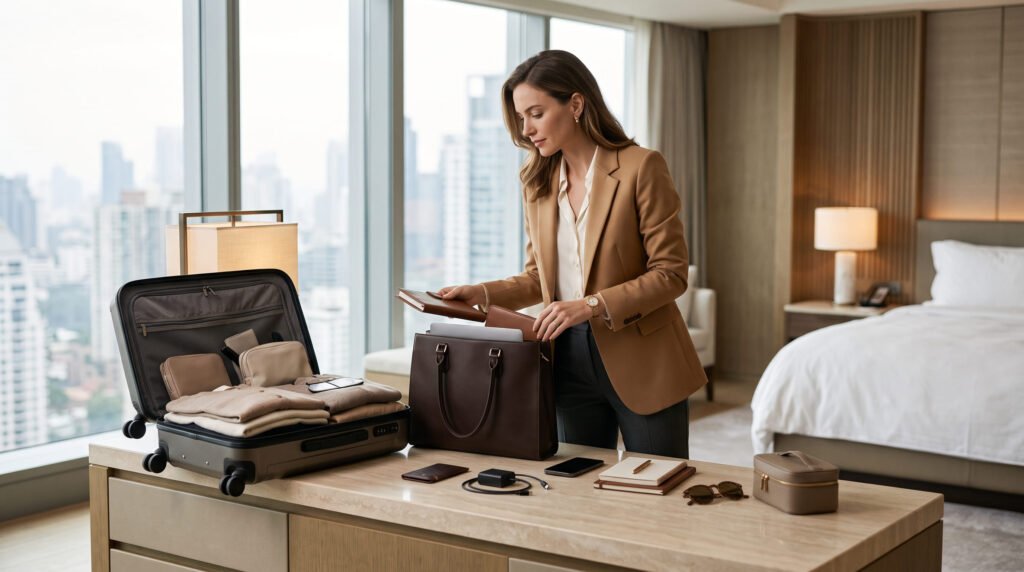
Business travel essentials for female professionals should make every work trip more organized, comfortable, and professional without adding unnecessary weight to your luggage. From a reliable laptop bag and wrinkle-resistant outfits to presentation materials, personal care products, and travel safety essentials, the right packing strategy helps you move confidently between airports, hotels, client meetings, and networking events.
The goal is not to pack everything you might need. It is to build a practical travel system that keeps your work accessible, your outfits coordinated, your personal belongings secure, and your energy focused on the business at hand. This guide covers what to bring, how to pack efficiently, and how to prepare for common business travel situations.
Quick Answer: Business Travel Essentials Checklist
For most short business trips, prioritize these categories: professional clothing, comfortable shoes, work technology, travel documents, personal care products, medications, and a compact emergency kit.
Use this checklist as your starting point and adjust it to your destination, itinerary, company dress code, and trip length.
- Travel documents: Identification, passport if required, tickets, hotel reservations, and meeting details.
- Work essentials: Laptop, charger, phone, headphones, presentation files, and necessary adapters.
- Professional wardrobe: Coordinated tops, tailored trousers or skirts, a blazer, undergarments, and sleepwear.
- Footwear: Professional shoes and comfortable walking shoes appropriate for the itinerary.
- Personal care: Toiletries, skincare, makeup if used, deodorant, and a compact hairbrush.
- Health and comfort: Regular medications, any required prescriptions, reusable water bottle, and personal comfort items.
- Security: Secure work bag, luggage identification, device passcodes, and access to important documents.
- Meeting supplies: Notebook, pens, business cards if relevant, and any required printed materials.
- Backup essentials: A spare top, essential cables, stain-removal supplies, and a small sewing kit.
For a one- or two-night trip, a carry-on suitcase and a structured laptop tote or backpack may be sufficient. Longer trips, formal events, or equipment-heavy assignments may require additional luggage.
1. Professional Clothing Essentials for Business Travel
A business travel wardrobe should balance professionalism, comfort, and versatility. Instead of packing a separate outfit for every possible occasion, choose pieces that coordinate with one another and suit the meetings on your calendar.
The most useful approach is to create a small business travel capsule wardrobe: a collection of interchangeable garments in complementary colors that can produce several polished outfits with relatively few items.
What to Pack for a Professional Travel Wardrobe


10
For a typical two- to three-day business trip, consider the following starting point:
| Clothing item | Suggested quantity | Why it matters |
|---|---|---|
| Blazer or tailored jacket | 1 | Adds structure to meeting and presentation outfits |
| Professional tops or blouses | 2–3 | Creates variety without excessive packing |
| Tailored trousers or skirts | 1–2 | Forms the foundation of several outfits |
| Professional dress | 1, optional | Offers a complete outfit for formal meetings or dinners |
| Comfortable undergarments | 1 per day, plus a spare | Supports comfort and unexpected changes |
| Sleepwear | 1 set | Keeps overnight packing simple |
| Socks or hosiery | As needed | Matches footwear and the dress code |
| Lightweight cardigan | 1, optional | Provides an additional layer in cold offices or aircraft cabins |
| Compact accessories | 2–3 versatile pieces | Changes the look without taking up much space |
These quantities are guidelines rather than strict rules. A two-day conference with evening networking events may require different clothing from a three-day office visit with a relaxed dress code.
Choose a Coordinated Color Palette
Neutral colors make business travel outfits easier to combine. Black, navy, charcoal, beige, ivory, and taupe work well as a foundation, while one accent color can add personality.
For example, a navy blazer, black trousers, ivory blouse, and neutral flats can form the basis of several outfits. Changing the blouse, adding a scarf, or switching accessories creates variation without requiring an entirely new ensemble.
Consider these combinations:
- Traditional corporate: Navy, white, charcoal, and black.
- Modern business casual: Taupe, ivory, camel, and chocolate brown.
- Creative professional: Neutral basics with a muted green, burgundy, or blue accent.
- Warm-weather business travel: Lightweight trousers, breathable blouses, and a polished, unstructured blazer.
Check the expected dress code before departure. Client-facing meetings, industry conferences, and internal office visits may call for different levels of formality.
Select Wrinkle-Resistant, Comfortable Fabrics
Clothing that creases easily can require extra time and attention after a flight. Consider fabrics such as wool blends, ponte knits, suitable polyester blends, and other travel-friendly materials that retain their shape.
Merino wool can be useful for layering and temperature regulation, while breathable cotton blends may suit warmer destinations. Linen is comfortable in hot weather but typically wrinkles more readily.
No fabric is completely wrinkle-proof. Check garment-care instructions, and test how a piece behaves after being folded in your luggage before relying on it for an important presentation.
Pack Shoes Strategically
Shoes often occupy more space than expected, so limit your selection to the footwear required by the itinerary.
- Professional flats or loafers: Useful for office meetings, conferences, and airport transfers.
- Low heels or formal shoes: Appropriate when the dress code or event calls for them.
- Comfortable walking shoes: Important when the trip involves large conference venues, public transport, or extensive walking.
Wear the bulkiest suitable pair during transit. Place smaller items such as socks inside packed shoes, using a shoe bag to protect clothing from dirt.
Avoid bringing several pairs that serve exactly the same purpose. Two complementary pairs are often more useful than three similar pairs.
2. The Best Business Travel Bags for Female Professionals
Your bag should protect work equipment, provide quick access to important items, and complement your professional wardrobe. Appearance matters, but comfort, organization, and security are equally important.


12
Laptop Tote vs. Business Backpack vs. Carry-On
| Bag type | Best suited for | Main advantage | Potential drawback |
|---|---|---|---|
| Structured laptop tote | Office visits and client meetings | Polished appearance and easy access | Can strain one shoulder when heavy |
| Professional backpack | Commuting, conferences, and walking-heavy trips | Distributes weight across both shoulders | Some designs look too casual for formal settings |
| Rolling carry-on | Overnight and multi-day trips | Keeps clothing and larger essentials organized | Less convenient on stairs or crowded public transport |
| Compact crossbody | Networking events and personal outings | Keeps small essentials accessible | Usually cannot replace a work bag |
For many female professionals, a structured laptop backpack or a laptop tote with a luggage sleeve provides a useful balance of appearance and practicality.
Look for a padded laptop compartment, secure closures, durable construction, comfortable straps, and enough space for a charger, notebook, headphones, and personal essentials. Water-resistant material can provide additional protection against light rain, although it does not guarantee waterproofing.
What to Keep in Your Work Bag
Your work bag should contain the items you may need before reaching your hotel or opening your suitcase.
- Laptop and essential charger
- Smartphone and charging cable
- Headphones or a headset for calls
- Notebook and pen
- Identification and necessary travel documents
- Presentation materials or a portable presentation adapter
- Wallet and essential payment cards
- Compact personal care kit
- Regular medication needed during the journey
- A small snack and reusable water bottle, where permitted
Keep heavier items close to your back when using a backpack. Avoid overloading a tote simply because it has extra space; a comfortable, manageable bag is more useful than one that carries everything.
3. Essential Technology and Work Accessories
Technology problems can disrupt a presentation, delay a deliverable, or make it difficult to communicate with colleagues. A small, organized tech kit reduces the chance of forgetting a critical accessory.
Business Travel Technology Checklist
- Work laptop and laptop charger
- Smartphone and charging cable
- Power bank, if needed and permitted by the airline
- Wireless earbuds or a reliable headset
- Universal travel adapter appropriate for the destination
- HDMI, USB-C, or other presentation adapter required by your equipment
- Portable mouse, if it improves your workflow
- Backup access to essential documents
- Any required security key or work authentication device
Not every traveler needs every item. Check the equipment available at your meeting venue before packing specialized accessories.
Protect Your Digital Workspace
Before leaving, update your devices if appropriate, confirm that you can access your work accounts, and download important files for offline use.
Store critical presentation materials in an approved cloud service and keep a permitted backup where practical. If you rely on company software, verify that multifactor authentication will work while traveling.
Use a strong device passcode and follow your employer’s rules for public Wi-Fi, VPN access, confidential documents, and remote working. Avoid leaving an unlocked laptop unattended in a café, airport lounge, or hotel business center.
Understand Power Bank and Battery Restrictions
Airline restrictions for lithium batteries vary by jurisdiction, airline, and battery specifications. Power banks generally belong in cabin baggage rather than checked luggage, and capacity limits or approval requirements may apply.
Check the operating airline’s current rules before departure, particularly for high-capacity batteries. Keep battery capacity markings legible, and never pack damaged or swollen batteries. Do not assume that an item accepted on one airline will automatically be accepted on another.
For flights involving airport security screening, review the current rules for liquids, electronics, and other restricted items on your route rather than relying on an old packing checklist.
4. Toiletries, Skincare, Makeup, and Personal Care
A business trip often involves moving directly from a flight to a meeting, or from a full workday to an evening networking event. A compact personal care kit helps you refresh without packing a full bathroom cabinet.
Essential Toiletries for Business Trips


12
Consider packing:
- Toothbrush, toothpaste, and floss
- Deodorant
- Face cleanser and moisturizer
- Sunscreen appropriate for your destination
- Makeup essentials, if used
- Makeup remover
- Hairbrush or comb
- Hair ties, clips, and a compact styling tool if needed
- Shampoo and conditioner if not supplied or unsuitable at your accommodation
- Period products or other personal care items you may need
- Prescription medication and necessary health supplies
Choose travel-sized containers or refillable bottles for products you use regularly. Pack liquids in a leak-resistant pouch, separate from electronics and clean clothing.
For carry-on travel through US Transportation Security Administration checkpoints, the standard liquids rule generally limits individual containers to 3.4 ounces (100 milliliters), with containers placed in a single quart-sized bag under the usual rule. Exceptions and screening procedures can vary, so verify the latest guidance for your airport and itinerary. Other countries may apply different requirements.
Create a Five-Minute Refresh Kit
Keep a smaller pouch in your work bag for items that help you feel presentable between travel and meetings.
A practical version might include lip balm, tissues, a compact mirror, hand sanitizer, blotting papers, a travel comb, and a small stain-removal wipe. Add products suited to your own routine rather than carrying duplicates of every item in your main toiletry bag.
If you use cosmetics, select a few versatile products that can transition from a daytime meeting to dinner. The objective is convenience, not recreating your entire daily routine on the road.
Pack Personal Care Items for Comfort
Air travel, unfamiliar climates, and changes in routine can make personal comfort more important than usual. Bring your usual skincare products if you are prone to irritation, and avoid experimenting with several new products immediately before an important trip.
Keep essential medications in your cabin bag, in their original packaging where practical, and carry prescriptions or supporting documentation when appropriate. Check restrictions for medicines at your destination, especially when traveling internationally.
5. Travel Documents, Payments, and Business Meeting Materials
A polished wardrobe cannot compensate for a missing passport, an inaccessible reservation, or a presentation that will not open. Prepare the administrative side of the trip before departure.
Essential Travel Documents
- Government-issued identification and passport, if required
- Boarding pass or access to the airline’s booking
- Hotel reservation and ground transportation details
- Meeting invitations, venue addresses, and attendee information
- Work travel authorization, if required by your employer
- Visa or entry documentation where applicable
- Travel insurance details, if covered or purchased
- Emergency contacts and relevant company contacts
Keep digital copies of important documents in a secure location and separate from the physical originals when possible. Digital copies are useful for reference but do not replace an original passport, visa, or other document when authorities require it.
For international trips, verify passport validity, entry requirements, transit rules, and any business-activity restrictions well in advance. Permission to enter a country as a visitor does not necessarily authorize every type of paid or professional activity.
Prepare for Meetings Before You Leave
Organize your meeting materials so you can find them quickly. Save the final presentation in the correct format, check embedded media, and verify that links and attachments work.
For an important presentation, consider having an approved offline copy and a backup method for accessing the file. If you need printed handouts, confirm the required quantity and whether the venue can print them.
Bring business cards if they are relevant to your industry and the event. A notebook and pen remain useful even when most of your work is digital, especially when taking notes during discussions or informal networking.
Organize Payments and Receipts
Carry a suitable payment method for your destination and keep a backup card separate from your main wallet. For international travel, check foreign transaction fees, local payment preferences, and whether your cards need advance travel notifications.
If your employer reimburses business expenses, review the expense policy before leaving. Keep itemized receipts, note the business purpose where required, and record expenses while they are easy to identify.
These small administrative habits can make expense reporting far less stressful after returning home.
6. Safety, Security, and Personal Comfort Essentials
Personal safety deserves a place in every business travel plan. Female professionals may travel alone, arrive late at night, attend unfamiliar venues, or need to move between a hotel and a meeting location. Preparation can reduce avoidable stress without making the trip feel complicated.
Practical Safety Essentials
Consider bringing:
- A phone with reliable service and emergency contacts saved.
- A secure work bag with dependable closures.
- A portable charger to maintain phone battery life.
- A compact crossbody bag for evenings when a laptop bag is unnecessary.
- A small flashlight if your itinerary involves unfamiliar areas or late arrivals.
- Any personal safety device that is legal at your destination and permitted by your airline.
- Travel insurance and relevant emergency assistance details.
Before arrival, save your hotel’s address, the meeting venue, and your planned transportation options. Share your itinerary with a trusted contact or colleague when appropriate.
Choose accommodation with convenient access to your meetings and transportation, taking the surrounding area and your arrival time into account. When booking transportation, verify the driver and vehicle details through the official service.
Avoid displaying expensive equipment unnecessarily in public places. Keep your passport and payment cards secure, and use the hotel’s available safe when appropriate, while remembering that no storage method guarantees complete security.
Comfort Essentials for Long Travel Days
A business trip can involve several hours of sitting, waiting, walking, and working. A few compact items can make these transitions easier.
- A lightweight cardigan, scarf, or extra layer.
- A reusable water bottle, filled after security where permitted.
- Healthy snacks suited to your dietary needs.
- Compression socks if appropriate for your circumstances.
- An eye mask or earplugs for rest during travel.
- Hand sanitizer and tissues.
- Comfortable shoes for airport transfers and conference venues.
If you have specific medical concerns, ask a qualified healthcare professional about suitable travel precautions. For long flights, follow current medical guidance relevant to your individual needs.
7. How to Pack Business Travel Essentials Efficiently
Efficient packing is not simply about fitting everything into a small suitcase. It is about making important items accessible, preventing clothing damage, and reducing the time spent getting ready.
Use a Three-Layer Packing System
Organize your belongings according to how frequently you need them.

Layer 1: Your work bag
Keep your laptop, chargers, identification, meeting materials, medication, and other journey-critical items here. Store essentials you might need before checking into your hotel within easy reach.

Layer 2: Your suitcase
Pack clothing, shoes, sleepwear, and your main toiletry kit. Use packing cubes to group items by category or outfit, rather than filling the suitcase randomly.

Layer 3: Small organizers
Use separate pouches for electronics, toiletries, jewelry, and personal care. This prevents small items from disappearing among clothing and makes repacking easier.
Choose Between Rolling and Folding
Both techniques can work well, depending on the garment.
- Rolling: Suitable for many casual tops, knitwear, sleepwear, and soft garments.
- Folding: Useful for structured pieces that need to retain their shape.
- Garment bags: Worth considering for formalwear or delicate business clothing.
- Packing cubes: Helpful for separating outfits, undergarments, and clean clothing from worn items.
For a blazer, follow its construction and care instructions. Folding it carefully along its natural seams or using an appropriate garment bag can reduce creasing, although the result depends on the fabric and how tightly the bag is packed.
Leave a little room for items acquired during the trip. An overfilled suitcase can put pressure on zippers and make it difficult to retrieve belongings without disrupting everything.
Plan Outfits Around Your Itinerary
Before packing, list each scheduled activity and match it with an outfit.
| Activity | Outfit approach |
|---|---|
| Flight and airport transfers | Comfortable trousers, a breathable top, and practical shoes |
| Client presentation | Tailored blazer, coordinated trousers or skirt, and professional footwear |
| Conference sessions | Polished separates and comfortable shoes suitable for walking |
| Business dinner | A versatile dress or an upgraded version of your daytime outfit |
| Hotel work session | Comfortable clothing appropriate for video calls |
| Return journey | Rewear a clean, versatile outfit if practical |
Photographing your planned combinations can be useful when traveling for several days. It reduces the time spent deciding what to wear in the morning and helps you avoid packing items that do not work with the rest of your wardrobe.
8. What to Pack for Different Business Travel Scenarios
Not every work trip needs the same packing list. Your itinerary, destination, and access to laundry or office facilities should determine what you bring.
Overnight Business Trip
For one night away, prioritize a small set of essentials:
- One meeting outfit and a backup top.
- One pair of professional shoes, worn if practical.
- Sleepwear and necessary undergarments.
- Laptop, charger, phone, and meeting materials.
- Compact toiletries and medication.
- Identification, reservations, and payment cards.
A carry-on backpack or compact suitcase may be enough, particularly when your work equipment fits comfortably in a separate laptop compartment.
Three-Day Conference
A conference often involves long days, networking, and more walking than a typical office visit.
Pack two or three coordinated tops, one or two bottoms, a blazer, comfortable professional shoes, an optional evening outfit, and sufficient undergarments. Include a water bottle, portable charger, notebook, and any event-specific materials.
Check whether the conference includes a formal dinner, outdoor activity, or dress-code requirements. These details may change your clothing and footwear choices.
International Business Trip
International travel requires additional planning beyond clothing and electronics.
Verify passport validity, visas or entry permissions, transit requirements, airline baggage limits, electrical compatibility, and local business customs. Check whether your phone plan supports roaming or whether another approved connectivity option is needed.
Bring appropriate adapters, keep work files accessible offline, and confirm that your payment methods will work at your destination. If your trip involves multiple countries, check requirements for each one rather than assuming the rules are identical.
Warm-Weather and Cold-Weather Destinations
For warm destinations, choose breathable fabrics, lightweight layers, and clothing appropriate for the local professional environment. Sun protection and a compact umbrella may be useful depending on the climate.
For colder destinations, prioritize a suitable coat, layers, weather-appropriate footwear, and accessories that do not take up excessive space. Wear bulky outerwear during transit when practical, but make sure it remains comfortable for the journey.
Indoor environments can be heavily air-conditioned even in warm climates. A lightweight layer is useful for maintaining comfort in meeting rooms, aircraft cabins, and hotels.
9. Common Business Travel Packing Mistakes to Avoid
Even a well-planned trip can become inconvenient when packing decisions are driven by uncertainty rather than the actual itinerary.
Packing too many outfits. Bringing separate clothing for every possible scenario creates bulk. Start with your calendar and select garments that can be combined in multiple ways.
Carrying unnecessary technology. Extra cables, adapters, and accessories add weight. Check which devices and connections you will actually need.
Packing important items in checked luggage. Keep essential documents, medication, valuable electronics, and critical work materials with you whenever practical and consistent with applicable rules.
Choosing appearance over comfort. Shoes that look appropriate but hurt after an hour can make conference days unnecessarily difficult. Test footwear before the trip and consider how much walking is involved.
Ignoring baggage restrictions. Airline carry-on dimensions, weight limits, and battery policies vary. Check the operating airline’s rules, including any connecting flights.
Forgetting a backup plan. A dead phone, unavailable presentation file, or misplaced charger can create avoidable problems. Bring only the backups that are genuinely useful, and know how to access essential information if your primary device fails.
Leaving packing until the last minute. A short checklist and an itinerary review the evening before departure can help catch missing items without encouraging overpacking.
10. The Final Business Travel Packing Checklist
Use this consolidated checklist before closing your suitcase. Remove anything that does not fit your itinerary, and add any requirements specific to your employer or destination.
Departure-ready checklist
0/16 packed
Documents and administration
Identification, passport, and required entry documentsBoarding pass, hotel reservation, and transport detailsMeeting schedule and work travel authorizationPayment cards, expense requirements, and emergency contacts
Clothing and footwear
Coordinated meeting outfits and a suitable blazerComfortable professional shoes and walking footwear if neededUndergarments, sleepwear, and any required hosieryWeather-appropriate outerwear and versatile accessories
Technology and work
Laptop, charger, and smartphoneCharging cables, headphones, and necessary adaptersPresentation files and offline document accessRequired security keys and approved work applications
Personal care and safety
Toiletries, skincare, and personal care productsPrescription medication and necessary supporting documentsCompact refresh kit and personal comfort itemsSecure bags, portable charger, and safety contacts
Copy checklistReset
FAQs
1. What are the most important business travel essentials for female professionals?
The essentials are identification and travel documents, a laptop and charger, professional clothing, comfortable shoes, toiletries, necessary medication, payment methods, and meeting materials. Prioritize items that are difficult to replace or essential to completing your work.
2. What should a woman pack for a three-day business trip?
Start with two or three tops, one or two coordinated bottoms, a blazer, suitable footwear, undergarments, sleepwear, toiletries, and essential work technology. Add an outfit or accessories for formal dinners or special events on your itinerary. A coordinated capsule wardrobe can reduce luggage without limiting outfit options.
3. Is a backpack or tote better for female business travelers?
A structured laptop tote offers quick access and a formal appearance, while a professional backpack generally distributes weight more evenly. Choose based on your work equipment, walking distance, dress code, and comfort. A luggage sleeve and a padded laptop compartment are useful features in either style.
4. How can female professionals avoid wrinkles when packing business clothes?
Choose fabrics that resist creasing, fold structured garments along their natural seams, and avoid overfilling your suitcase. Packing cubes can keep outfits organized, while a garment bag may help protect formalwear. Check clothing-care instructions and use an appropriate hotel iron or steamer if available.
5. What should women keep in their personal item during a business flight?
Keep identification, essential medication, a phone, laptop and necessary work equipment, chargers, headphones, payment methods, and important documents accessible in your cabin bag or personal item. Check airline restrictions before packing batteries, liquids, and electronic accessories, and retain essential work files in an approved accessible location.
Conclusion
The most effective business travel essentials for female professionals are the items that support your work, simplify your routine, and help you feel comfortable throughout the journey. A coordinated wardrobe, a well-organized laptop bag, reliable technology, compact personal care products, and carefully prepared documents provide a strong foundation for most work trips.
Start with your itinerary rather than a generic list, then adjust your packing for the trip’s duration, climate, meeting schedule, and dress code. With a repeatable packing system, you can spend less time preparing your luggage and more time focusing on presentations, professional relationships, and the work that matters.
1 comment