
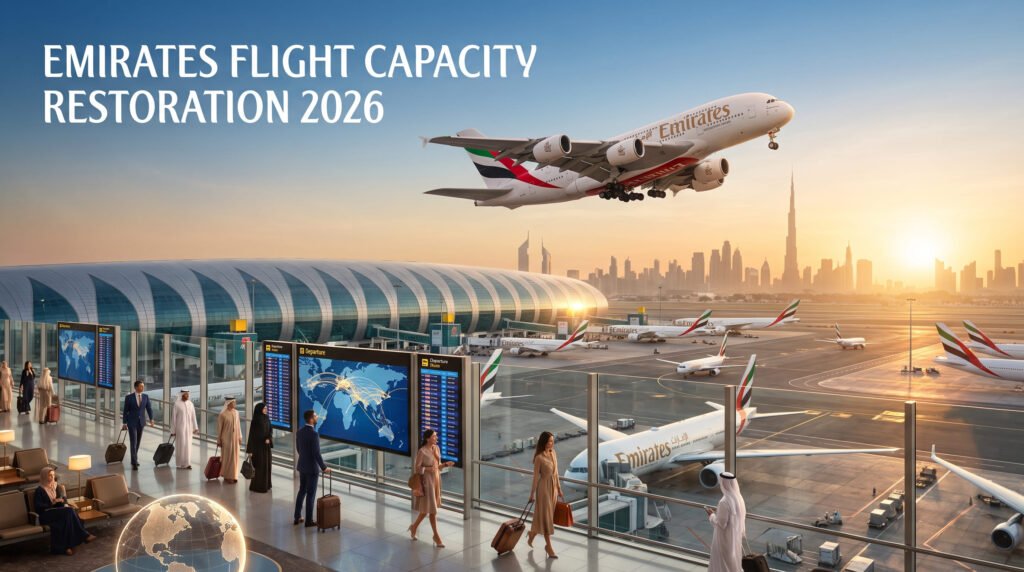
The Emirates flight capacity restoration in 2026 marks a major step toward rebuilding the airline’s international network after a period of operational disruption. Emirates has progressively restored services across Europe, the Americas, Africa, West Asia, the Middle East, the Far East and Australasia, reconnecting passengers through its Dubai hub.
For travelers, however, network restoration does not always mean that every route is operating at its previous frequency or seat capacity. Understanding the difference between network recovery, flight frequency and available capacity is essential when planning an Emirates journey in 2026.
What Is Emirates Flight Capacity Restoration?
Emirates flight capacity restoration refers to the process of bringing back suspended or reduced services and increasing the number of flights and available seats across the airline’s network. It can include restarting routes, adding weekly frequencies and deploying additional aircraft where demand and operating conditions allow.
Emirates’ May 2026 milestone showed how quickly the network was recovering. The airline announced that 96% of its global network had been restored, while its operating capacity stood at 75% of the pre-disruption level at that point.
How Much of the Emirates Network Has Been Restored in 2026?
By early May 2026, Emirates reported that 96% of its global network was restored, with services progressively returning across major international regions. This represented a near-full return of the airline’s destination network following operational disruption.
It is important to distinguish this figure from overall flight capacity. A restored destination can initially operate with fewer weekly flights than before, meaning network restoration can progress faster than capacity restoration. Travelers should therefore check the exact flight schedule for their route rather than assuming previous frequencies have completely returned.
Emirates Network Restoration vs Flight Capacity: What Is the Difference?

Network restoration means that a destination is once again connected to the Emirates network. Flight frequency restoration means increasing the number of services operating to that destination, while capacity restoration focuses on the number of seats or overall available flying capacity.
This distinction matters because an Emirates route may be operational while still having fewer flights than it had before disruption. As aircraft availability, demand, airport conditions and operational requirements change, Emirates can gradually increase frequencies and capacity.
Which Emirates Routes Are Being Restored?
Emirates has progressively resumed services across Europe, the Americas, Africa, West Asia, the Middle East and GCC, the Far East and Australasia. This broad recovery reinforces Dubai’s role as a major international connecting hub.
For passengers, restored routes can improve connections between major cities in Asia, Europe, Africa, Australia and North America. However, individual schedules can change, so travelers should confirm their specific route, flight number and departure date before traveling.
Emirates Flight Frequencies and Schedule Recovery

Restoring a route is only one part of the recovery process. Emirates can also increase weekly flight frequencies, adjust aircraft deployment and add seats as operational conditions improve. These changes can gradually bring popular international routes closer to their previous schedules.
Travelers should therefore compare the current Emirates flight schedule with their preferred travel dates instead of relying on older timetables. The airline provides online flight schedules, booking tools and flight-status services for checking current operational information.
Dubai International Airport and Emirates Network Recovery
Dubai International Airport (DXB) remains central to Emirates’ global network because a large proportion of the airline’s international connections pass through Dubai. As Emirates restores its network, the availability of connecting flights through DXB becomes increasingly important for passengers traveling between continents.
A stronger Emirates schedule can improve connection options, reduce the need for alternative routings and give travelers more flexibility when selecting departure dates. Nevertheless, passengers with tight connections should always check their current itinerary and airport requirements before departure.
Are Emirates Flights Operating Normally in 2026?
Emirates has made substantial progress toward restoring its international operations, but “normal” should not be interpreted as every route having identical frequencies to an earlier schedule. Operational conditions, airspace restrictions, airport requirements, aircraft availability and seasonal demand can still affect individual flights.
The safest approach is to check the specific Emirates flight status before leaving for the airport. Emirates provides flight-status information covering departures, arrivals, delays and cancellations.
How to Check Emirates Flight Status Before Travel
Passengers can check an Emirates flight using the flight number or route and travel date. The official flight-status service provides current information about scheduled departures, arrivals, delays and cancellations.
It is particularly important to check shortly before departure when traveling during periods of operational disruption. Emirates also maintains a regularly updated travel-information page for changes and cancellations affecting passengers.
What Does Capacity Restoration Mean for Travelers?
Greater Emirates flight capacity can provide travelers with more departure choices, better connection options and potentially greater flexibility when selecting travel dates. More frequencies can also make it easier to recover from a missed connection or change a travel plan.
However, restored capacity does not automatically guarantee cheaper fares. Ticket prices continue to depend on demand, seasonality, cabin availability, route competition, booking timing and other commercial factors.
Emirates International Travel: What Passengers Should Do
Passengers planning an Emirates trip in 2026 should verify their itinerary shortly before departure and allow sufficient time at the airport. Emirates currently advises passengers to check their ticket and airport information because arrival requirements can vary, with some airports requiring up to four hours before departure.
For connecting passengers, it is also sensible to avoid unnecessarily tight connections when possible. Keeping travel documents, booking information and flight notifications readily available can make the journey easier if the schedule changes.
Emirates Flight Capacity Restoration and Future Expansion
The 2026 recovery should be viewed as an ongoing process rather than a single event. Once a route returns, Emirates can continue adjusting frequencies, aircraft types and seat availability according to demand and operational conditions.
This means travelers may see additional schedule improvements even after the initial network restoration milestone. Checking the latest Emirates announcements and flight schedule remains the best way to identify route-specific changes.
FAQs
1. What is Emirates flight capacity restoration in 2026?
It is the process of restoring Emirates routes, increasing flight frequencies and rebuilding available seat capacity after operational disruptions.
2. How much of Emirates’ network was restored in 2026?
Emirates announced in May 2026 that 96% of its global network had been restored, while capacity was reported at 75% of the pre-disruption level at that milestone.
3. Does 96% network restoration mean 96% flight capacity?
No. Network restoration and capacity restoration are different measurements; Emirates’ May 2026 announcement reported 96% network restoration and 75% of pre-disruption capacity.
4. How can I check whether my Emirates flight is operating?
Use Emirates’ official flight-status tool to check the flight number or route for current departure, arrival, delay and cancellation information.
5. Are Emirates flight schedules guaranteed after restoration?
No. Flight schedules can change because of operational, airport, airspace, aircraft or other circumstances, so passengers should verify their specific flight before departure.
Conclusion
The Emirates flight capacity restoration in 2026 represents a significant recovery of the airline’s global network and its Dubai-based international connectivity. Emirates reported that 96% of its network had been restored by May 2026, although network restoration and overall flight capacity remained separate measures.
For travelers, the key is to look beyond broad recovery headlines and check the specific Emirates route, flight frequency, schedule and flight status for the planned journey. As Emirates continues adjusting its network and capacity, regular schedule checks will remain the most reliable way to plan international travel in 2026.
1 comment