
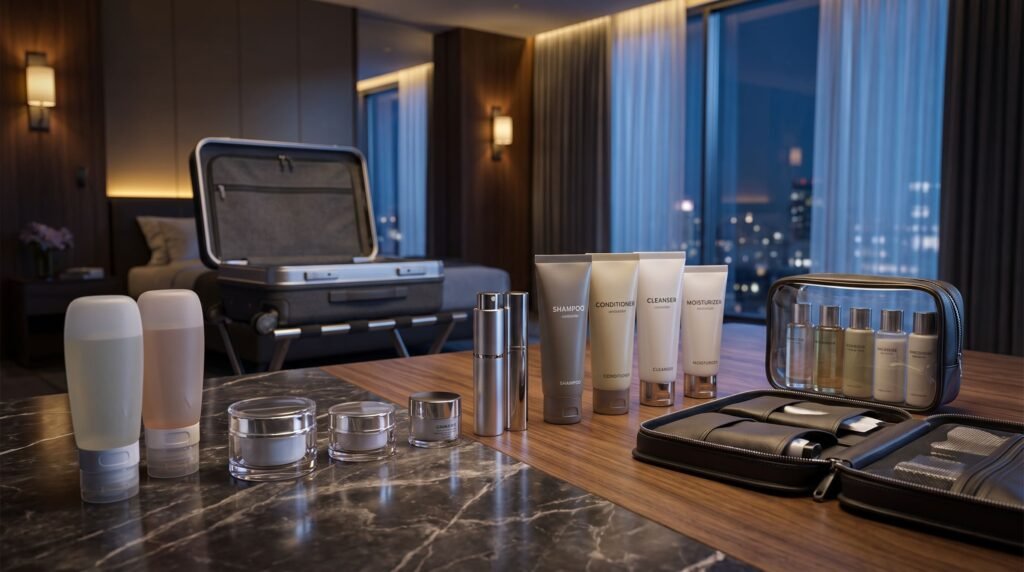
Decanting toiletries for travel is one of the simplest ways to make a carry-on lighter, more organized, and easier to manage. Instead of bringing bulky full-size bottles, you transfer only the amount of shampoo, conditioner, cleanser, moisturizer, sunscreen, or other personal-care products you realistically need.
But good decanting is more than squeezing products into small bottles. The right system means choosing suitable containers, calculating how much product you actually need, preventing leaks, keeping incompatible products separate, and packing liquids so they are easy to remove at airport security.
This guide explains how to decant toiletries for travel step by step, what to decant, what to leave in its original packaging, how much to pack for different trip lengths, and how to build a compact carry-on toiletry kit without unnecessary weight or waste.
What Does It Mean to Decant Toiletries for Travel?
Decanting means transferring a product from its original container into a smaller travel container for easier packing.
For example, instead of carrying a large bottle of shampoo, you might transfer enough shampoo for a seven-day trip into a smaller refillable bottle. The same approach can work for conditioner, facial cleanser, body wash, moisturizer, sunscreen, hair products, and other toiletries.
The important principle is simple:
Pack the amount you need, not automatically the largest amount you are allowed to carry.
A 100ml container can be useful for carry-on travel, but that does not mean every product needs 100ml. If you only need 35ml of moisturizer for a week, taking 100ml simply creates unnecessary bulk.
Decanting is particularly useful for one-bag travelers, frequent flyers, business travelers, and anyone trying to keep a small personal item or carry-on organized.
What Toiletries Should You Decant?
The best candidates are products you use regularly in liquid, cream, gel, lotion, or paste form and normally receive in containers larger than you want to carry.
Good Products to Decant
Common examples include:
- Shampoo
- Conditioner
- Body wash
- Facial cleanser
- Moisturizer
- Sunscreen
- Liquid foundation
- Hair styling products
- Hair serum
- Liquid hand soap
- Aftershave
- Liquid skincare treatments
- Certain fragrances
- Shaving gel or cream
The best candidates are products where a smaller quantity is genuinely sufficient for the trip.
Products You May Not Need to Decant
Some toiletries are easier to carry in their original packaging, especially when the original container is already small.
Examples may include:
- Small toothpaste tubes
- Mini deodorants
- Small medication containers
- Contact-lens products in appropriately sized packaging
- Products with specialized dispensing mechanisms
- Items where the manufacturer specifically recommends keeping the product in its original container
Prescription medicines deserve particular care. Keep medications appropriately labeled and follow the rules that apply to your destination and medication rather than transferring them casually into an unmarked container.
When Keeping the Original Packaging Makes More Sense
Decanting is not automatically better.
Keep a product in its original packaging when:
- You need the original label or instructions.
- The product is sensitive to contamination.
- The packaging has a specialized pump or applicator.
- You are carrying a very small quantity already.
- The product’s stability could be affected by transferring it.
- You may need to identify the contents easily.
The goal is not to decant everything. The goal is to create the smallest practical toiletry kit without compromising convenience or product integrity.
How to Choose Travel Containers
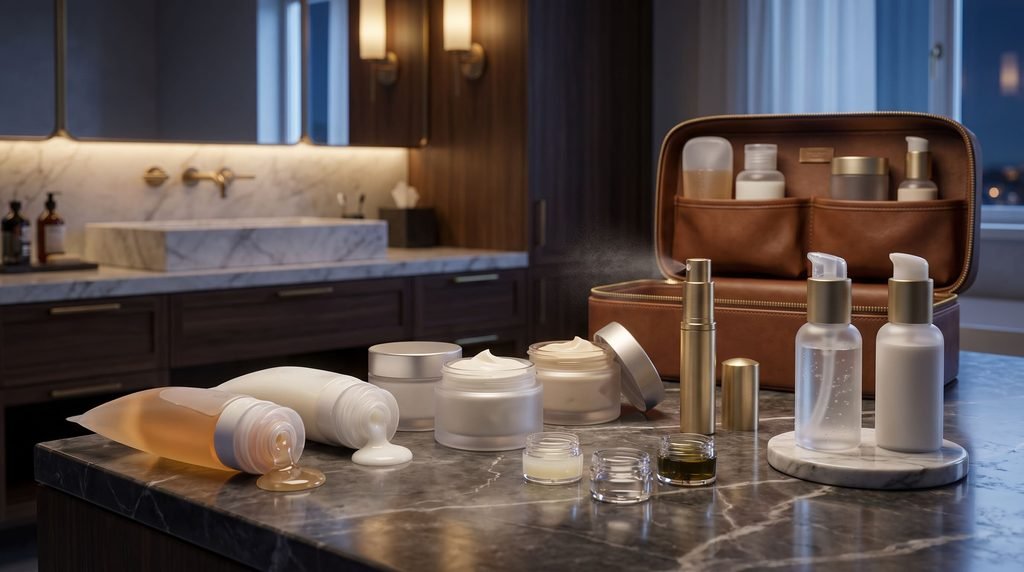
Travel containers should match the product rather than simply matching each other.
A thin liquid may work well in a squeeze bottle, while a thick cream may need a wider opening. A tiny amount of serum may be easier to manage in a small dropper-style container.
Match the Container to the Product
Consider:
Thin liquids:
Use secure bottles with controlled openings to reduce spills.
Thick shampoo or conditioner:
A soft squeeze bottle with a sufficiently wide opening can make dispensing easier.
Creams and balms:
Small jars can be convenient, although they require clean hands or an appropriate applicator.
Very small quantities:
Use appropriately sized containers rather than filling a large bottle partially.
Fragrance:
A dedicated refillable atomizer may be more practical than transferring fragrance into a generic bottle.
Aerosols:
Do not casually transfer aerosol products. Their pressurized packaging serves a specific purpose, and aviation rules can apply to aerosols beyond ordinary liquids.
The FAA notes that personal toiletry aerosols such as hairspray, perfume, shaving cream, and sunscreen can be permitted under specific conditions, while carry-on liquids, gels, and aerosols are additionally subject to TSA security limits at the checkpoint.
How to Decant Toiletries for Travel Step by Step
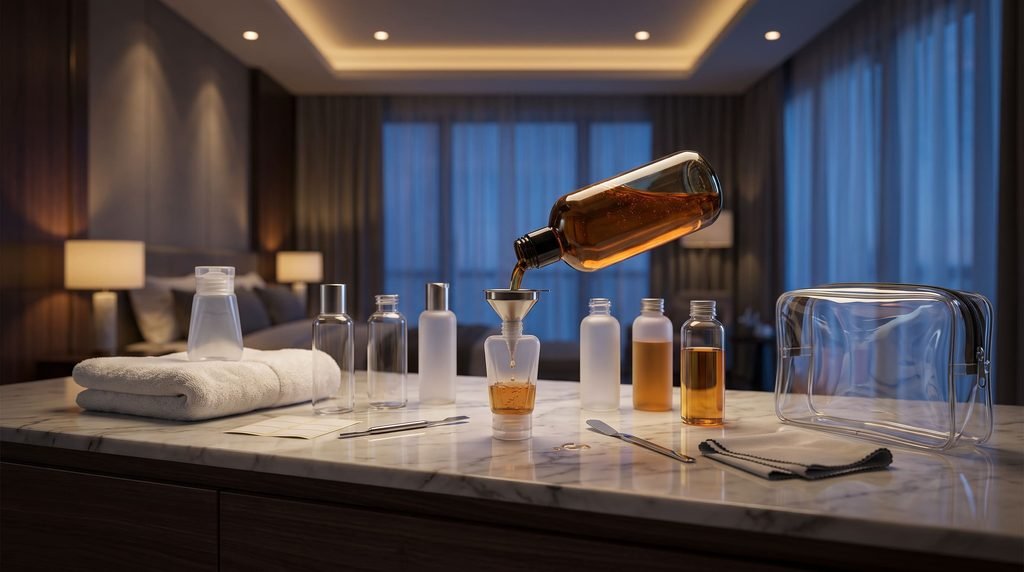
Once you know what you actually need, the process is straightforward.
1. Lay Out Every Toiletry
Start with everything you might normally take.
Put full-size bottles, travel-size products, solid alternatives, skincare, hair products, and other personal-care items on a clean surface.
Do not begin transferring products immediately.
First decide what you actually use.
2. Remove Unnecessary Products
Ask yourself:
- Will I use this every day?
- Can I buy it at my destination if necessary?
- Is there a solid alternative?
- Do I already have a smaller version?
- Do I need the entire product for this trip?
This is where much of the weight reduction happens.
3. Estimate Your Required Quantity
Think about how much you normally use per day and multiply it by the number of travel days.
A simple planning formula is:
Estimated daily use × number of days + small safety margin = amount to pack
You do not need laboratory-level precision. The purpose is to avoid both extremes: carrying far too much or running out halfway through the trip.
4. Select the Smallest Practical Container
Choose the container based on your calculated quantity.
For example, if you estimate that you need around 40ml of shampoo, there is little reason to fill a 100ml bottle unless you want additional flexibility.
Smaller containers can reduce:
- Weight
- Empty space
- Liquids-bag congestion
- Product waste
- Packing volume
5. Transfer the Product Carefully
Use a clean transfer funnel, pump, spatula, or other suitable method when necessary.
Avoid pouring quickly into a narrow opening. Thick products can create air pockets and overflow unexpectedly.
Leave enough space for the cap and closure to work properly.
6. Close and Wipe the Container
Clean the outside of the bottle before packing it.
Check the threads, cap, nozzle, and seal.
A tiny amount of product around a cap can become a much larger mess once the bottle is packed against clothing.
7. Label the Container
A small label can prevent unnecessary confusion.
This is particularly useful when several products look similar.
Labeling is even more valuable for skincare products, hair treatments, and products that you do not use every day.
8. Test for Leaks
Do not wait until you reach the airport to discover that a bottle leaks.
Close the container and turn it upside down over a sink or another easy-to-clean surface.
For a longer trip, give each container a more thorough leak test before packing it with clothing.
9. Pack the Liquids Bag Last
Once everything is secure, place the appropriate liquids into the transparent bag required by the relevant security rules.
Keep that bag accessible rather than burying it beneath clothing.
TSA’s current travel checklist recommends placing the 3-1-1 liquids bag where it is readily accessible for screening.
How Much Toiletry Product Should You Pack?
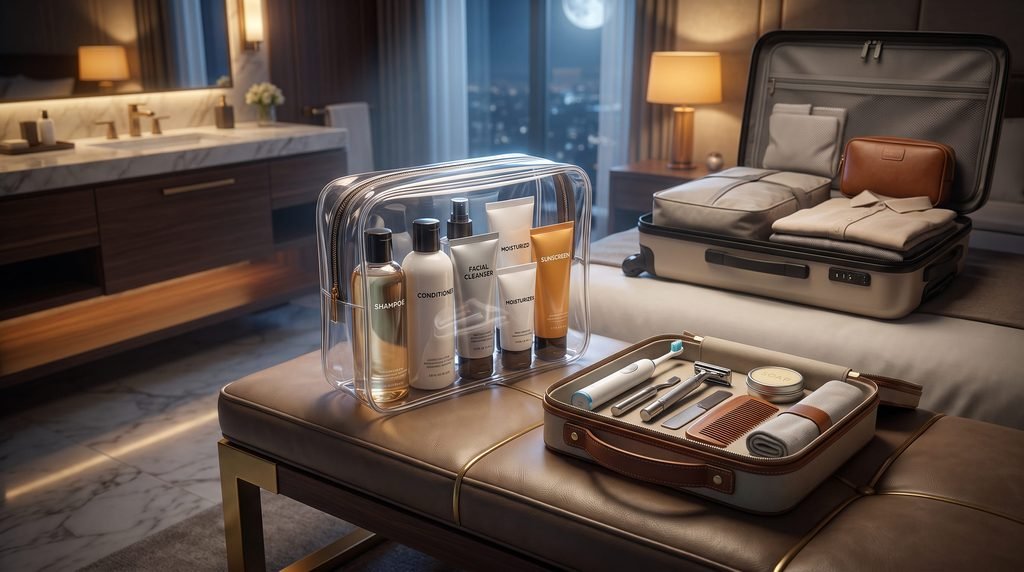
This is where many travelers make their biggest mistake.
They see a 100ml limit and assume they should pack 100ml of everything.
You do not.
The security limit is a maximum container capacity, not a recommendation for how much product to bring.
For a Weekend Trip
A short weekend may require surprisingly little:
- A small amount of shampoo
- A small amount of conditioner
- Minimal cleanser
- Small moisturizer
- Sunscreen appropriate for your activities
- Toothpaste
- Any essential hair or skincare products
For many travelers, the smaller the trip, the more useful it is to use genuinely small containers.
For a 7-Day Trip
A week-long trip gives you more reason to calculate quantities.
Estimate your normal daily use, multiply it by seven, then add a modest buffer.
For products you use sparingly, a container substantially smaller than 100ml may be enough.
For a 10-Day Trip
Ten days may justify larger containers for frequently used products such as shampoo or sunscreen, but again, your actual consumption matters more than the trip length alone.
A traveler with short hair may use dramatically less shampoo than someone with long, thick hair.
For a Two-Week Trip
For longer travel, consider whether you genuinely need to carry two weeks of every product.
You may be able to:
- Use solid alternatives
- Pack smaller amounts
- Refill during the trip
- Purchase inexpensive basics locally
- Choose accommodations with suitable toiletries
- Carry only products that are difficult to replace
The best solution depends on the destination, trip style, and personal routine.
How to Prevent Travel Toiletries From Leaking
A leak can turn an otherwise excellent packing system into a disaster.
Use Containers With Reliable Closures
A secure cap and well-fitting seal are more important than appearance.
If a bottle feels flimsy, the cap does not close firmly, or the seal looks damaged, replace it.
Do Not Overfill
Leave sufficient room for the closure and normal handling.
An overfilled bottle can be harder to close properly and more likely to squeeze product through the opening.
Keep Bottles Upright When Possible
Organizing your toiletry kit so bottles remain upright can add another layer of protection.
It should not replace a proper seal, but it can reduce unnecessary pressure on closures.
Add a Secondary Barrier
For products where leakage would be particularly inconvenient, place the container inside a small waterproof pouch or sealed bag.
This is especially useful for:
- Oils
- Hair treatments
- Sunscreen
- Liquid makeup
- Thick conditioners
Test Before Packing
A five-minute leak test at home is much better than discovering a problem after your clothes smell like conditioner.
How to Pack a Carry-On Toiletry Bag
A good toiletry kit is organized around frequency of use and access, not simply appearance.
Place the products you use every day together.
For example:
Daily essentials
- Toothpaste
- Cleanser
- Moisturizer
- Deodorant
- Sunscreen
Shower products
- Shampoo
- Conditioner
- Body wash
Hair and grooming
- Hair product
- Razor
- Shaving product
- Comb or brush
Occasional products
- Treatments
- Makeup
- Specialty skincare
Keep the liquids that must be presented at security together rather than scattering them throughout your luggage.
A transparent liquids bag is particularly practical because you can see what you have and remove it quickly when required.
What Is the TSA Liquids Rule for Carry-On Toiletries?
For travelers departing from U.S. airports, TSA’s current 3-1-1 liquids rule generally requires liquids, gels, aerosols, creams, and pastes in carry-on baggage to be in containers of 3.4 ounces (100ml) or less, with the containers fitting into one quart-size, clear, resealable plastic bag, with one such bag per passenger.
That means the important distinction is:
Container capacity matters.
A half-empty 150ml bottle is still a 150ml container. Simply carrying less product inside an oversized container does not make it compliant with the standard 3.4-ounce container requirement at the TSA checkpoint.
There are exceptions for certain items, including medically necessary liquids, but these can involve additional screening procedures. Always check the current official guidance for your circumstances.
Does the 100ml Rule Apply to Every Toiletry in Every Situation?
Not necessarily.
Aviation regulations and security-screening rules are not exactly the same thing.
The FAA has separate rules concerning medicinal and toiletry articles, including certain aerosols, perfumes, sunscreen, and other personal-care products. The FAA states that these items can be subject to quantity limits and other requirements, while TSA screening rules further restrict most carry-on liquids, gels, and aerosols to 100ml containers at the security checkpoint.
This is why it is better to check both:
- Your airport/security authority’s carry-on liquid rules.
- Your airline’s baggage restrictions.
- FAA or other aviation dangerous-goods guidance where relevant.
What About International Travel?
International travel requires a little more planning because security requirements can differ by airport and may change over time.
If your journey includes multiple airports, do not assume that a rule you encountered at your departure airport will be identical everywhere else.
For an international trip:
- Check your departure airport’s current liquid rules.
- Check the rules for connecting airports when relevant.
- Keep your liquids accessible.
- Follow your airline’s baggage requirements.
- Check restrictions for unusual toiletry products.
- Leave extra time if your itinerary involves multiple security checkpoints.
The FAA specifically advises international travelers to review applicable travel requirements and follow TSA 3-1-1 rules for carry-on liquids when departing from the United States.
Decanting vs Buying Travel-Size Toiletries
Both approaches can work.
| Option | Best For | Main Advantage | Main Drawback |
|---|---|---|---|
| Decanting | Frequent travelers | Use your preferred products | Requires preparation |
| Travel-size products | Occasional travelers | Convenient and ready to pack | Limited product choice |
| Solid toiletries | Minimalist travelers | Avoid many liquid products | Not every product has a good solid equivalent |
| Original small packaging | Specialized products | Product integrity and labeling | Can take more space |
Decanting Is Best When…
You already own products you love and travel frequently.
It also makes sense when you want a consistent toiletry kit that can be replenished before every trip.
Travel-Size Products Are Best When…
You travel occasionally and prefer convenience over building a reusable system.
They can also be useful when the manufacturer already offers a well-designed small package.
Solid Toiletries Are Best When…
You want to reduce the number of liquids in your security bag.
Solid shampoo, soap, cleansing bars, and other solid formats can be particularly useful for minimalist packing, although the suitability of each product depends on your personal routine.
Common Toiletry-Decanting Mistakes
Filling Every Bottle to 100ml
This is one of the easiest ways to create unnecessary weight.
Use the smallest container that comfortably holds the quantity you need.
Taking Too Many Products
A toiletry bag can become an inventory of every possible scenario.
Start with your daily routine and remove anything you are unlikely to use.
Using Containers That Are Too Large
A large bottle that is only partly filled still occupies unnecessary space.
Forgetting to Test the Seal
A bottle can look perfectly secure and still leak.
Test it before it reaches your suitcase.
Mixing Products With Similar Packaging
Unlabeled containers can become confusing, especially when several products have similar textures or colors.
Decanting Products Without Considering Product Stability
Not every formulation is equally suitable for transfer into another container.
When a product has specific packaging or storage instructions, follow the manufacturer’s guidance.
Packing the Liquids Bag Too Deep
Even a compliant liquids bag becomes inconvenient if it is buried under shoes and clothing.
Keep it accessible.
Assuming Airport Rules Never Change
Security procedures can change. For current travel, verify the relevant airport’s requirements rather than relying on an old packing routine.
A Simple Pre-Flight Decanting Checklist
Before closing your carry-on, check:
- I removed unnecessary toiletries.
- I calculated approximately how much product I need.
- I used appropriately sized containers.
- Every transferred product is clearly identifiable.
- All caps and seals are secure.
- I tested leak-prone containers.
- I protected particularly messy products with a secondary barrier.
- I separated products that should remain in original packaging.
- My carry-on liquids comply with the relevant security rules.
- My liquids bag is easy to access.
- I checked special rules for aerosols or unusual products.
- I checked current requirements for my departure and connecting airports.
Is Decanting Toiletries Worth It?
For frequent travelers, especially those who prefer carry-on-only or one-bag travel, decanting is usually worth the small amount of preparation involved.
The biggest benefit is not simply saving a few ounces of weight. It is creating a repeatable system.
Once you know which products you use, how much you need, which containers work, and where everything belongs, preparing for a trip becomes much faster.
The ideal toiletry kit is not the one with the most products or the largest bottles. It is the one that gives you everything you genuinely need while taking up as little space as practical.
Who Benefits Most From Decanting Toiletries?
Frequent Travelers
A reusable system saves preparation time before each trip.
One-Bag Travelers
Small containers help control both weight and volume when every item has to earn its place.
Business Travelers
A compact toiletry kit can make short trips significantly easier to manage.
Minimalist Travelers
Decanting supports a deliberate approach to personal-care products rather than carrying full-size packaging.
Families
Families may benefit from calculating shared quantities carefully, although each traveler’s security and baggage circumstances still need to be considered.
Long-Term Travelers
For extended trips, decanting can be combined with occasional local purchases or refills instead of carrying an oversized supply from home.
FAQs
1. How do you decant toiletries for travel?
Choose the products you actually need, estimate the quantity required for the trip, select appropriately sized containers, transfer each product carefully, label the containers, test the seals for leaks, and place applicable liquids in your airport-security liquids bag.
2. What size bottles can I use for carry-on toiletries?
For standard TSA screening in the United States, carry-on liquids, gels, aerosols, creams, and pastes generally need to be in containers of 3.4 ounces (100ml) or less and fit within the required 3-1-1 liquids bag.
3. How much shampoo should I pack for a week?
There is no universal amount because hair length, washing frequency, and product use vary. Estimate your normal daily or per-wash consumption, multiply it by the number of days you expect to use it, and add a modest buffer.
4. How do I stop travel toiletry bottles from leaking?
Use containers with secure seals, avoid overfilling, close the caps carefully, wipe the threads clean, test each bottle before departure, and place particularly leak-prone products inside a secondary waterproof barrier.
5. Is it better to decant toiletries or buy travel-size products?
Decanting is generally more flexible when you already own preferred products or travel frequently. Buying travel-size products is simpler for occasional travelers, while solid toiletries can reduce the number of liquids you need to pack.
Conclusion
Learning how to decant toiletries for travel is less about finding the smallest bottles and more about building a smarter system.
Start with the products you genuinely use, calculate realistic quantities, choose containers suited to each formulation, test everything for leaks, and keep your carry-on liquids organized and accessible. For flights subject to TSA screening, remember that the standard 3-1-1 rule concerns container capacity as well as the liquids bag itself.
Most importantly, do not treat 100ml as a target. Treat it as a limit where that rule applies. A well-planned 30ml or 60ml container can be far more useful than a full 100ml bottle you never needed.
Once your toiletry system is established, future trips become simpler: refill, check, pack, and go.
1 comment