
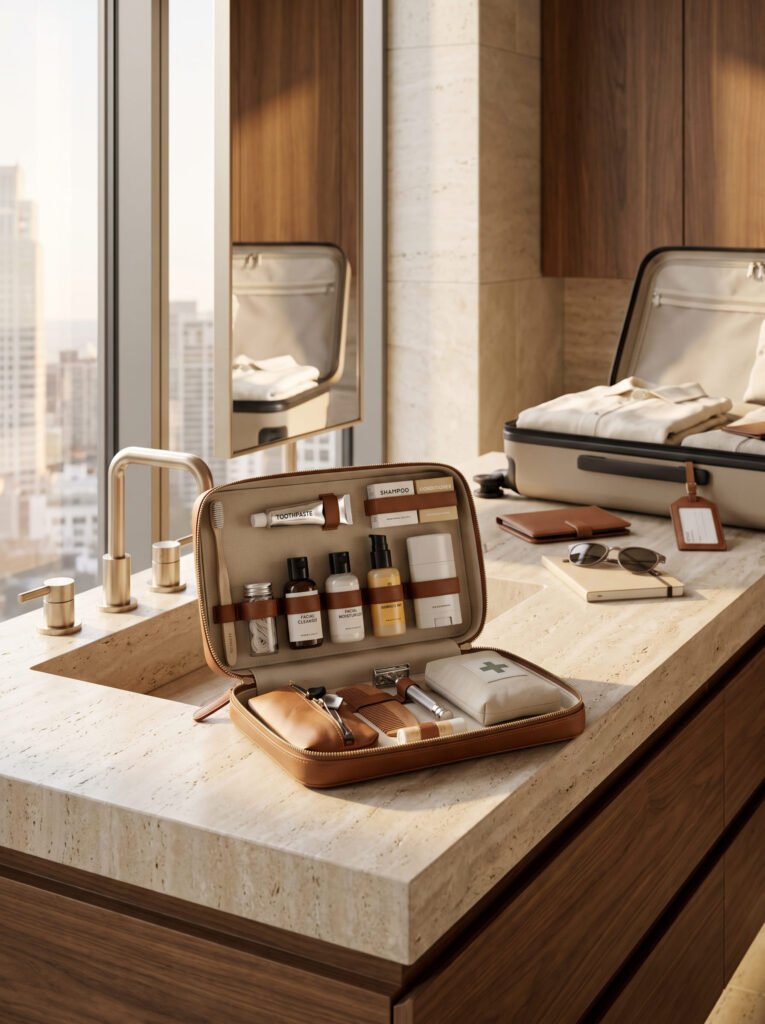
A minimalist toiletry kit can make one-bag travel noticeably easier. The goal isn’t to bring the fewest possible products at any cost; it’s to bring the products you genuinely use, in formats and quantities that make sense for the trip.
The best minimalist toiletry kit balances personal routine, carry-on restrictions, destination climate, trip length, and available hotel amenities. Instead of filling a large organizer with every product you might possibly need, build a compact system around essentials, then customize it only where your routine requires more.
This guide explains what belongs in a minimalist travel toiletry kit, what you can replace with solid alternatives, how to handle carry-on liquids, what to leave behind, and how to adapt your kit from a weekend away to a longer international trip.
Why a Minimalist Toiletry Kit Makes Travel Easier
Toiletries are surprisingly easy to overpack because many products seem small individually. A face cleanser, shampoo, conditioner, moisturizer, sunscreen, styling product, fragrance, toothpaste, deodorant, shaving products, and several skincare items can quickly turn into an entire pouch.
A minimalist approach asks a more useful question:
Will I genuinely use this during the trip, and is there a smaller or simpler way to bring it?
That shift eliminates much of the unnecessary weight and bulk.
A compact kit also makes your carry-on easier to organize. Products can be grouped by function, liquids can be kept accessible for security screening, and frequently used essentials won’t disappear inside a deep toiletry bag.
Most importantly, minimalism should be personal rather than competitive. Someone who needs a particular skincare product or medication shouldn’t leave it behind simply to achieve an arbitrary item count.
The Essential Minimalist Travel Toiletry Checklist
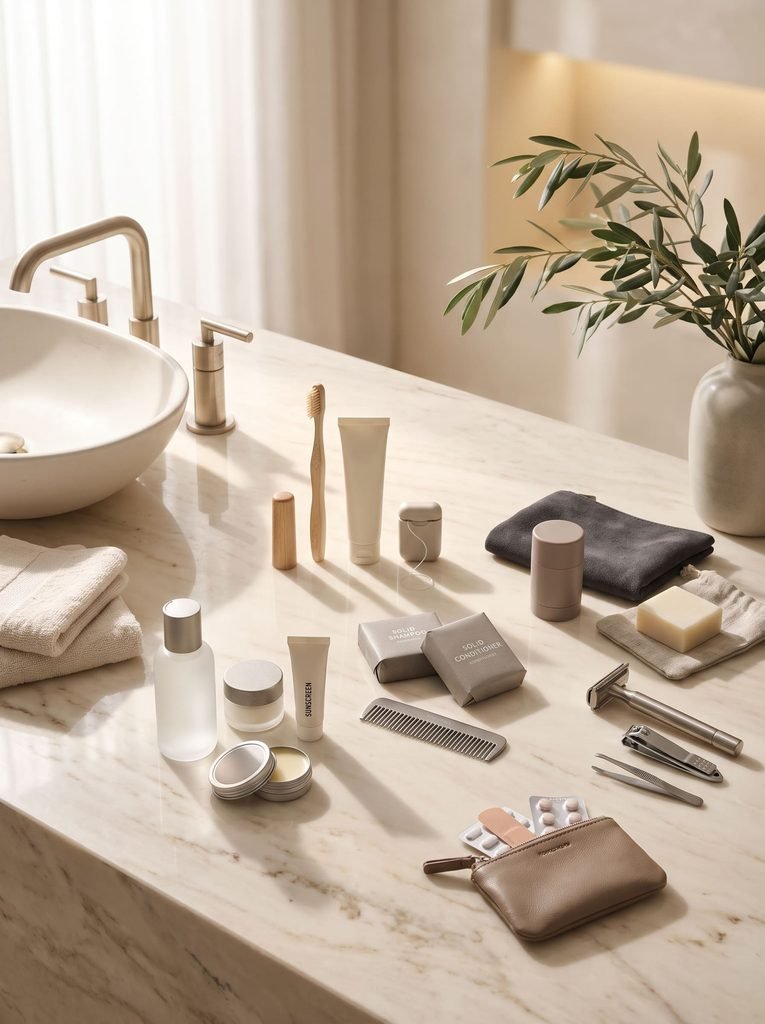
Think of your toiletry kit in categories rather than as one long shopping list. Start with the basics below, then add only what your routine or destination genuinely requires.
Dental Care
Your dental essentials are usually straightforward:
- Toothbrush
- Toothpaste
- Floss or interdental cleaner
- Toothbrush cover if useful for your setup
A full-size tube of toothpaste rarely makes sense for a short trip. A smaller tube or another appropriate travel format usually takes considerably less room.
If you use toothpaste tablets, they can be another compact option because they don’t require a conventional liquid or gel tube. Choose the format you already know works for you rather than experimenting immediately before a trip.
Skin Care
Keep skincare focused on products you actually use every day.
A compact routine might include:
- Facial cleanser
- Moisturizer
- Sunscreen
- Lip balm
- One treatment product if genuinely necessary
Don’t automatically transfer an entire home skincare routine into travel bottles. A trip is usually a good opportunity to identify which products are essential and which ones are occasional extras.
Sunscreen deserves particular attention because destination, season, altitude, and outdoor activity can significantly change how much you need.
Hair Care
Hair products can become one of the largest sections of a toiletry bag, particularly when shampoo, conditioner, styling cream, serum, and other products are all packed separately.
For a minimalist kit, consider:
- Shampoo
- Conditioner if needed
- One styling product
- Compact comb or brush
Solid shampoo or conditioner bars can reduce the number of liquid containers, although they aren’t automatically better for every hair type.
If your accommodation provides suitable hair products, you may be able to leave one or more items at home. Check the specific property rather than assuming amenities will always be available.
Body Care
A streamlined body-care setup may include:
- Soap or body wash
- Deodorant
- Small body moisturizer if needed
- Fragrance only if you actually use it
Solid soap and solid deodorant can be particularly useful for travelers trying to reduce liquid volume.
Fragrance is optional. If you wear it regularly, a small travel format can make sense. If you rarely use it at home, vacation probably isn’t the time to add another bottle.
Grooming
Pack only the grooming tools relevant to your routine.
Depending on your needs, that could mean:
- Razor
- Shaving product
- Nail clippers
- Tweezers
- Small grooming scissors where permitted
- Hair-removal products you regularly use
Don’t pack an entire grooming arsenal simply because the items are small. Several small tools can collectively occupy more space than expected.
Also check the security rules for your departure airport before packing blades or other potentially restricted grooming tools.
Health & First Aid
Health items should be treated differently from optional toiletries.
Bring the medication and health products you genuinely need rather than trying to minimize them for the sake of a lighter bag.
Depending on the traveler and destination, this may include:
- Prescription medication
- Regular over-the-counter medication
- Small first-aid supplies
- Blister protection
- Contact-lens supplies
- Other personally necessary health products
Medication requirements can differ by country, so travelers carrying prescription or controlled medication should check the rules for both their destination and transit points before departure.
Personal Essentials
This is the category that makes a minimalist toiletry kit personal.
Depending on your routine, you may need:
- Menstrual products
- Contact lenses and solution
- Specialty skincare
- Dental appliances
- Personal hygiene products
- Specific hair-care products
- Other daily necessities
These aren’t “extras” simply because another traveler doesn’t need them.
The right minimalist kit is the smallest kit that comfortably supports your actual routine.
How to Decide What Stays Home
Before putting something into your toiletry bag, ask five questions:
- Do I use it regularly?
- Do I need it for this particular trip?
- Can I bring a smaller amount?
- Can I replace it with a solid version?
- Can I easily obtain it at the destination if necessary?
This creates a simple decision system:
Essential → Pack
Essential but bulky → Find a smaller format
Liquid but available as a suitable solid → Consider switching
Occasional-use item → Question whether it earns the space
Easy to replace locally → Consider buying it there
Unnecessary → Leave it home
The objective isn’t to eliminate everything. It’s to remove products that don’t provide enough value for the space they occupy.
Solid vs. Liquid Toiletries: What Saves the Most Space?
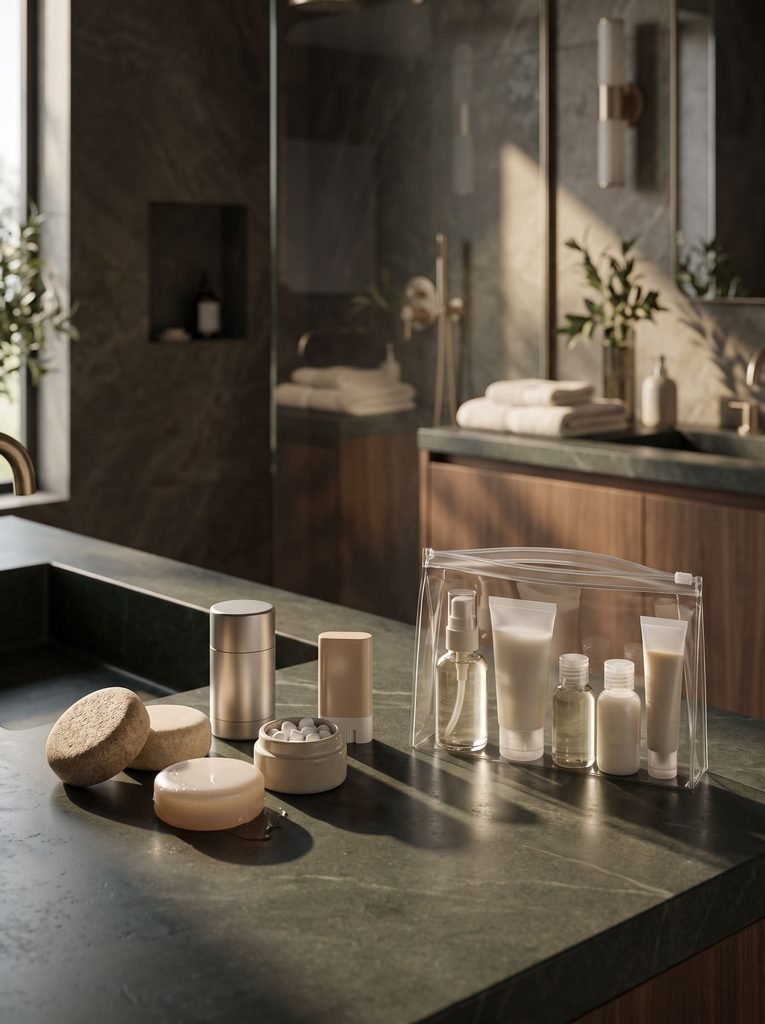
Solid toiletries can be extremely useful for carry-on travelers because they reduce dependence on liquid containers.
Potential solid alternatives include:
- Bar soap
- Shampoo bar
- Conditioner bar
- Solid deodorant
- Toothpaste tablets
- Sunscreen stick
- Solid fragrance formats
But “solid” doesn’t automatically mean “better.”
A liquid product may be the better choice if it works substantially better for your skin or hair, lasts longer, or is the only formulation you tolerate comfortably.
A useful decision hierarchy is:
Can I use a solid? → If yes, consider it.
If not, can I decant the liquid? → Use only the amount needed.
If not, can I buy it locally? → Consider destination purchase.
If none of those work → Pack the product in an appropriate travel format.
This prevents minimalism from becoming unnecessarily restrictive.
TSA Liquids: What Goes in the Quart Bag?
For travelers departing from or going through U.S. TSA screening, carry-on liquids, gels, and aerosols are subject to the TSA’s 3-1-1 liquids rule. TSA’s current travel checklist states that each container should be 3.4 ounces (100 ml) or less, with the liquids fitting in one quart-size clear plastic zip-top bag, with one such bag per passenger.
That means the important issue isn’t simply how many toiletry products you own. It’s how much liquid, gel, or aerosol you are attempting to carry through the checkpoint and how those products are packed.
Examples can include:
- Shampoo
- Conditioner
- Liquid cleanser
- Moisturizer
- Sunscreen
- Toothpaste
- Liquid foundation
- Hair gel
- Shaving gel
- Fragrance
Keep the liquid bag easy to access inside your carry-on. TSA’s travel checklist specifically recommends placing the 3-1-1 bag where it can be readily accessed for screening.
A Crucial International-Travel Note
The 3-1-1 rule discussed here is U.S. TSA guidance. Travelers departing from another country should check the security authority for that airport because screening procedures can differ.
For an international itinerary, consider the rules at your departure airport, transit airports, and any airport where you may have to clear security again.
How to Build a Minimalist Toiletry Kit for Different Trip Lengths
The number of days doesn’t necessarily determine how many different products you need. It mainly changes how much of each product you need.
Weekend Trip
For two to four nights, aim for a particularly compact kit.
Bring:
- Core dental products
- Deodorant
- Basic skincare
- Necessary hair products
- Essential grooming tools
- Required medication
- Sunscreen when appropriate
Small quantities are usually enough.
This is where decanting becomes especially useful. Carrying an almost-full bottle of cleanser for a two-night trip defeats the purpose of a minimalist setup.
One to Two Weeks
For a longer trip, don’t automatically multiply every product.
Instead, think about consumption rate.
If you use only a small amount of moisturizer each day, you may still need surprisingly little for two weeks.
For products that run out quickly, consider whether they can be purchased at the destination.
Longer Trips
Long trips don’t necessarily require enormous toiletry bags.
Instead, use a replenishment strategy.
Bring enough for the beginning of the trip, then replace common products locally when necessary. This can be particularly practical for widely available basics such as soap, shampoo, or toothpaste.
However, specialized products should generally be planned more carefully. If a product is essential and difficult to replace, don’t assume you’ll find an equivalent after arrival.
How Your Destination Changes Your Toiletry Kit
Your destination should influence your toiletry choices just as much as your trip length.
Hot and Humid Destinations
You may prioritize:
- Sunscreen
- Lightweight moisturizer
- Deodorant
- Hair products suited to humidity
- After-sun care if relevant
Avoid automatically adding multiple skincare products just because the climate is different. Start with your normal essentials and adjust only where conditions genuinely require it.
Cold and Dry Destinations
Dry air can change your skincare needs.
You may want:
- Richer moisturizer
- Lip balm
- Hand cream
- Suitable hair conditioner
- Sunscreen
Again, the goal is targeted adaptation rather than adding an entire second routine.
Beach and High-Sun Trips
Sun protection becomes especially important.
Consider:
- Broad-spectrum sunscreen appropriate for your needs
- Lip protection with SPF where appropriate
- After-sun moisturizer if useful
- Any personal products needed for swimming or outdoor activities
How much you need will depend on the length and nature of your outdoor exposure.
City Trips
City breaks often require the least specialized toiletry setup.
A basic personal-care kit may be sufficient, especially when staying in a hotel with suitable amenities.
The main advantage here is resisting the temptation to pack products “just in case.”
Hotel Toiletries: What Can You Leave at Home?
Hotel amenities can reduce what you need to carry, but don’t treat them as guaranteed.
Depending on the accommodation, you may find products such as:
- Soap
- Body wash
- Shampoo
- Conditioner
- Lotion
Higher-end properties may provide more extensive amenities, while budget accommodations, vacation rentals, hostels, and apartments may provide little or none.
Check your property’s current amenities before deciding what to leave behind.
For a product you strongly prefer or medically need, bring your own even when the accommodation advertises a similar item.
How to Choose a Minimalist Toiletry Bag
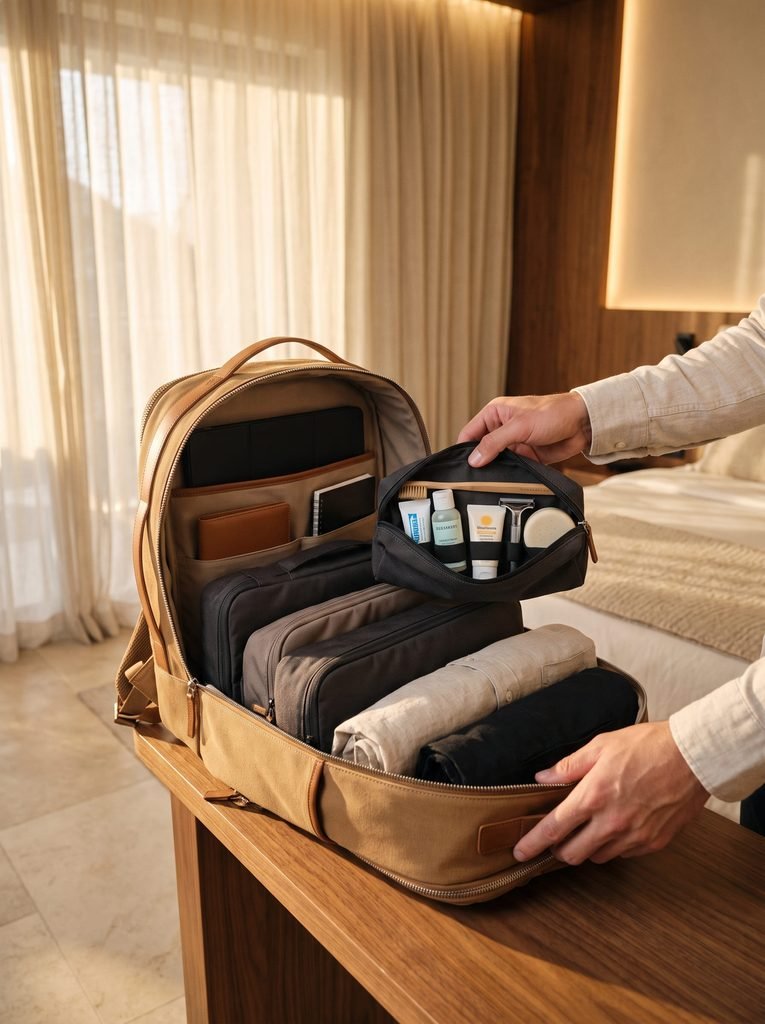
The best toiletry bag isn’t necessarily the biggest or most elaborate one.
Look for:
- Compact dimensions
- Easy-clean interior
- Secure closures
- Useful compartments
- Durable construction
- Easy access to liquids
- Enough capacity for your actual routine
A hanging organizer can be useful in small bathrooms because it takes advantage of vertical space.
A simple pouch can be better for travelers who already keep their kit extremely compact.
Avoid buying a large organizer simply because you have one available. Extra space often encourages extra packing.
How to Pack Your Toiletry Kit Inside a Carry-On
Organization matters almost as much as the products themselves.
1. Separate liquids
Keep liquids, gels, and aerosols together so they’re easy to remove when required for screening.
2. Protect leak-prone products
Use secure caps and, where appropriate, secondary protection around products that could leak.
3. Put frequently used items near the top
If you use your toothbrush, moisturizer, or deodorant every morning, you shouldn’t have to unpack half your bag to reach them.
4. Keep tools together
Store grooming tools in one small section instead of scattering them through your luggage.
5. Don’t fill every compartment
Unused space is not a packing failure. It gives you room to access your belongings and accommodate small changes during the trip.
Common Minimalist Toiletry Packing Mistakes
Packing full-size products
A full-size bottle can take up disproportionate space when only a fraction of it is needed.
Taking duplicate products
Two cleansers, several moisturizers, or multiple styling products can quickly undermine an otherwise minimalist setup.
Treating “travel size” as automatically necessary
A tiny product is still unnecessary if you won’t use it.
Packing for imaginary situations
The phrase “just in case” is responsible for many oversized toiletry bags.
Pack for the trip you are actually taking.
Replacing trusted products too aggressively
Minimalism shouldn’t force you to abandon products that work for you. If a solid alternative irritates your skin or doesn’t work for your hair, the space-saving benefit may not justify the compromise.
Forgetting destination-specific needs
A cold-weather city, tropical beach, hiking trip, and business trip may require different adjustments.
Ignoring security rules
Airport security requirements can change, and rules differ between jurisdictions. Check the relevant official authority before departure rather than relying on an old packing list.
Who Should Customize the Basic Kit?
Almost everyone should customize it to some degree.
First-Time One-Bag Travelers
Start with the basics and resist adding products simply because you own them.
Frequent Travelers
Build a permanent travel kit containing the formats you already know work for you. This can make packing much faster.
Families
A shared kit can sometimes reduce duplicate items, but personal medications and individual hygiene requirements should remain individualized.
Luxury Travelers
Luxury accommodation can reduce the need to carry certain basic toiletries, but preferred skincare, hair products, and specialty items may still justify space.
Travelers With Specialized Routines
Don’t sacrifice necessary products to meet an arbitrary minimalist standard. The purpose of minimalism is to eliminate unnecessary belongings—not necessary ones.
A Simple Minimalist Toiletry Formula
If you want a repeatable system, build your kit around these layers:
Core essentials
- Dental care
- Deodorant
- Basic skincare
- Basic body care
- Required medication
Routine-specific essentials
- Hair products
- Grooming tools
- Contact-lens supplies
- Menstrual products
- Specialty skincare
- Other personal necessities
Trip-specific additions
- Extra sun protection
- Outdoor-care products
- Cold-weather skincare
- Activity-specific products
Optional items
- Fragrance
- Extra styling products
- Occasional-use skincare
- Convenience items
Then apply one final test:
Would I notice its absence during the trip?
If the answer is no, it probably doesn’t need to occupy valuable carry-on space.
FAQs
1. What should be in a minimalist toiletry kit?
A basic kit usually includes dental care, deodorant, essential skincare, basic body care, necessary grooming items, and any required medication or personal-care products. Add hair care and destination-specific items according to your actual routine.
2. How do you pack toiletries for one-bag travel?
Start by removing duplicate and rarely used products. Then reduce quantities, replace suitable liquids with solid formats, decant what remains, and organize everything in one compact toiletry bag. Keep your liquid bag accessible when airport screening requires it.
3. What toiletries can I bring in a carry-on?
Carry-on toiletry rules depend on the airport and security authority. For U.S. TSA screening, liquids, gels, and aerosols generally need to follow the 3-1-1 rule: containers of 3.4 ounces (100 ml) or less, packed in one quart-size clear plastic bag, with one bag per passenger.
4. Are solid toiletries better for travel?
They can be useful because they reduce the amount of liquid you need to carry, but they aren’t automatically better for every traveler. If a solid shampoo, deodorant, cleanser, or other product doesn’t work for you, a suitably sized liquid may be the more practical choice.
5. Should I buy toiletries at my destination?
For common products that are easy to replace, destination shopping can reduce packing volume, especially on longer trips. However, prescription medication, specialized skincare, specific hair products, and other difficult-to-replace essentials are better planned before departure.
Conclusion
A minimalist toiletry kit isn’t about owning fewer products simply for the sake of having fewer products. It’s about creating a compact travel system in which every item has a clear purpose.
Start with your genuine daily essentials, reduce the quantities, choose solid alternatives when they work for you, and keep liquids organized according to the security rules that apply to your journey. Then adjust the kit for climate, activities, accommodation, and trip length.
The result should be small enough to disappear into your carry-on—but complete enough that you never feel like you’ve packed too little.