

AI Travel Apps
Planning a trip used to mean opening dozens of tabs, comparing flights, searching hotels, building itineraries, checking weather, and saving places manually. In 2026, AI travel apps are changing that process by bringing many of these tasks into one smarter travel-planning experience.
From finding flights and creating personalized itineraries to translating languages and organizing travel plans, artificial intelligence can help travelers save time and make better decisions. The key is knowing which AI travel tools are genuinely useful and how to use them effectively.
What Are AI Travel Apps?
AI travel apps are mobile or web-based travel tools that use artificial intelligence to help with tasks such as trip planning, destination research, itinerary creation, flight searches, hotel discovery, translation, and travel recommendations.
Instead of simply displaying a database of information, AI-powered travel apps can understand natural-language requests and personalize suggestions according to your destination, budget, interests, travel dates, and preferred activities.
Why AI Travel Apps Are Becoming Popular in 2026
Modern travelers increasingly want personalized recommendations rather than generic travel guides. AI can analyze a travel request and quickly turn it into a practical plan covering destinations, activities, restaurants, transportation, and daily schedules.
The biggest advantage is convenience. Instead of spending hours researching every part of a vacation, travelers can use AI travel planning tools to create a starting itinerary and then adjust it according to their preferences.
Best Uses of AI for Travel Planning
AI can assist with almost every stage of a trip, from the first destination idea to the journey home. Travelers can use AI to research destinations, compare travel options, organize activities, estimate travel times, and create personalized itineraries.
It can also help identify gaps in a travel plan, such as unrealistic travel times or too many activities scheduled for one day. This makes AI particularly useful for travelers who want structure without manually building everything from scratch.
AI Travel Apps for Creating Personalized Itineraries
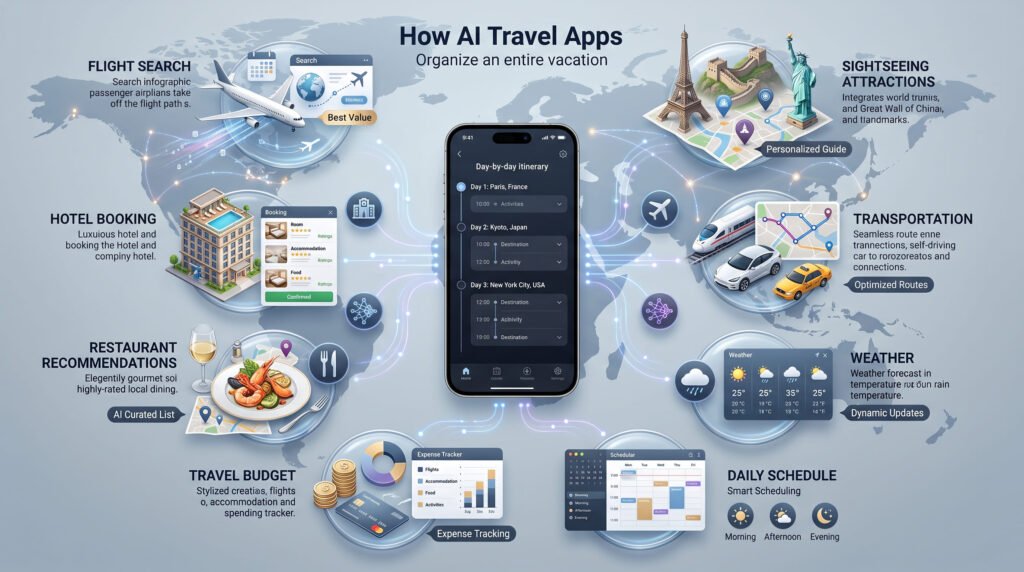
One of the most useful applications of artificial intelligence in travel is AI itinerary planning. You can describe the type of vacation you want, including destination, number of days, budget, interests, and preferred pace.
An AI travel planner can then organize attractions and activities into a day-by-day schedule. The resulting itinerary should be treated as a starting point because opening hours, transportation conditions, reservations, and local events can change.
AI Apps for Finding Cheap Flights
Finding affordable airfare often requires comparing multiple dates, airports, airlines, and routes. AI-powered flight tools can make this process easier by analyzing available options and helping travelers identify potentially better combinations.
Useful features can include flight price tracking, flexible-date searches, fare alerts, alternative airports, route comparisons, and airfare predictions. However, travelers should always verify the final fare directly with the airline or booking provider before purchasing.
AI Travel Apps for Hotel and Accommodation Search
AI can also simplify hotel research by matching accommodation recommendations to your travel preferences. Instead of searching only by destination and price, travelers can describe requirements such as location, family-friendly facilities, quiet surroundings, business amenities, or proximity to attractions.
The best approach is to use AI to create a shortlist and then check current hotel reviews, cancellation policies, taxes, resort fees, location, and final pricing before booking.
AI Travel Apps for Personalized Travel Recommendations
Traditional travel apps often show the same popular attractions to everyone. AI travel recommendations can be more personalized because they can consider interests such as food, history, beaches, photography, shopping, nightlife, nature, or family activities.
For example, a traveler interested in architecture can ask an AI travel assistant to prioritize historic buildings and museums rather than filling the itinerary with generic tourist attractions.
AI Travel Apps for Language Translation
Language barriers can make international travel stressful, especially when reading menus, signs, transportation information, or communicating with locals. AI-powered translation tools can provide real-time text, voice, and image translation.
These tools are particularly helpful when traveling through countries where you do not speak the local language. Still, travelers should remember that machine translation can make mistakes, especially with slang, regional expressions, or culturally sensitive conversations.
AI Travel Apps for Navigation and Local Discovery
AI can make destination navigation more personalized by helping travelers discover places based on their interests and current location. Instead of searching broadly for “things to do,” travelers can request nearby attractions, cafes, shopping areas, scenic locations, or activities that match their schedule.
When using AI for navigation, always verify the actual location, opening hours, transportation availability, and route information through a reliable map or local source.
AI Travel Apps for Packing and Travel Checklists
Packing is another area where AI can be surprisingly useful. A traveler can provide the destination, trip length, season, planned activities, luggage limitations, and accommodation type, and an AI assistant can generate a personalized packing list.
This can help prevent both overpacking and forgetting important items. A good AI packing assistant can also separate essentials, clothing, electronics, documents, toiletries, and activity-specific items.
AI Travel Apps for Travel Budget Planning
A vacation budget can quickly become complicated when flights, accommodation, transportation, food, activities, and unexpected expenses are combined. AI budgeting tools can help organize estimated costs into categories and identify areas where spending can be reduced.
Travelers can ask AI to create a daily budget based on their destination and travel style. Estimates should not be treated as exact prices because exchange rates, seasonal costs, taxes, and local prices can change.
AI Travel Apps for Road Trips
AI is especially useful for planning road trips because the journey involves multiple stops rather than a single destination. Travelers can provide their starting point, final destination, available days, preferred attractions, and driving limits.
An AI road-trip planner can suggest routes, overnight stops, scenic locations, attractions, and food breaks. Before starting the journey, confirm road conditions, driving times, fuel availability, parking, and local restrictions.
AI Travel Apps for Family Vacations
Family travel often requires balancing different ages, interests, budgets, meal preferences, and activity levels. AI can create family-friendly itineraries that include attractions suitable for children while leaving enough time for meals and rest.
Parents can also ask AI to prioritize shorter travel distances, child-friendly accommodation, indoor alternatives, and flexible activities. The recommendations should still be checked for age restrictions, accessibility, safety, and availability.
AI Travel Apps for Solo Travelers
Solo travelers can use AI to build flexible itineraries based on personal interests and travel pace. AI can suggest neighborhoods, activities, transportation options, restaurants, and day plans without requiring a large amount of manual research.
For solo travel, however, AI recommendations should never replace basic safety planning. Verify local conditions, transportation options, accommodation details, and official travel information before making important decisions.
AI Travel Apps for Last-Minute Trips
AI can be valuable when there is little time to plan. Instead of researching dozens of websites, travelers can ask an AI assistant to prioritize essential bookings, nearby attractions, practical transportation, and activities that fit the available time.
For last-minute travel, real-time information becomes especially important. Always verify availability and current prices because AI-generated suggestions may not reflect the latest booking inventory.
How to Use AI Travel Apps Without Overplanning Your Trip
One mistake travelers can make is allowing AI to create an itinerary packed with activities from morning until night. A theoretically efficient schedule can become exhausting in real life.
Leave free time between major activities for meals, transportation delays, unexpected discoveries, rest, and changes in weather. The best AI-generated itinerary should feel flexible rather than like a strict timetable.
Are AI Travel Apps Accurate?
AI travel apps can be extremely useful, but they are not infallible. Artificial intelligence may provide outdated opening hours, incorrect prices, unavailable attractions, inaccurate travel times, or recommendations based on information that has changed.
For important travel decisions, use AI for research and organization, then verify critical details through official airline, hotel, attraction, transportation, government, or destination sources.
Are AI Travel Apps Better Than Traditional Travel Apps?
AI travel apps and traditional travel apps serve different purposes. Traditional apps are often excellent for real-time bookings, maps, reservations, reviews, prices, and availability, while AI tools are particularly useful for understanding a traveler’s request and turning it into personalized recommendations.
The strongest approach is not to choose one over the other. Use AI for planning and personalization, then use trusted travel platforms and official sources for real-time verification and booking.
How to Get Better Results From AI Travel Apps
The quality of an AI travel recommendation depends heavily on the information you provide. Instead of asking, “Plan my trip to Paris,” include your travel dates, budget, interests, accommodation preferences, transportation style, group size, and preferred pace.
You can also ask the AI to avoid specific things, such as crowded attractions, expensive restaurants, long walking routes, or early-morning activities. More context generally produces a more useful starting plan.
Important Things to Check Before Trusting an AI Travel Recommendation
Before following an AI-generated recommendation, verify the details that can affect your money, safety, or schedule. Check current prices, opening hours, booking availability, cancellation policies, transportation schedules, visa requirements, and local travel restrictions.
AI should function as a travel planning assistant, not as the final authority. Combining artificial intelligence with reliable real-world sources gives travelers a much safer and more accurate planning process.
Best AI Travel Strategy for 2026

The smartest way to use AI travel apps in 2026 is to combine automation with human judgment. Let AI generate ideas, organize itineraries, compare possibilities, create packing lists, and personalize recommendations.
Then verify important details through reliable travel services and official sources. This approach saves research time while reducing the risk of following outdated or inaccurate information.
FAQs
1. What are AI travel apps?
AI travel apps use artificial intelligence to help travelers plan trips, create itineraries, discover destinations, organize budgets, find travel options, and receive personalized recommendations.
2. Can AI travel apps find cheaper flights?
They can help identify potentially cheaper travel dates, routes, airports, and fares, but travelers should verify current prices and availability before booking.
3. Can AI create a complete travel itinerary?
Yes, AI can create detailed day-by-day itineraries based on destinations, dates, interests, budget, and preferred travel pace.
4. Are AI travel recommendations always accurate?
No. AI can sometimes provide outdated or incorrect information, so important details such as prices, opening hours, schedules, and travel requirements should be verified.
5. Are AI travel apps useful for international travel?
Yes. They can help with itinerary planning, translation, destination research, budgeting, packing, transportation ideas, and local recommendations, making international trip planning more convenient.
Conclusion
AI travel apps are becoming powerful companions for modern travelers because they can reduce research time and turn complicated travel-planning tasks into simpler, personalized experiences. From AI itinerary generators and flight research to translation, packing, budgeting, and local recommendations, artificial intelligence can support almost every stage of a journey.
However, the smartest travelers will not rely on AI blindly. Use artificial intelligence for ideas, organization, personalization, and planning, then verify important information through reliable real-time and official sources. In 2026, the best travel strategy is not AI instead of traditional travel tools—it is AI combined with trusted travel information and human judgment.