
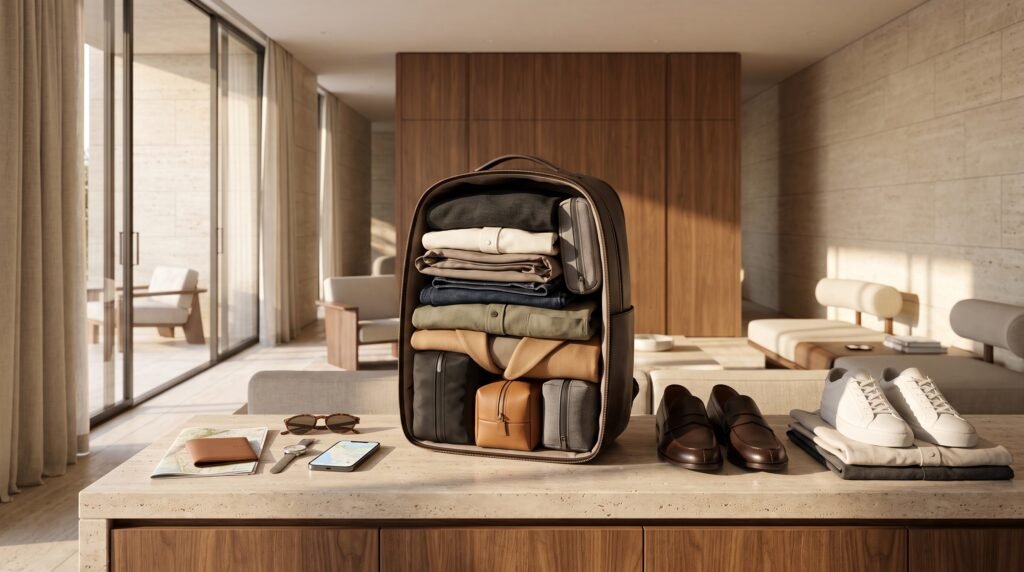
Packing for a trip with one bag becomes much easier when you stop thinking in terms of one outfit per day and start thinking in terms of a small wardrobe that works together.
A well-planned one-bag capsule wardrobe can give you enough variety for a week, two weeks, or even longer while keeping your luggage manageable. The secret is not owning fewer clothes for the sake of minimalism. It is choosing pieces that can be worn repeatedly, layered easily, washed without difficulty, and combined into several different outfits.
The best capsule also begins before you open your closet. Your destination, weather, activities, dress requirements, laundry access, footwear needs, and airline baggage allowance all influence what belongs in the bag. Since baggage dimensions and weight limits vary by airline and fare, always verify the rules for your specific itinerary before packing.
This guide explains how to build a flexible travel wardrobe from the ground up, including clothing quantities, fabrics, colors, shoes, laundry, climate adjustments, and a final test that helps eliminate unnecessary pieces.
What Is a One-Bag Capsule Wardrobe?
A one-bag capsule wardrobe is a deliberately limited collection of travel clothing designed to fit into one carry-on bag or personal item while producing multiple wearable outfits.
Unlike a conventional vacation packing list, it does not attempt to provide a completely different outfit for every day. Instead, a smaller group of coordinated tops, bottoms, layers, shoes, and accessories is repeatedly recombined.
The goal is maximum usefulness from minimum volume.
A good capsule should allow you to:
- Wear most pieces in several combinations
- Dress outfits up or down
- Adapt to changing temperatures
- Repeat clothing without feeling repetitive
- Wash selected garments during longer trips
- Avoid packing items for unlikely scenarios
- Leave enough room for toiletries, technology, documents, and other essentials
The exact number of pieces is not universal. A tropical weekend and a cold-weather business trip cannot realistically use the same wardrobe. The system should adapt to the trip rather than forcing the trip into a formula.
How Many Clothes Do You Need for One-Bag Travel?
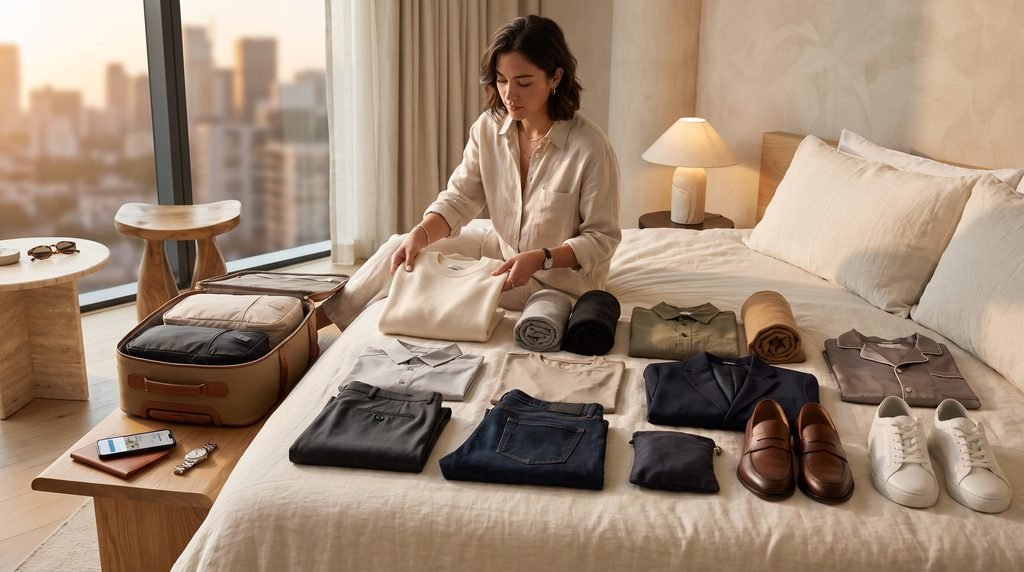
For many travelers, a useful starting point is roughly 8–12 core clothing pieces, plus underwear, sleepwear where needed, accessories, and one or two pairs of shoes.
A practical starting framework could look like:
- 3–5 tops
- 2–3 bottoms
- 1–2 versatile layers
- 1 special-purpose piece, if genuinely required
- 1–2 pairs of shoes
This is a framework, not a rule.
A seven-day city trip with mild weather might need fewer pieces than a five-day trip involving hiking, formal dinners, and changing temperatures. Likewise, a two-week trip does not necessarily require twice as many clothes. Once laundry becomes part of the plan, clothing quantity can remain relatively stable while washing frequency increases.
Think in Wears, Not Days
Instead of asking, “How many outfits do I need for 10 days?” ask:
How many different ways can I wear the clothes I am bringing?
Four tops and three bottoms can already create numerous basic combinations if the colors, cuts, and fabrics work together. Layers and accessories then change the appearance and function of those combinations.
That is the central idea behind a successful one-bag capsule wardrobe: pack a wardrobe, not ten separate outfits.
Start With the Trip, Not Your Closet
Before selecting a single garment, define what the trip actually demands.
Check the Weather
Look beyond the average temperature.
Consider:
- Daytime temperatures
- Evening temperatures
- Rain
- Humidity
- Wind
- Indoor air conditioning
- Temperature changes between destinations
- Expected weather during your travel dates
A warm destination can still require a light layer, while a cool city may feel comfortable during the day and significantly colder after sunset.
List Your Activities
Write down what you will actually do.
For example:
- Walking through cities
- Museums and sightseeing
- Restaurants
- Beach days
- Hiking
- Business meetings
- Religious or cultural sites
- Nightlife
- Casual evenings
- Exercise
This prevents the classic mistake of packing clothing for imaginary situations.
Identify Dress Requirements
If your itinerary includes a wedding, business meeting, upscale restaurant, religious site, or other event with a specific dress expectation, account for it before building the capsule.
One versatile elevated garment can sometimes serve several purposes. A polished button-down, simple dress, tailored trouser, or refined overshirt may work for both daytime and evening depending on styling.
Check Laundry Access
Laundry availability can dramatically change your packing strategy.
If your accommodation has a washing machine, your wardrobe can be smaller. If you expect to wash clothing in a sink, prioritize garments that dry efficiently. If neither is practical, you may need a slightly larger clothing rotation.
Laundry is not an emergency solution for overpacking. It is part of the wardrobe design.
Choose the Bag Before Finalizing the Wardrobe
Your bag creates the physical boundary of your capsule.
Start by checking the exact baggage allowance for your airline, route, and fare. Airline policies can differ significantly, particularly between standard carry-on allowances and personal-item-only fares.
Then consider:
- External dimensions
- Internal capacity
- Weight
- Laptop or technology storage
- Organization
- Accessibility
- Comfort when walking
- Whether the bag must fit under a seat or in an overhead compartment
A larger bag does not automatically make packing easier. Extra space can simply encourage extra clothing.
For strict one-bag travel, the best bag is usually the smallest one that comfortably accommodates your genuine requirements without forcing you to sacrifice necessary items.
Build a Simple Color Palette
Color coordination is one of the easiest ways to make a small wardrobe feel larger.
A practical capsule can begin with:
- One dark neutral: black, navy, charcoal, brown, or deep olive
- One light neutral: white, cream, beige, light grey, or similar
- One accent: burgundy, rust, blue, green, mustard, or another color you genuinely enjoy
You do not have to follow a three-color rule exactly. The important principle is compatibility.
If your tops work with most of your bottoms, you can create more outfits without adding more garments.
Use Accessories for Variety
Accessories can change the visual character of repeated clothing without consuming much space.
Depending on the destination, consider:
- A lightweight scarf
- Belt
- Compact hat
- Simple jewelry
- Watch
- Small crossbody bag
- Sunglasses
Choose only accessories you are genuinely likely to use.
Choose Fabrics That Earn Their Space
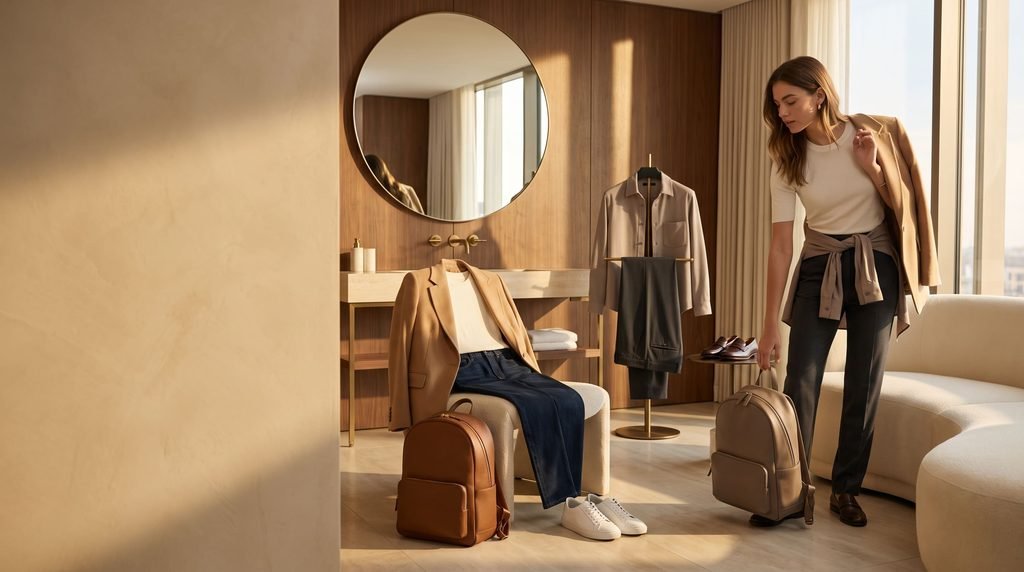
A one-bag wardrobe places more demands on fabric than a conventional closet.
Useful characteristics include:
- Lightweight construction
- Comfortable stretch
- Reasonable wrinkle resistance
- Breathability
- Reasonable drying speed
- Odor management
- Durability
- Easy care
No single fabric is perfect for every traveler or climate.
Merino Wool
Merino is popular in travel wardrobes because it can provide temperature regulation and odor resistance while remaining relatively comfortable across changing conditions.
It can be particularly useful for:
- T-shirts
- Base layers
- Socks
- Lightweight sweaters
However, merino is not automatically the best choice for every traveler. Cost, personal sensitivity, care instructions, durability, and climate should all be considered.
Synthetic Blends
Technical synthetic fabrics can be useful for travel because many are lightweight, durable, stretchy, and fast-drying.
They are particularly practical for:
- Travel pants
- Activewear
- Rain layers
- Workout clothing
- Warm-weather tops
Their main drawback is that odor retention can vary considerably between fabrics and finishes, so construction matters as much as the generic label.
Cotton
Cotton remains comfortable and familiar, especially for casual travel.
The limitation is practical: heavier cotton garments can occupy more space and may take longer to dry after washing.
That does not mean cotton should never enter a one-bag wardrobe. A lightweight cotton shirt that you love and wear repeatedly may be more useful than an expensive technical garment you dislike.
Linen
Linen can be excellent for hot-weather travel because of its breathability, but its tendency to crease may make it less convenient for travelers who want a consistently polished appearance.
The right question is not whether a fabric is objectively “best.”
Ask whether it works for your destination, your activities, and your washing routine.
Build Your One-Bag Capsule Wardrobe
Once the trip, bag, colors, and fabrics are established, build the clothing categories.
Tops: Choose Versatility First
A useful starting point is 3–5 tops.
You might combine:
- One everyday T-shirt
- One second neutral T-shirt
- One lightweight long-sleeve top
- One button-down, blouse, or elevated shirt
- One optional accent top
Every top should ideally work with multiple bottoms.
Avoid bringing three versions of essentially the same shirt unless you know you will use them.
A long-sleeve shirt can be especially useful because it may work for cooler evenings, sun protection, cultural settings, or a slightly dressier outfit.
Bottoms: Build the Foundation
Two or three bottoms can cover a surprising number of outfits.
A practical combination might include:
- One comfortable everyday trouser
- One lighter or alternate bottom
- One optional short, skirt, or second trouser depending on climate
Choose based on your itinerary rather than fashion categories.
For example, a traveler spending most of the day walking may prioritize stretch and comfort, while someone attending business meetings may need a more polished silhouette.
Bottoms are also useful for controlling visual repetition. Repeating the same trousers several times is often less noticeable than repeating the same top.
Layers: Think Modularly
Instead of packing one bulky sweater for every possible temperature, consider a modular layering system.
A useful combination might include:
Base layer → lightweight mid-layer → weather shell
This gives you more flexibility than relying on a single heavy garment.
Possible layers include:
- Lightweight cardigan
- Merino sweater
- Fleece
- Overshirt
- Packable vest
- Lightweight insulated jacket
- Wind or rain shell
For mixed climates, thin layers are particularly useful because you can add or remove them throughout the day.
Shoes: Make Every Pair Work Hard
Shoes are among the most difficult items to compress, so footwear deserves deliberate planning.
For many one-bag trips, two pairs are a practical target:
- A comfortable primary walking shoe
- A lighter secondary shoe suited to the destination
Wear the bulkier pair during transit when practical.
But two pairs should not become an absolute rule. A hiking itinerary, winter trip, formal event, or beach destination may require different footwear.
Before adding another pair, ask:
Can the shoes I already have perform this function?
If the answer is yes, leave the additional pair behind.
The Special-Purpose Piece
Some trips genuinely require one item outside the normal capsule.
Examples include:
- Swimsuit
- Formal dress
- Blazer
- Hiking layer
- Religious-site clothing
- Cold-weather base layer
- Workout gear
The key is to avoid allowing one special activity to turn into an entirely separate wardrobe.
Whenever possible, choose a piece that overlaps with other uses.
A lightweight dress, for example, might work for sightseeing, dinner, and a more polished evening. A collared shirt could work for daytime travel and a business meeting.
Create an Outfit Grid Before You Pack
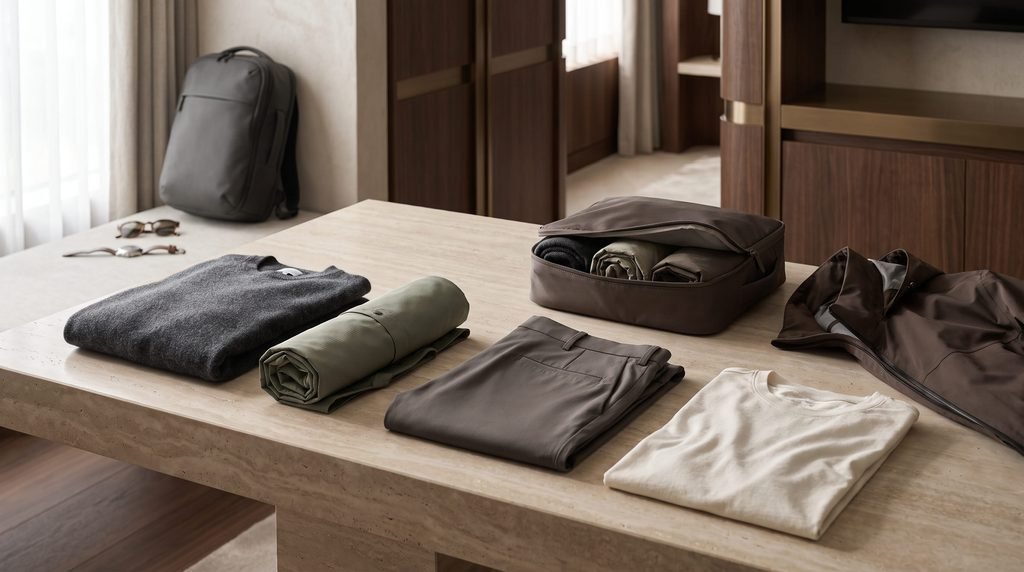
One of the most useful tests for a one-bag capsule wardrobe is to physically lay everything out.
Put your tops in one row and bottoms in another.
Then test the combinations.
Do not count an outfit simply because the colors technically match. Ask:
- Would I actually wear this?
- Is it comfortable?
- Does the silhouette work?
- Does it suit the destination?
- Does it work with my shoes?
- Can I wear it for more than one activity?
If one item only works with one other garment, it deserves another look.
The strongest capsule pieces usually have multiple roles.
Use the Three-Outfit Test
A simple editing rule is:
Every important clothing item should contribute to at least three genuinely wearable outfits whenever practical.
This is not a mathematical requirement. A rain shell may technically produce fewer visible outfit combinations but still be essential because it protects the entire wardrobe from weather.
The point is to identify clothing that consumes space without providing enough value.
Build Your Laundry Strategy
Longer travel does not automatically require more clothes.
It usually requires a better laundry plan.
Sink Washing
For lightweight garments, hand washing can be useful when appropriate.
Before relying on this method, consider:
- How quickly clothes dry
- Humidity
- Ventilation
- Access to a suitable place to hang clothes
- Whether the garment’s care instructions permit the method
Laundromat Washing
A laundromat can reset much of your wardrobe in one session.
For longer trips, consider scheduling laundry during an otherwise slower part of the itinerary rather than waiting until everything is dirty.
Accommodation Laundry
A washer at your accommodation can make a compact wardrobe much easier to manage.
Always check the actual facilities and instructions rather than assuming laundry will be available.
The Important Principle
Your wardrobe does not need to expand simply because your trip becomes longer.
A seven-day wardrobe can often support a much longer journey if you are comfortable washing clothing periodically.
The exact cadence depends on climate, activity level, clothing fabric, personal preferences, and access to laundry.
Adapt the Capsule to Hot Weather
Hot-weather travel usually benefits from:
- Breathable tops
- Lightweight bottoms
- Shorts or skirts where appropriate
- Sun protection
- Sandals or breathable shoes
- A lightweight long-sleeve layer
- Quick-drying clothing for active days
Avoid automatically packing more clothing simply because you expect to sweat.
Instead, select fabrics that suit your activity and establish when you will wash them.
Adapt the Capsule to Cool Weather
Cool-weather packing works best when clothing is layered.
Consider:
- Long-sleeve base layer
- Lightweight sweater or fleece
- Comfortable trousers
- Weather-resistant outer layer
- Warm socks
- Compact accessories such as a scarf or gloves
The goal is flexibility rather than carrying one oversized garment that handles every condition.
Adapt the Capsule to Winter
Cold destinations require more careful volume management.
Wear your bulkiest practical layers during transit when comfortable and permitted, and prioritize pieces that can work together.
A winter capsule might emphasize:
- Thermal base layer
- Merino or synthetic mid-layer
- Packable insulated jacket
- Weather-resistant shell
- Warm trousers
- Gloves
- Hat
- Appropriate winter footwear
Extreme cold may simply require more volume than a conventional one-bag formula can comfortably accommodate. In those circumstances, practicality should take priority over forcing the trip into an arbitrary packing limit.
Adapt the Capsule to Mixed-Climate Trips
Mixed-climate travel is where a capsule system becomes particularly valuable.
Instead of packing completely separate warm- and cold-weather wardrobes, create layers that can be added progressively.
For example:
T-shirt → long-sleeve layer → lightweight mid-layer → weather shell
The same base pieces can then travel through several temperature ranges.
This is usually more efficient than packing multiple heavy garments.
Adapt the Wardrobe to Different Trip Types
City Breaks
Prioritize:
- Comfortable walking shoes
- Versatile trousers
- Polished casual tops
- Lightweight layer
- Compact weather protection
Beach Trips
Prioritize:
- Swimwear
- Breathable clothing
- Lightweight cover-up
- Sun protection
- Sandals
- One outfit suitable for dinner
Hiking Trips
Prioritize performance and safety over outfit variety.
Your capsule may need:
- Technical base layer
- Hiking bottoms
- Appropriate footwear
- Weather protection
- Warm layer
- Activity-specific essentials
Business Travel
A business trip can require a more structured wardrobe.
Choose pieces that can transition between:
- Airport
- Meetings
- Dinner
- Casual downtime
One polished jacket, trouser, dress, or shirt may be more useful than several casual alternatives.
Formal or Event Travel
If a wedding or formal event is the main reason for the trip, build around that requirement first.
Then select casual pieces that can share colors, shoes, layers, or accessories with the formal outfit where possible.
Don’t Forget Underwear, Sleepwear, and Small Essentials
The visible wardrobe is only part of the packing system.
Depending on your trip, account for:
- Underwear
- Socks
- Sleepwear
- Swimwear
- Workout clothing
- Belt
- Accessories
- Laundry bag
- Small repair items
These pieces can quietly become a large portion of the bag if they are not considered from the beginning.
Common One-Bag Capsule Wardrobe Mistakes
Packing One Outfit for Every Day
This is the fastest way to turn a small trip into an oversized bag.
Build combinations instead.
Packing for Imaginary Emergencies
“If I suddenly need this” is not always a good reason to pack something.
Identify the actual situation where you expect to use the item.
Bringing Too Many Shoes
Shoes are easy to justify and difficult to pack.
Give each pair a clear purpose.
Choosing Clothing You Never Wear at Home
Travel is not the ideal time to discover that a shirt is uncomfortable, shoes cause blisters, or trousers do not fit the way you expected.
Test important clothing before departure.
Ignoring the Weather
A beautiful capsule can still fail if it is built for the wrong climate.
Check the expected conditions close to departure and make sensible adjustments.
Treating Compression as Extra Capacity
Compression can help organize clothing, but it does not make a bag infinitely larger.
Do not use compression space as an excuse to pack additional low-value garments.
Forgetting the Airline’s Actual Rules
A bag that physically fits your packing system may still exceed an airline’s permitted dimensions or weight.
Check the exact allowance associated with your ticket before departure.
The Final One-Bag Test
Before closing the bag, perform one final review.
Ask These Questions
1. Does every piece suit the destination?
2. Can most tops work with most bottoms?
3. Do I have appropriate clothing for the actual activities?
4. Can I handle the expected weather?
5. Do my shoes cover the activities I have planned?
6. Do I know when and where I will do laundry?
7. Am I carrying anything only because I am afraid I might need it?
8. Have I checked my airline’s baggage allowance?
9. Have I worn the important clothing and shoes before the trip?
10. Is there anything I can remove without creating a genuine problem?
If the bag passes those questions, you are much closer to a functional capsule rather than simply a smaller pile of clothes.
A Practical One-Bag Capsule Checklist
Use this as a starting point rather than a rigid packing rule:
- 3–5 versatile tops
- 2–3 interchangeable bottoms
- 1–2 layers
- 1 weather-appropriate outer layer when necessary
- 1 special-purpose item when required
- 1 primary walking shoe
- 1 secondary shoe when useful
- Underwear
- Socks
- Sleepwear if needed
- Swimwear if relevant
- Minimal accessories
- Laundry solution
- Weather protection
- Any destination-specific clothing
The final list should be determined by your itinerary, not by the checklist alone.
Who Is a One-Bag Capsule Wardrobe Best For?
A one-bag system can work particularly well for:
First-Time One-Bag Travelers
It provides a structured way to begin reducing unnecessary clothing.
Frequent Travelers
A repeatable wardrobe system can make future packing faster.
Slow Travelers
Those staying several days or weeks in one location can take advantage of regular laundry.
City Travelers
A coordinated wardrobe can move easily between sightseeing, restaurants, transportation, and casual evenings.
Minimalist Travelers
The limited physical space naturally discourages unnecessary additions.
It may be less suitable for travelers whose equipment or clothing requirements are inherently bulky, such as specialized winter adventures, technical expeditions, or trips involving multiple formal events.
FAQs
1. What is a one-bag capsule wardrobe?
A one-bag capsule wardrobe is a small collection of coordinated travel clothing designed to fit inside one carry-on or personal item while creating multiple outfits. Instead of packing one outfit for every day, travelers rely on interchangeable pieces, strategic layering, and periodic laundry.
2. How many clothes should I pack for one-bag travel?
There is no universal number, but many travelers can begin with around 3–5 tops, 2–3 bottoms, 1–2 layers, and one or two pairs of shoes, then adjust for climate, activities, dress requirements, and laundry access. A longer trip does not necessarily require proportionally more clothing.
3. What fabrics are best for a one-bag capsule wardrobe?
Useful travel fabrics often include merino wool, technical synthetics, lightweight blends, and selected breathable natural fabrics. The best choice depends on the climate and your preferences. Look for clothing that is comfortable, reasonably lightweight, easy to care for, and appropriate for your laundry conditions rather than choosing a fabric simply because it is marketed as “travel.”
4. Can a one-bag capsule wardrobe work for a two-week or longer trip?
Yes. The key is to plan laundry rather than packing two weeks of clothing. A compact wardrobe can be reused and refreshed during the journey. The exact number of washes depends on climate, activities, clothing materials, accommodation, and personal comfort.
5. How do I make a one-bag capsule wardrobe work for different weather?
Use a layering system rather than packing a separate wardrobe for every temperature. Start with versatile base pieces, add a lightweight mid-layer, and use an appropriate outer layer for rain, wind, or cold. For extreme climates, add the specialized clothing genuinely required instead of forcing the trip into an unrealistic minimalist formula.
Conclusion
A successful one-bag capsule wardrobe is not about owning the fewest clothes possible. It is about making every piece useful.
Start with the actual trip: check the weather, identify your activities, understand your dress requirements, determine your laundry options, and confirm your airline’s baggage allowance. Then build around a coordinated color palette, versatile fabrics, interchangeable tops and bottoms, practical layers, and footwear that earns its space.
The best capsule is also personal. What works for a warm city break may not work for a winter adventure, and what suits a minimalist weekend traveler may not suit a business trip.
Think in combinations rather than individual outfits, wears rather than days, and real needs rather than hypothetical scenarios. Once that mindset becomes familiar, packing one bag becomes less about sacrificing options and more about choosing them intelligently.