

Traveling with necklaces can be surprisingly frustrating. A few delicate chains placed together in a jewelry pouch can quickly become a tight knot by the time you reach your destination. Fortunately, learning how to pack necklaces for travel without tangling does not require expensive organizers or complicated techniques.
The key is to keep chains separated, prevent them from moving freely, and secure each necklace before placing it inside your luggage. Simple solutions such as drinking straws, plastic wrap, small zip bags, buttons, jewelry cards, and dedicated travel organizers can make a significant difference.
Whether you are packing one everyday necklace or several delicate pieces for a longer trip, the methods below will help you keep your jewelry organized, protected, and ready to wear.
Quick Answer: What Is the Best Way to Pack Necklaces Without Tangling?
The easiest way to prevent necklaces from tangling is to separate each chain and secure it before packing. Threading a necklace through a straw, fastening it around a jewelry card, or placing each piece in its own small resealable bag are effective options.
For several necklaces, a dedicated travel jewelry organizer with individual compartments is usually the most convenient solution.
The basic rule is simple:
One necklace + one secured space = far fewer tangles.
At a Glance: Best Necklace Packing Methods
| Method | Best For | Tangle Protection | Space Needed |
| Jewelry organizer | Multiple necklaces | Excellent | Low–Medium |
| Jewelry card | Delicate chains | Excellent | Very low |
| Drinking straw | Fine chains | Excellent | Very low |
| Small zip bag | Simple organization | Very good | Low |
| Plastic wrap | Temporary packing | Very good | Very low |
| Button method | Lightweight necklaces | Good | Very low |
| Pill organizer | Small jewelry collections | Good | Low |
| Necklace roll | Multiple pieces | Excellent | Medium |
| Cling film layers | Short trips | Good | Very low |
| Individual pouches | Mixed jewelry | Very good | Medium |
Why Do Necklaces Tangle While Traveling?
Necklaces tangle because the chains are allowed to move, overlap, twist, and interact with one another inside your luggage.
A necklace can become tangled when:
- Several chains are packed together.
- Clasps catch onto other chains.
- Long chains fold repeatedly inside a pouch.
- Jewelry is placed loosely inside a suitcase pocket.
- Different necklace lengths overlap.
- The bag is moved, compressed, or turned during transit.
- Delicate chains are packed alongside earrings, rings, or other metal jewelry.
The problem becomes worse when several necklaces have similar chain thicknesses. Once they intertwine, separating them can take considerably longer than preventing the knot in the first place.
That is why the best packing strategy is not simply to find a larger jewelry pouch. It is to stop the chains from moving together.
1. Use a Travel Jewelry Organizer With Individual Compartments
For frequent travelers, a compact jewelry organizer is one of the simplest long-term solutions.
Choose an organizer that provides:
- Separate necklace compartments
- Individual hooks or loops
- A secure zipper or closure
- Soft interior material
- Enough length for your longest necklace
- A compact shape that fits easily into your luggage
Avoid throwing several necklaces into one large compartment. Even when an organizer has a jewelry section, chains can still twist together if they are allowed to move freely.
Best setup
Fasten each necklace separately and place each chain in its own compartment. Keep longer necklaces extended rather than tightly coiled.
This approach is especially useful when traveling with several necklaces for different outfits.
2. Thread Each Necklace Through a Drinking Straw
A drinking straw is one of the simplest DIY solutions for preventing delicate chains from tangling.
How to do it
- Unclasp the necklace.
- Thread one end of the chain through a straw.
- Pull the chain through until only the clasp remains outside.
- Fasten the clasp around the end of the straw.
- Trim the straw if necessary to make it shorter.
- Place the protected necklace in your jewelry pouch or luggage.
The straw creates a rigid channel around the chain, preventing it from folding and twisting into itself.
Best for
This method works particularly well for thin, lightweight necklaces and short to medium-length chains.
For larger statement necklaces, thicker chains, or rigid pendants, a jewelry organizer may be more practical.
3. Use Jewelry Cards for Delicate Chains
Jewelry cards are another excellent way to keep necklaces separated.
A jewelry card gives the chain a flat surface to stay against while keeping the clasp secured.
How to use one
- Place the necklace around the card.
- Thread the chain through the designated opening.
- Secure the clasp.
- Keep the pendant positioned neatly on the card.
- Store the card in a pouch or small compartment.
You can purchase jewelry cards or make simple DIY versions from sturdy cardstock.
For particularly delicate necklaces, avoid rough cardboard edges that could catch on the chain.
4. Pack Each Necklace in Its Own Small Zip Bag
If you want a method that requires almost no special equipment, use small resealable bags.
Place one necklace inside each bag and leave a small section near the zipper if needed to keep the chain from bunching excessively.
For longer necklaces:
- Lay the necklace straight.
- Close the clasp.
- Place it gently inside the bag.
- Avoid stuffing the chain into a tight ball.
- Store the bag flat among your clothing or inside a jewelry pouch.
Individual bags create physical separation between chains.
They also make it easier to identify the necklace you want without disturbing the rest of your jewelry.
A Better Version: Keep the Pendant Outside the Main Fold
If the pendant is delicate or easily scratched, position it carefully before closing the bag rather than allowing it to sit beneath the chain.
This is particularly helpful with:
- Fine pendants
- Gold-plated jewelry
- Gemstone necklaces
- Pieces with polished surfaces
- Necklaces with intricate details
5. Try the Plastic Wrap Method
Plastic wrap can create a simple temporary barrier between necklaces.
Lay a small sheet of plastic wrap flat, place the necklace on it, and cover it with another layer. Press gently around the chain so it stays in place.
Then fold or roll the protected piece carefully.
This method works best when you are traveling for a short trip and do not have a dedicated jewelry organizer.
Important consideration
Do not wrap jewelry excessively tightly. The goal is to keep the necklace stable, not compress it aggressively.
For valuable or particularly delicate jewelry, a proper jewelry case is generally preferable.
6. Use a Button to Keep Necklaces Separated
A spare button can become a surprisingly useful travel jewelry tool.
For smaller necklaces, thread the chain through the buttonholes and fasten the clasp. The button keeps the chain from forming a loose knot inside your luggage.
Why it works
The button acts as an anchor. Instead of allowing the entire necklace to move freely, it keeps sections of the chain organized around a fixed point.
This is especially useful when you are packing light and want to avoid carrying another travel accessory.
7. Use Small Individual Jewelry Pouches
Soft jewelry pouches work well when you want more protection than a plastic bag but less bulk than a full jewelry organizer.
The important part is one necklace per pouch.
Do not assume that placing multiple pouches together eliminates tangling. Chains can still emerge from their pouches and interact if they are not securely closed.
For a longer trip, organize pouches according to how you intend to wear the jewelry:
- Everyday jewelry
- Dinner or evening pieces
- Statement necklaces
- Minimalist pieces
- Backup jewelry
This makes your jewelry easier to access without unpacking everything.
8. Use a Jewelry Roll for Multiple Necklaces
A jewelry roll is useful if you are traveling with a larger collection.
Many jewelry rolls include:
- Necklace hooks
- Elastic loops
- Small zip compartments
- Ring sections
- Earring holders
- Separate areas for bracelets
The main advantage is organization. Each necklace has a designated position instead of being placed into one shared compartment.
Who should use a jewelry roll?
It is particularly useful for:
- Longer vacations
- Business trips with multiple outfits
- Weddings and special events
- Fashion-focused travel
- Trips involving several dress codes
If you are taking only one or two necklaces, however, a smaller solution may be more efficient.
9. Keep Necklaces Separate From Other Jewelry
Necklaces should ideally have their own space.
Avoid putting necklaces in the same loose compartment as:
- Earrings
- Rings
- Bracelets
- Hair accessories
- Keys
- Chargers
- Coins
- Other metal objects
Clasps can catch onto other jewelry, while fine chains can wrap around rings or earring posts.
A simple organization system is:
Necklaces → dedicated section
Earrings → separate compartment
Rings → ring holder or small pouch
Bracelets → separate compartment
This is particularly important when packing several types of jewelry.
10. Secure the Clasp Before Packing
It sounds minor, but an unsecured clasp can contribute to tangling.
Before packing each necklace:
- Straighten the chain.
- Close the clasp.
- Check that the clasp is fully secured.
- Choose your separation method.
- Place the necklace into its individual storage space.
A closed clasp reduces the number of loose chain ends moving around inside your luggage.
How to Pack Several Necklaces Without Tangling
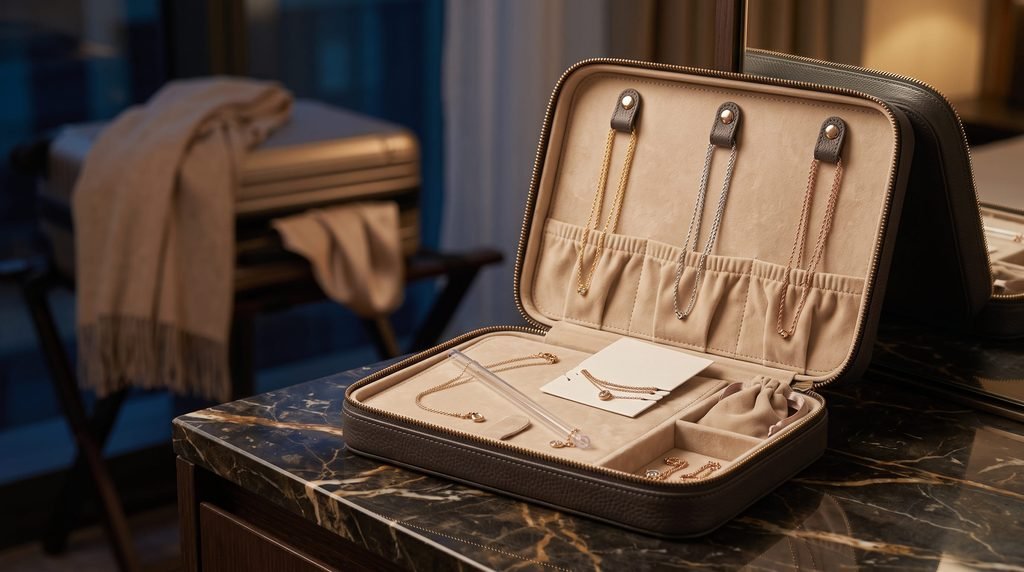
If you are bringing multiple necklaces, do not simply stack them together.
Instead, use a layered organization system.
For 2–3 necklaces
Use:
- Individual small pouches
- Jewelry cards
- Separate zip bags
- Straws for fine chains
For 4–6 necklaces
A compact jewelry organizer or jewelry roll becomes more practical.
Give every necklace its own position and keep longer chains away from shorter chains.
For more than 6 necklaces
Consider whether you genuinely need all of them.
Travel jewelry can quickly become unnecessary luggage weight and take up more organizational space than expected. Select versatile pieces that work with multiple outfits.
How to Pack Long Necklaces Without Tangling
Long necklaces are particularly vulnerable because there is more chain available to fold over itself.
The best approach is to keep the chain extended and secured rather than loosely coiled.
Good options include:
- Jewelry cards
- Necklace organizers with hooks
- Long straws
- Jewelry rolls
- Individual long pouches
Avoid tightly winding a long chain into a small ball.
That saves space initially but often creates a much bigger problem when you arrive.
How to Pack Gold and Fine Jewelry Safely
Fine jewelry deserves additional care.
If you are traveling with gold, gemstones, heirloom jewelry, or other valuable pieces, consider using a dedicated protective jewelry case rather than improvised packing methods.
Keep valuable pieces:
- Separated
- Securely closed
- Protected from scratches
- Away from liquids and cosmetics
- Away from excessive pressure
- In your carry-on rather than checked luggage when appropriate
For especially valuable jewelry, consider whether taking it on the trip is necessary at all.
Travel creates opportunities for jewelry to be misplaced, damaged, or lost, regardless of how carefully it is packed.
How to Prevent Tarnishing While Traveling
Tangle prevention and tarnish prevention are related but different problems.
A necklace can arrive perfectly untangled but still look dull if it was exposed to moisture, cosmetics, or unsuitable storage conditions.
Before packing:
- Make sure the necklace is clean and completely dry.
- Keep jewelry away from toiletries.
- Avoid storing damp jewelry.
- Use a clean, dry jewelry pouch.
- Separate pieces that could scratch each other.
- Keep jewelry away from perfumes and lotions.
For jewelry that is particularly prone to tarnishing, an appropriate anti-tarnish storage solution may be useful.
Should You Pack Necklaces in Your Carry-On or Checked Bag?
For valuable or sentimental necklaces, keeping them in your carry-on is generally the safer choice than placing them in checked luggage.
A carry-on allows you to maintain better control over your valuables and reduces the risk associated with checked baggage handling or delays.
For inexpensive costume jewelry, the consequences are obviously lower, but organized packing is still worthwhile.
Always consider the specific airline, destination, and security requirements that apply to your journey, especially when traveling with valuable items.
The Best Method for Different Types of Necklaces
| Necklace Type | Recommended Method |
| Very thin chain | Straw or jewelry card |
| Short pendant necklace | Small individual pouch |
| Long chain | Jewelry card or organizer |
| Several delicate chains | Individual organizer compartments |
| Chunky statement necklace | Jewelry pouch or compartment |
| Valuable fine jewelry | Protective jewelry case |
| Costume jewelry | Zip bag or compact organizer |
| Necklace with large pendant | Jewelry card or padded compartment |
How to Pack Necklaces for a Carry-On Bag
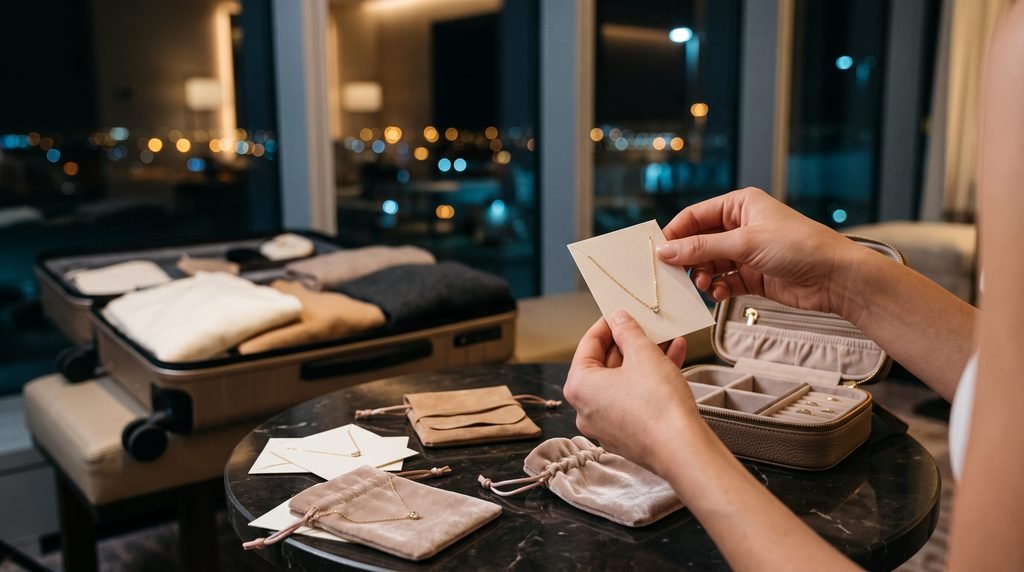
When space is limited, avoid taking a large jewelry box.
Instead, use a compact system:
- Select only the necklaces you are likely to wear.
- Separate every necklace.
- Secure each clasp.
- Use jewelry cards, straws, or individual pouches.
- Place the protected pieces inside a small organizer.
- Keep the organizer in an accessible but secure part of your carry-on.
- Keep jewelry away from liquids and heavy objects.
A small jewelry organizer can often hold several pieces without taking significant luggage space.
A Minimalist Necklace Packing Formula
For a one-bag or carry-on-only trip, you usually do not need a necklace for every outfit.
A more efficient approach is to choose:
- 1 everyday necklace that works with casual clothing
- 1 elevated necklace for dinners or events
- 1 statement piece if your itinerary calls for it
Choose pieces that complement multiple outfits rather than packing jewelry based on individual looks.
This reduces clutter and makes getting dressed easier.
What Not to Do When Packing Necklaces
Some common packing habits almost guarantee tangles.
Don’t put multiple loose necklaces in one pouch
Even if the pouch looks roomy, the chains can intertwine during transit.
Don’t tightly coil delicate chains
A tight coil can create knots that are difficult to loosen.
Don’t leave clasps open
Loose clasps can catch onto other sections of the chain.
Don’t pack jewelry beside toiletries
Leaks and moisture can damage jewelry and its packaging.
Don’t bury jewelry under heavy items
Pressure can bend delicate components or damage pendants.
Don’t overpack jewelry
More jewelry means more organization, more weight, and more opportunities to lose something.
How to Untangle a Necklace After It Knots
Even with careful packing, a chain can occasionally become tangled.
Do not immediately pull hard on the ends.
Instead:
- Place the necklace on a flat, well-lit surface.
- Open the clasp if possible.
- Separate the largest visible loops first.
- Use two fine-pointed objects to gently loosen tight sections.
- Work slowly rather than pulling aggressively.
- Once loosened, straighten the chain completely.
- Repack it using an anti-tangle method.
For valuable or extremely delicate jewelry, professional assistance may be safer than forcing a stubborn knot.
A 5-Minute Pre-Travel Necklace Packing Checklist
Before closing your suitcase, check:
Necklace Preparation
- ☐ Select only the pieces you need
- ☐ Clean and dry each necklace
- ☐ Close every clasp
- ☐ Check delicate chains for existing knots
Anti-Tangle Protection
- ☐ Separate each necklace
- ☐ Use jewelry cards, straws, pouches, or an organizer
- ☐ Keep long chains extended
- ☐ Prevent chains from moving freely
Luggage Organization
- ☐ Keep jewelry away from toiletries
- ☐ Keep valuable pieces in your carry-on
- ☐ Place the organizer somewhere secure
- ☐ Keep jewelry away from heavy objects
The Best Overall Strategy
If you want one simple system that works for most travelers, use this approach:
Separate → Secure → Protect → Organize.
Separate: Never pack several loose necklaces together.
Secure: Close the clasp and anchor the chain to a card, straw, hook, or organizer.
Protect: Keep delicate jewelry away from pressure, moisture, and abrasive objects.
Organize: Place each necklace in its own compartment or pouch.
This system is more reliable than simply throwing jewelry into a small bag and hoping the chains stay apart.
FAQs
1. What is the best way to pack necklaces for travel without tangling?
The best method is to keep each necklace physically separated and secured. Jewelry cards, individual compartments, straws, and small pouches all work well because they prevent chains from moving together.
2. How do you pack multiple necklaces in a suitcase?
Pack each necklace separately using a jewelry organizer, jewelry card, small pouch, or zip bag. Close each clasp and keep longer chains secured rather than loosely coiled.
3. Does the straw method really prevent necklace tangles?
Yes. Threading a necklace through a drinking straw creates a protective channel around the chain and limits its ability to twist around itself or other necklaces. It works particularly well for thin chains.
4. How should I pack delicate necklaces for a flight?
Place each delicate necklace in its own protected space, such as a jewelry card, padded compartment, or small pouch. Keep valuable jewelry in your carry-on and away from liquids, heavy objects, and other metal items.
5. How can I pack necklaces without taking up much luggage space?
Use jewelry cards, short sections of drinking straws, or slim individual pouches. These methods provide separation without the bulk of a large jewelry box and work especially well for carry-on and one-bag travel.
Conclusion
Learning how to pack necklaces for travel without tangling comes down to one principle: never let loose chains travel together. Separate each necklace, secure the clasp, and give every piece its own protected space.
For one or two delicate necklaces, a jewelry card or straw can be enough. For several pieces, a compact travel jewelry organizer offers better organization and protection. Whatever method you choose, a few minutes of preparation before your trip can save you from untangling frustrating knots when you arrive.
1 comment